After co-creating reinforcement learning from human feedback (RLHF), Diogo Almeida grew frustrated: our current large language models (LLMs) are stellar at producing natural language, yet stumble when it comes to real automation. Aiming to fix this gap, he left OpenAI two years ago and founded TypeSafe AI. On September 18, 2026 the company introduced Jev, a model that isn’t an LLM and doesn’t generate text — but it may shift how developers build intelligent systems.
How Jev works and why it matters
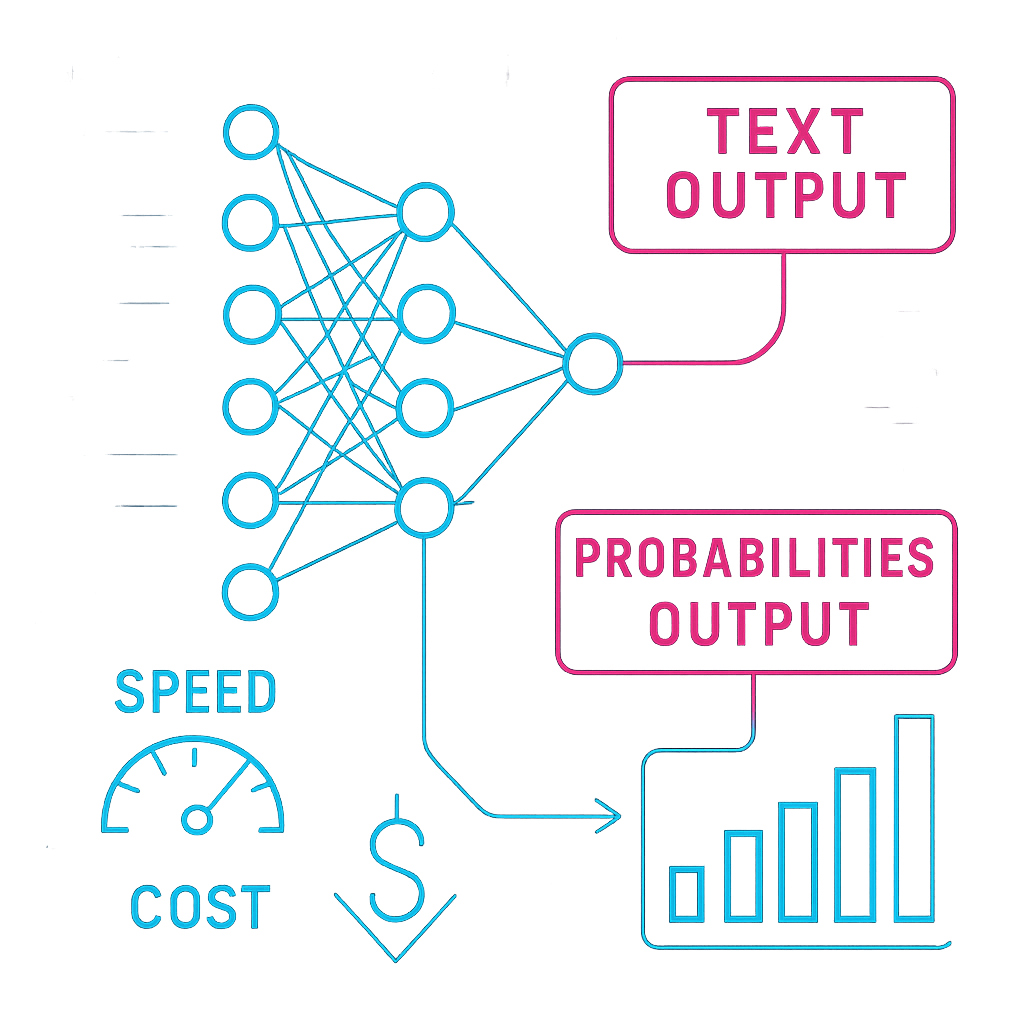
Jev is built around transformer-based architecture, but diverges sharply from LLMs by returning probability scores instead of natural language output. Users predefine the model’s possible outputs, and Jev chooses among them with calibrated confidence. Since it skips text generation altogether, it slashes output costs and drastically reduces inference time. Developers metering inputs by the billions instead of millions, and enjoy hallmarks like speed, cost efficiency, and no risk of hallucination — because there is no free-form text to drift off into fantasy.
This new paradigm is tailor-made for automation: context classification, safety checks, workflows—all areas where traditional LLMs get pricey or inconsistent. In one internal test, Vercel replaced an OpenAI model with Jev for safety review of user commands, achieving 5 to 18 times faster turnaround and more accurate results. In a separate comparison, Jev was matched against Gemini for classifying business emails: though Gemini edged it in pure accuracy, it cost 10 to 20 times more. The ability to return explicit probability scores makes Jev especially appealing for building reliable pipelines and gating decision logic.
Beyond replacement: augmenting AI responsibly
Jev doesn’t just aim to replace LLMs in some cases; it can also act as a safety guard around them. Because Jev’s outputs are predictable and calibrated, it can monitor LLM agents in production, flag risky outputs, or help with “agent routing”—deciding in real time which model should handle a task. This hybrid architecture could reduce the cost overhead of using LLMs for every job while making automation more trustworthy.
The model is dubbed after economist William Stanley Jevons and is classified by its creators as a “System One model,” one that emphasizes intuition over reasoning. It’s trained entirely on synthetic data through a process termed “reinforcement learning from calibrated decisions.” The startup isn’t disclosing its architecture fully, but outside observers speculate Jev may build on open-weight LLM foundations.
So far, the market seems intrigued. Demand for Jev’s API briefly overwhelmed TypeSafe. Developers testified it delivers speed, cost savings, and measurable confidence scores in ways they’ve found hard to get from standard LLMs. It’s particularly strong in software infrastructure, automated safety, and real-time decisioning—tasks where text output is superfluous, expensive, or risky.
There are risks too: narrowing outputs means narrowing applications, and there’s still a question whether synthetic training can capture the nuance required in many real-world scenarios. Also, who draws the confidence threshold—and when—is still a judgment call for developers, not something Jev decides for you.
TypeSafe plans more System One models in other modalities. Jev is only the first effort, but if Almeida is right, we’re looking at a moment when intelligence becomes omnipresent—distributed and cheap—rather than centralized in massive LLMs.
What this means: As LLMs accrue capabilities, their limits are increasingly obvious—hallucinations, latency, cost. Jev offers a new kind of lightweight, focused intelligence that sidesteps many of those issues. If other players follow, this could usher in a wave of dedicated, probabilistic models specialized for real-time decisioning rather than conversation. Watch for Jev-style agents handling safety audits, content filtering, routing. The era where programmable probability becomes as familiar as free-form text may be just beginning.