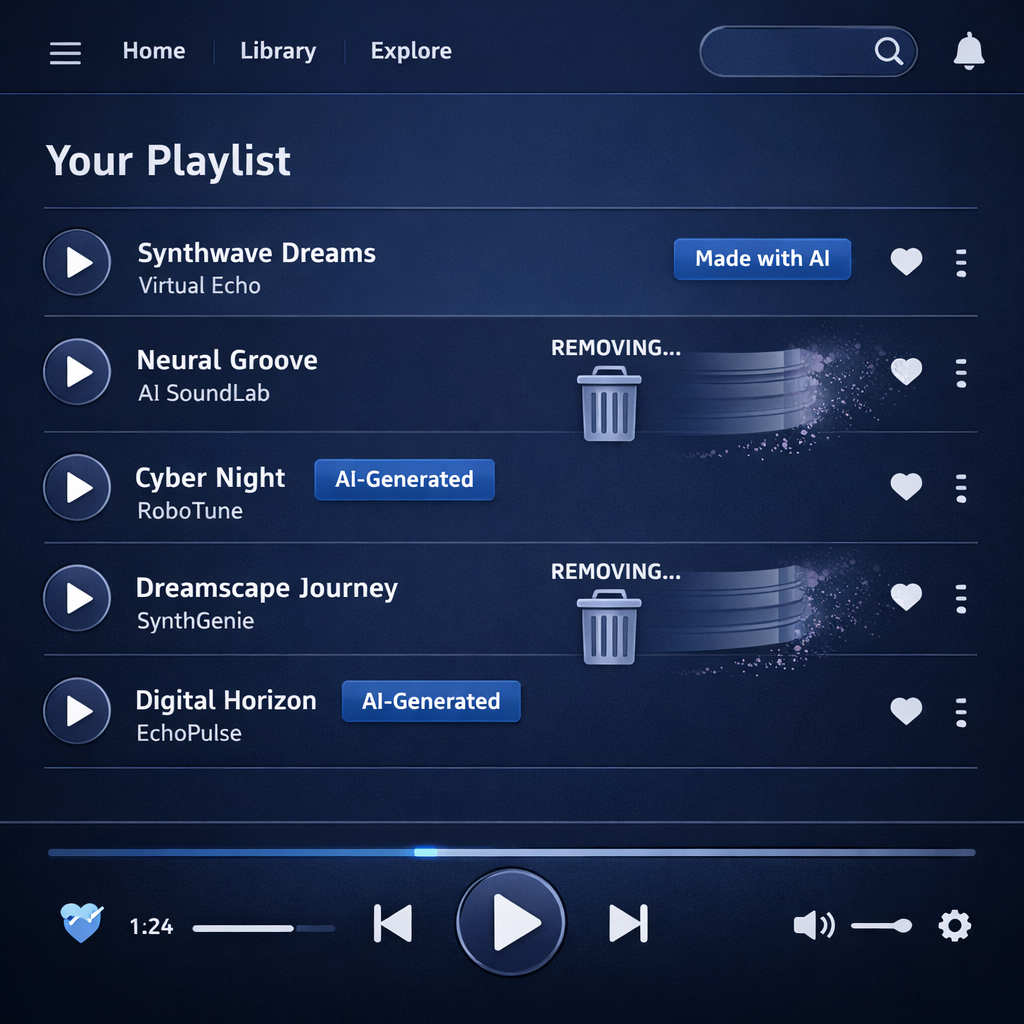
Tidal is taking a firm stand against music entirely made by artificial intelligence. Starting December 9, any tracks uploaded to the platform that are fully generated by AI will be removed, with a complete ban expected by early 2027. Songs that are AI-assisted—where human input played a role—will still be allowed. The move expands on Tidal’s earlier policy that had merely demonetized pure AI content.
Tidal’s Rationale and Scope
The reasoning behind the ban hinges on usage statistics and content volume. Tidal reports that in a recent 90-day period, roughly 43 percent of uploads have been flagged as AI‐generated—an astonishing number given that the vast majority get no listens. In fact, 96 percent of AI songs on the service receive zero plays. As part of the purge, an estimated 29 million tracks will be deleted, and future uploads of pure AI tracks are expected to be rejected at a rate of about 80,000 to 85,000 per day.
How Apple Music’s Policy Differs
Unlike Tidal, Apple Music isn’t banning AI music. Instead, it requires that tracks which are “materially generated using AI” carry a “Made With AI” label, a policy rolled out earlier in 2026. Labels and distributors are tasked with declaring AI involvement. Data shared by Apple suggests that over one-third of monthly uploads are entirely AI-generated—but they account for less than 0.5 percent of actual listening time.
This contrast in approach—Tidal’s prohibition versus Apple’s transparency service—is shaping up to define how music platforms draw the line in the age of generative AI.
While Tidal’s ban starts in December, it expects full compliance by the start of 2027. Apple’s label policy, by contrast, is already in place and depends on disclosure rather than outright removal.
Analytical angle: Tidal’s move signals a sharp crackdown on AI music, prioritizing human artistry and listener impact over volume. Apple’s transparency model, meanwhile, leans into disclosure norms rather than exclusion. Going forward, enforcement mechanisms—how AI songs are detected, how mislabeling is punished, how platforms safeguard artists’ work—will come into sharp focus. This decision isn’t just about policy—it stands to shape industry standards over what counts as music, what listeners deserve, and how platforms handle the fast-evolving capacity of AI to generate content in bulk.