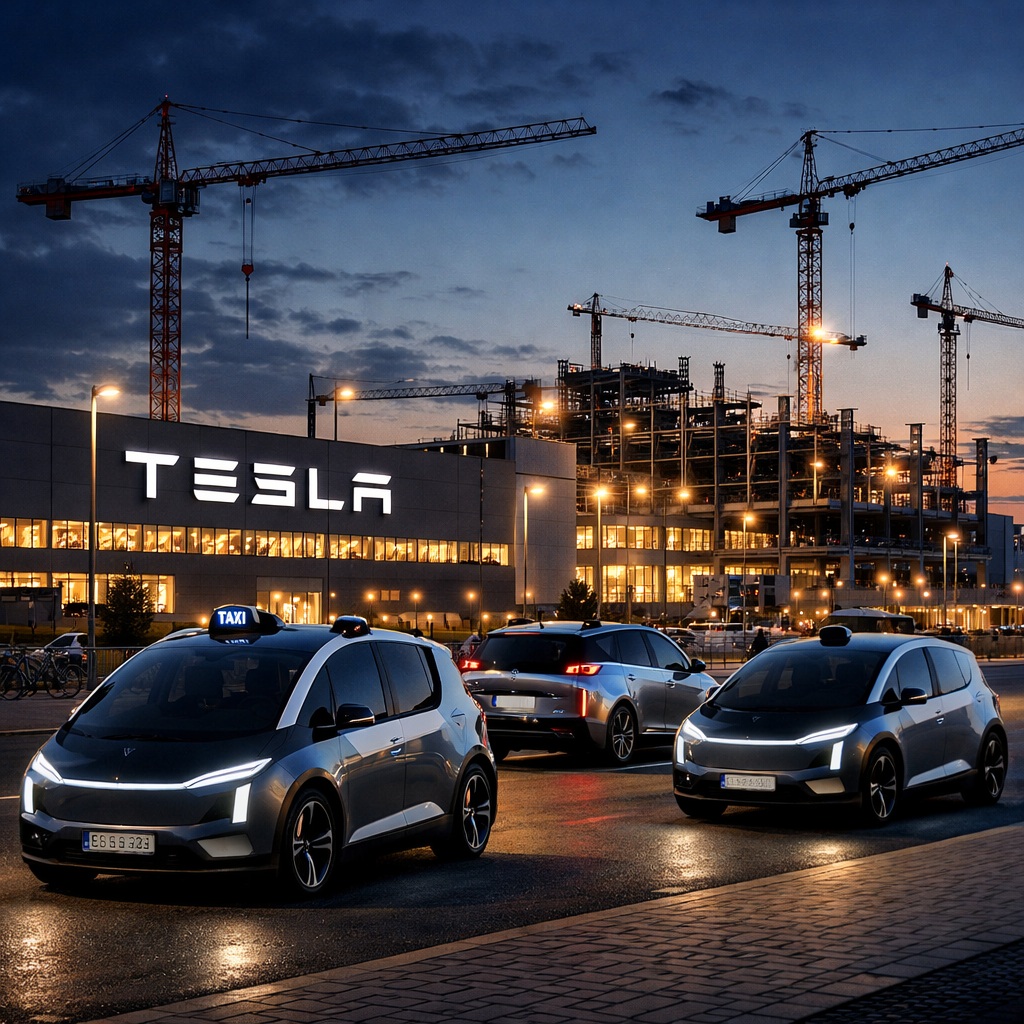
Tesla is placing a high-stakes wager on its futuristic Cybercab line with a major expansion of its Berlin gigafactory. The company will invest €3 billion (about $3.3 billion) to grow production capacity in Grünheide, just east of Berlin, aiming to begin mass-producing the autonomous Cybercabs by 2029. The upgraded facility is expected to reach an output of up to 1 million vehicles annually once the expansion completes. Construction is slated to commence in the first half of 2027.
Autonomous Future: More than Just EVs
This move signals Tesla’s shift from traditional automaking toward autonomous vehicles and robotics. The Cybercab—released publicly in September 2026—lacks a steering wheel, pedals, and other standard driving controls, reflecting Tesla’s ambition for fully autonomous transport rather than assisted driving systems. Meanwhile, federal regulators are investigating Tesla’s decision to self-certify the Cybercab, given that some of the features it omits are typically required under existing safety standards.
Tesla has already committed to ending production of the Cybertruck next year to free up resources and space for expanded Cybercab operations at its Austin facility. CEO Elon Musk has expressed skepticism toward consumer-driven electric vehicles, even as demand for its Model 3 and Model Y continues to grow globally. The company delivered more than 486,000 units in the third quarter of 2026—slightly up from Q2—and is seeing especially strong growth in Europe as EV adoption rises.
Rolling Out the Robotaxi: Progress and Challenges
So far, Cybercabs have operated with notable constraints. They’re prohibited from driving during late-night hours, though Tesla is working to lift those restrictions. Since their September launch, more than two months ago, the units haven’t been involved in any major incidents—giving Tesla what appears to be enough confidence to commit heavily to scaling production and expansion.
Today, some 1,307 robotaxis are registered across Texas, most converted Model Ys used in robotaxi services. The Cybercab fleet is newer and smaller: around 573 are currently making roads in Austin and preparing to expand into Dallas. The Berlin investment moves Europe up the priority list, ensuring the autonomous vehicle push goes international.
Tesla’s autonomous driving approach also contrasts with rivals like Waymo. Tesla is focusing solely on camera-based perception for its self-driving systems, shunning lidar and other sensors. While cameras mimic human vision, this strategy demands rigorous training of its AI models to reliably handle scenarios where extra sensor data would otherwise help clarify complex or ambiguous situations.
Contextually, this isn’t a spur-of-the-moment bet. Tesla unveiled the Cybercab concept in 2024 and made the vehicle publicly available in late 2026 as a central component of its ambition to be seen as more than a carmaker. Self-driving capabilities—especially those that eliminate the need for human input—represent a cornerstone of the company’s long-term strategy.
What to watch next: whether Tesla can satisfy regulatory requirements in different regions, scale production without compromising safety, and overcome skepticism over camera-only systems. It’s a bold move that will test Tesla’s ability to transform not just how cars are made, but what a car even needs to be.