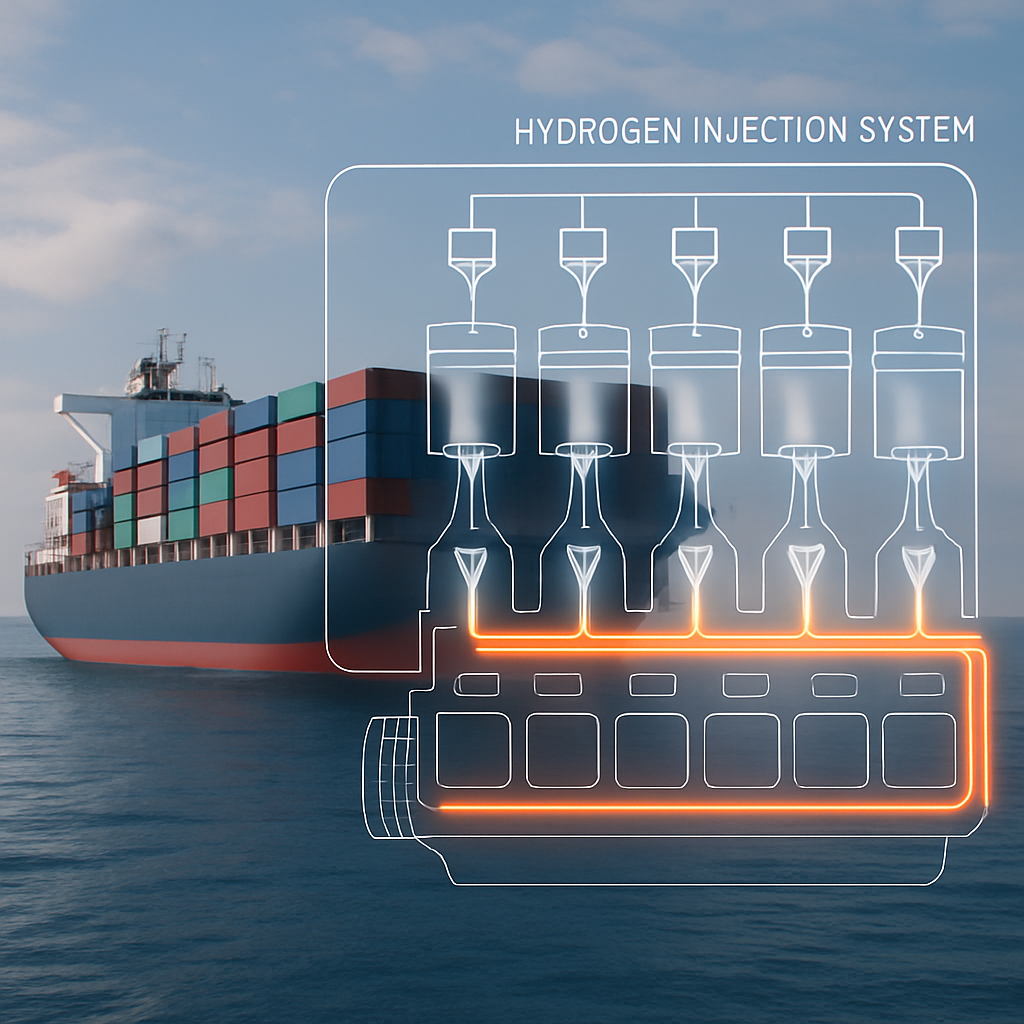
A San Francisco Bay Area startup has developed a hydrogen injection retrofit for cargo ships that cuts fuel consumption by more than 20%, reduces CO₂ emissions by 28%, and can save individual vessels up to $500,000 annually.
The company, Newlight, has created a system designed to be bolted onto existing diesel engines with minimal modifications. Built for ease of installation, the hybrid retrofit doesn’t require a ship to go into dry dock and can be fitted in less than two weeks. Its hardware injects compressed hydrogen alongside diesel during optimal moments of the engine cycle, such as when exhaust temperature, combustion pressure, or air intake reach ideal thresholds. That real-time monitoring lets the system adjust hydrogen flows every millisecond as pistons move in the cylinders.
A sea trial yields promising results
Newlight’s system has already undergone a full long-range commercial test. A 650-foot bulk carrier vessel owned by Lomar Shipping was outfitted with the retrofit and sailed from Singapore to Ghana—a voyage of about 8,500 nautical miles. Over the course of that journey, the hydrogen-diesel setup achieved a 24% reduction in fuel use and cut carbon dioxide emissions by 28%.
Newlight’s team consists of co-founders Evyatar Cohen and Haran Cohen Hillel. Their shared background in the Israeli Navy played a role in shaping the company’s approach. The pair launched the startup with a seed round of $9 million. Backers include LomarLabs (the investment arm of Lomar Shipping), BIRD Energy (a U.S.-Israel government joint venture), venture funds Undeterred Capital and CiRi Ventures, as well as Accelerator-VC Fusion.
Scaling up amid fleet demand
Following the successful sea trial, Newlight has secured commitments to retrofit its hydrogen injection system onto 12 additional vessels and aims to expand further across fleets next year. The approach competes with other emission-cutting alternatives such as ammonia or methanol fuel systems. But Newlight contends its retrofit requires far fewer changes to existing engines, avoiding many of the trade-offs others are making.
While the maritime shipping industry is the current focus, the founders see potential beyond sea-going vessels. They are evaluating applications in sectors including rail transport and data centers. However, they remain committed to deepening their presence in shipping first, aiming to scale operations before branching out.
This development comes as global shipping faces mounting pressure to decarbonize. International regulations and carbon pricing are pushing operators to adopt cleaner solutions. Newlight’s hydrogen injection could offer a transitional technology that delivers big fuel savings without waiting for full hydrogen engines, ammonia bunkering, or radical redesigns.
Why this matters: Newlight’s system hits a sweet spot—it leverages existing engine infrastructure to deliver high cuts in fuel use and CO₂ emissions with relatively low installation costs and downtime. What to watch: whether fleet-scale deployment matches trial results; hydrogen supply infrastructure; regulatory acceptance; and financial models that let shipowners trust the return on investment from these retrofits.