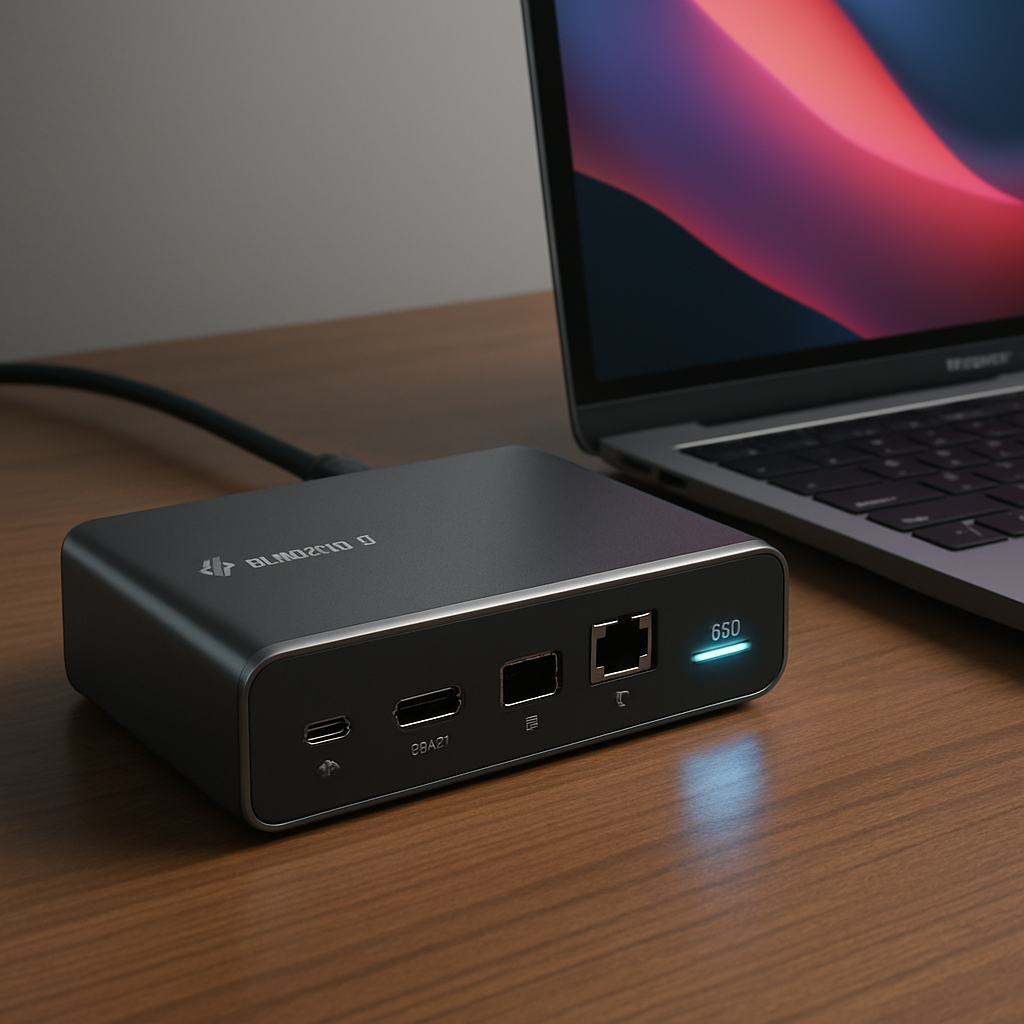
The newly released Sonnet Echo 21 Thunderbolt 5 SuperDock marks a bold upgrade for Mac users seeking maximum connectivity. Priced at $499, the dock delivers major performance and port advances over its predecessor, the Echo 20 Thunderbolt 4 SuperDock, especially when paired with Thunderbolt 5–enabled Macs. Available now, it’s a dock that turns a single cable into a robust command center.
What’s inside: Ports, performance, and power
At its core, the Echo 21 replaces every Thunderbolt 4 port with Thunderbolt 5 both upstream and downstream. That means up to 80 Gbps bidirectional bandwidth per port, and dynamic lane allocation for situations demanding extra upstream throughput—Sonnet claims it could peak around 120 Gbps under the right conditions.
The dock now supports 140 W power delivery via the upstream port—a significant jump from the 100 W limit on the Echo 20. The power adapter has also been beefed up to match: a 20 V 12 A unit versus the prior model’s lower-rated brick.
Additional features and use-case upgrades
A couple of the most requested additions are included. First: a full-size DisplayPort. While previously limited to HDMI or USB-C/Thunderbolt display outputs, the Echo 21 adds DisplayPort compatibility, enabling up to 4K 144 Hz displays (whereas HDMI remains capped at 4K 60 Hz). Keep in mind that only one of HDMI or DisplayPort can be active at once, with HDMI taking priority if both are plugged in.
Next, the dock now includes 10-Gigabit Ethernet, courtesy of a Marvell AQC113 chipset. It also retains USB ports (nine USB 3.0 ports at 10 Gbps), multiple front-facing ports including one USB-C with 15 W output, hi-res audio support up to 24-bit/192 kHz, and SD + microSD UHS-II slots. Internally, you can add an M.2 NVMe SSD up to 8 TB—though it uses just two PCIe lanes internally, so external Thunderbolt 5 SSDs still outperform the internal drive.
In terms of temperature management, Sonnet addressed the internal SSD heat issue by sandwiching the drive between two thermal pads and adding a small fan with an intake port. Noise from the fan is minimal at a distance, though audible up close.
How it lives on your desk
The Echo 21 maintains a flat, horizontal design. It trades vertical space for stability and keeps cable clutter at bay with rear Thunderbolt I/O. Front-of-desk access remains strong with eight front-facing ports—including that higher-power USB-C slot and the always-useful microSD support.
Display output options vary depending on your Mac’s chip: base models like M1-M3 handle fewer displays, while M5 Pro/Max units can run three or even four displays when leveraging daisy-chains. Each display combines Thunderbolt, DisplayPort, or HDMI, depending on available ports and how you prioritize them.
Overall, the Echo 21 SuperDock offers one of the most flexible dock setups out there. The move to Thunderbolt 5, added DisplayPort, faster power delivery, and expanded I/O address many weak spots in its predecessor. But the premium price tag—nearly $500—and some compromises like limited internal SSD lane width mean it’s not the perfect choice for everyone. For users needing high-end audio, multiple displays, or future-proof connectivity, it’s a compelling investment.
Analysis: This dock signals the acceleration of Thunderbolt 5 adoption in peripherals—reflecting a moment where Macs and other devices are finally catching up to bandwidth demands of content-creation, high-frame-rate displays, and fast networking. What to watch: real-world thermal behavior over sustained loads, ecosystem support for Thunderbolt-5 monitors/drives, and whether competing docks can challenge Sonnet on price without cutting features.