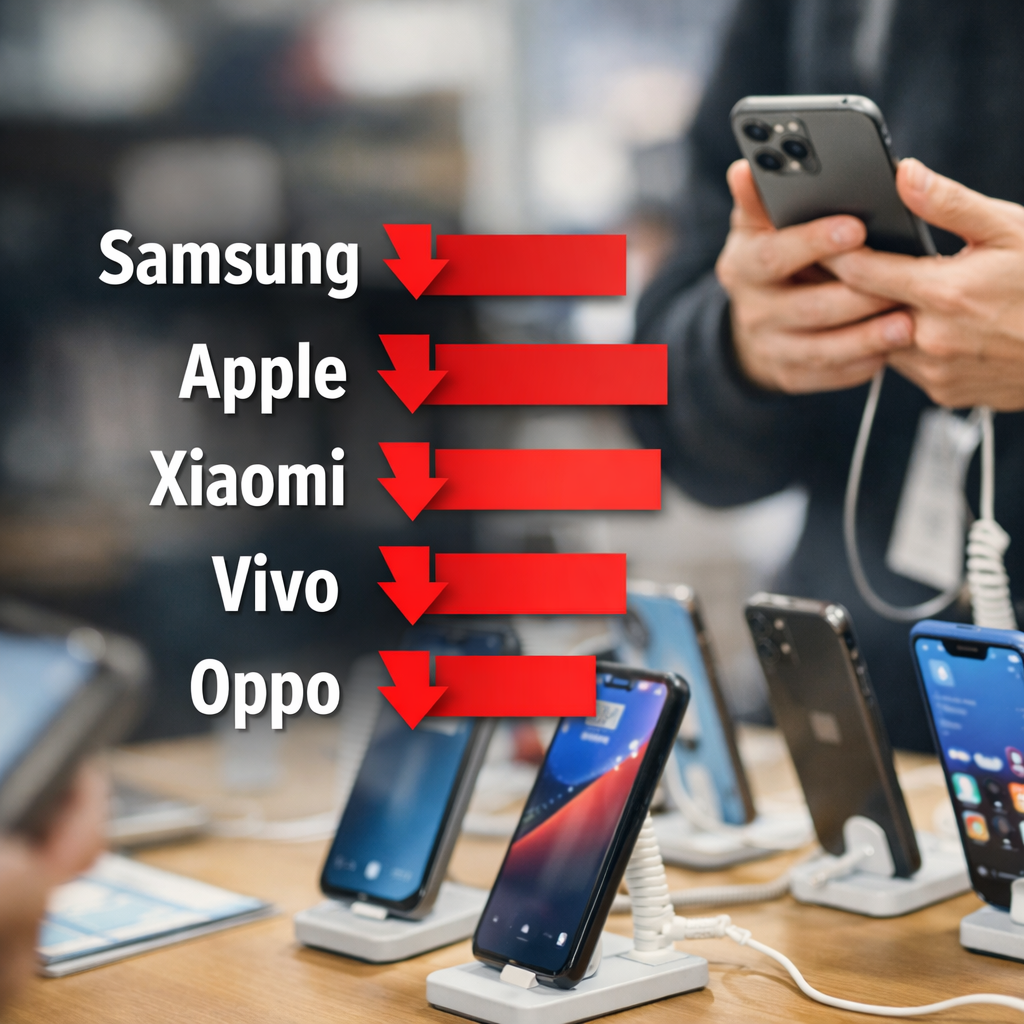
Major smartphone manufacturers are already updating their 2027 shipment targets downward in response to growing concerns over component shortages, price inflation, and a cooling market. Estimates now suggest several brands will see drops of up to 30% compared to 2026 volumes. These revised forecasts include both premium and low-tier players, with the deepest reductions expected in the mid-range and entry segments.
Projected targets: Who is cutting by how much?
Recent reports out of China lay out the forecast adjustments for 2027 across top global brands. Apple’s shipments are expected to drop to about 220 million units—a 5.6% reduction year-over-year. Samsung anticipates shipping 210 million, down 9.5%. More dramatic cuts are seen at brands like Xiaomi (down 25% to 90 million) and Vivo, whose target has reportedly plunged 29% to 60 million units. Other major names like Oppo (–14%), Transsion (–12%), Huawei (–16%), and Lenovo/Motorola (–20%) are also lowering expectations. Honor stands out as an exception, aiming to hold steady at its 2026 target of 50 million units following stronger-than-expected third-quarter performance.
What’s driving the pullback?
The reduced targets are largely driven by rising costs for key components—including chips and RAM—and tighter supply in core hardware. Many companies are reportedly worried that margins will be squeezed if they attempt to push large volumes of lower-margin, budget-friendly phones in what’s expected to be a sluggish market. Mid-range and entry-level phones tend to bear the brunt of these pressures since they are highly price-sensitive and more exposed to component cost fluctuations.
Another factor behind the scaling back is the assumption that demand will taper off in 2027. After several years of continued growth—bolstered by 5G upgrades, foldables, and chip advancements—the market is now expected to slow. Companies appear to believe that consumer spending may pull back, especially in price-sensitive regions, meaning they won’t be able to move as many units as hoped without cutting margins significantly.
The reported figures remain preliminary and could change based on how supply constraints evolve or how global economic conditions shift. Brands may still adjust strategy if key material costs decrease or if demand rebounds more strongly than anticipated.
What this means: Across the board, these downward revisions suggest industry-wide caution. Smartphone makers are bracing for a year of thinner profits, tighter inventory controls, and perhaps fewer discounted devices. For consumers, this could mean slower rollout of lower-end models, longer wait times for price drops, or fewer promotions.