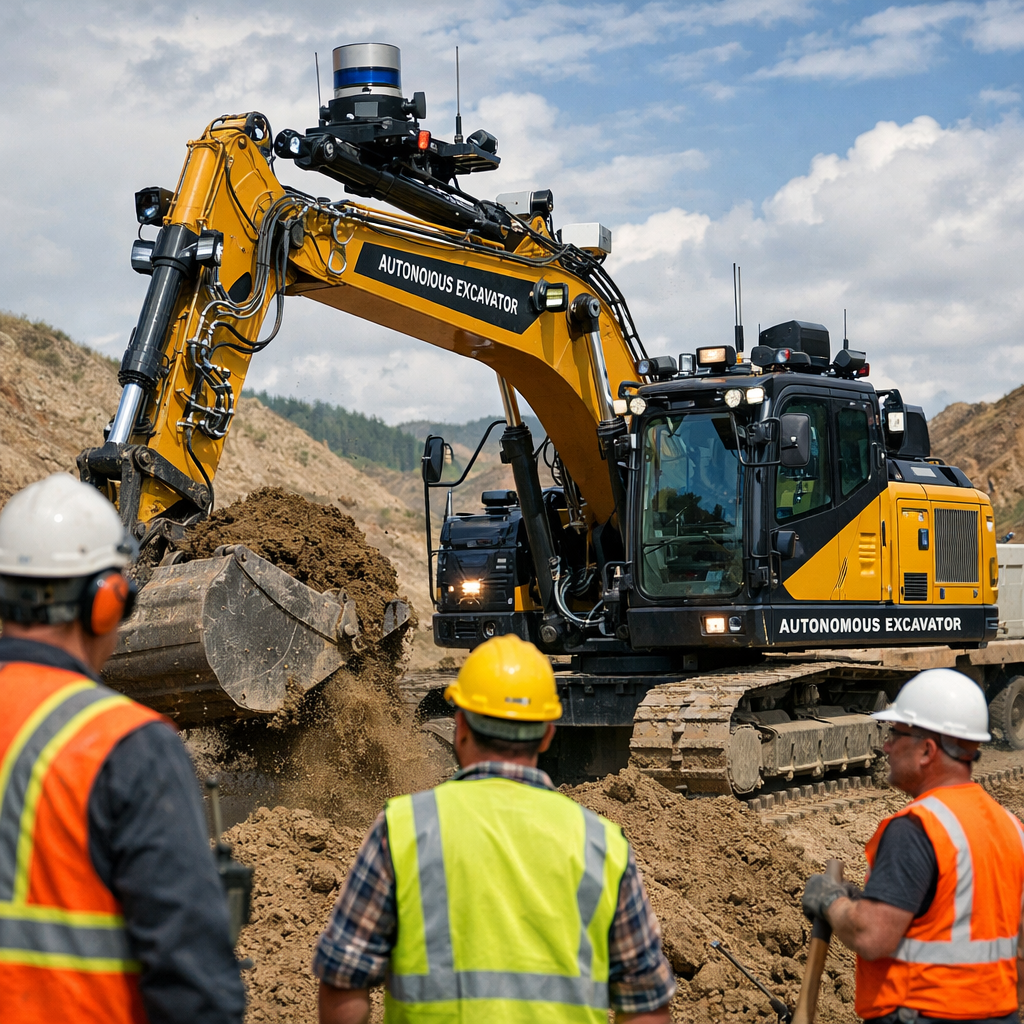
A two-year-old robotics startup has just raised a massive $600 million in Series C funding, bringing its valuation up to $4.1 billion. The company, Bedrock Robotics, has developed autonomous kits that can be added to excavators and other worksite machines. With this capital infusion, it’s officially leaving the test phase behind and rolling its tech into real construction jobs.
Autonomous Excavators Finally Get Real
Bedrock’s retrofit systems turn standard heavy machinery into self-driving excavators. It has already deployed these in commercial settings including a water treatment facility in Nevada, earthwork operations in Texas, and a major civil construction job involving 1.2 million cubic yards of soil with Zachry Construction. This marks a transition from pilot programs to full-scale engagement in built environments.
The startup has raised nearly $1 billion in total funding since its launch in 2024. The new round is co-led by CapitalG and Emergence Capital. Additional participating investors include US Innovative Technology Fund, Bessemer Venture Partners, Temasek, and follow-on engagement from earlier backers such as 8VC, Georgian, Valor Equity Partners, Xora, Eclipse, Perry Creek Capital, and Nvidia.
Team, Vision, and Market Forces
Bedrock was founded by industry veterans: Boris Sofman, formerly part of Waymo’s self-driving trucks division and co-founder of Anki Robotics; Kevin Peterson (CTO) and Ajay Gummalla (VP Engineering and Infrastructure), both also with Waymo backgrounds; plus Tom Eliaz, formerly with Segment and Twilio. The leadership’s mix of autonomy, robotics, hardware, and infrastructure experience has positioned Bedrock to scale quickly.
The company has expanded its executive team alongside the funding round. Amy Jones Satrom, with experience at Amazon, Nuro, and Uber, joins as VP of Operations. Lando Juarez, who formerly led legal efforts for Uber’s autonomous and delivery operations, has become General Counsel. These hires signal ramped-up efforts in both deployment and regulatory readiness.
Industry Needs and Strategy Moving Forward
One of the biggest drivers behind Bedrock’s momentum is the widening gap in available skilled labor. Operating excavators reliably can take years of training—often five or more. Meanwhile, a large portion of the current construction workforce is nearing retirement. The company sees its autonomous solutions as a way to fill that labor void.
With the funds, Bedrock plans to broaden its geographic and customer footprint, scaling up deployment at additional construction sites. It also intends to build out support infrastructure and teams to ensure on-site reliability for contractors. A new partnership with general contractor Haydon, based in Arizona, will feature use of Bedrock’s machines in projects across advanced manufacturing, water and wastewater infrastructure, data centers, and healthcare.
Speaking of its value proposition: Bedrock claims its autonomous excavators are capable of real, meaningful work in live construction environments, working alongside existing crews and workflows. The challenge ahead is delivering that capability as a dependable, scaled solution for contractors at large.
By closing a capital round of this scale just two years post-founding, Bedrock Robotics steps into a category of autonomous heavy equipment with strong signs of product-market fit. Its leadership strength, combined with market pressure from a shrinking skilled workforce and surge in infrastructure investment, give it a runway to become indispensable in tomorrow’s construction sites. What to watch: safety validation, regulatory approvals, uptime in demanding conditions, and whether retrofits can scale to different vehicle types.