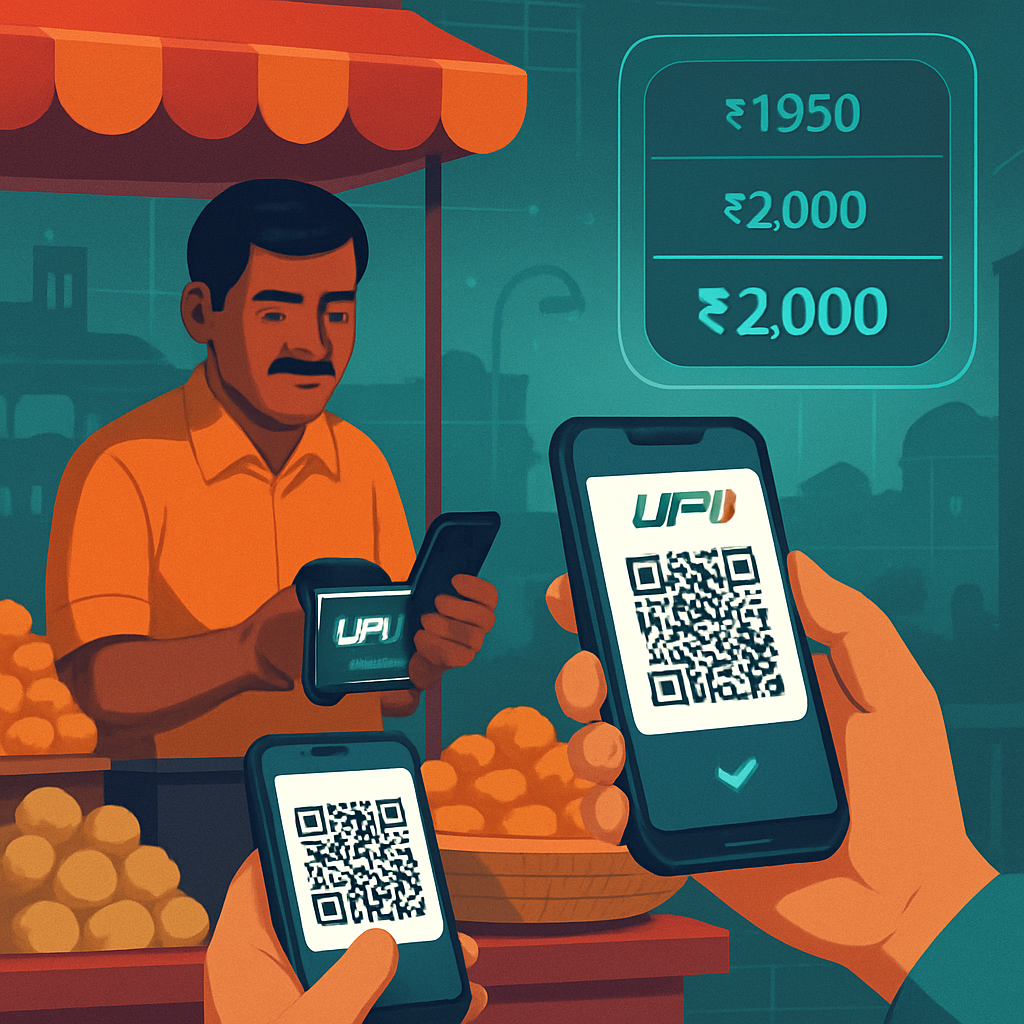
India is ending the era of completely free merchant acceptance on its domestic payments platform for higher-value transactions. Starting October 15, merchants will incur a 0.4% fee on Unified Payments Interface (UPI) transactions above ₹2,000 (about $21 USD). Everyday consumers will still enjoy the service at no charge, as the fee applies only to merchants. The new policy comes from the National Payments Corporation of India (NPCI), which runs the UPI system, and represents a major financial shift in how UPI operates.
What changes and who is affected
Currently, merchants face no fees for any UPI transactions. Under the new rules, any transaction over ₹2,000 will carry the 0.4% merchant charge, capped at ₹300 (roughly $3) for transactions of ₹75,000 (about $783) or more. Transactions of ₹2,000 or less remain free. Moreover, small merchants whose UPI receipts do not surpass ₹100,000 ($1,041) per month will not be subject to the fee. The free limits have been designed to protect both low-volume merchants and the millions of small daily transactions.
Why the policy has changed
UPI’s fee-free model has been in place since January 2020, when merchant fees were removed to drive adoption among merchants and consumers alike. The government made up for lost revenue by subsidizing banks and payment firms. But over time, the growing workload—running infrastructure at massive scale, preventing fraud, supporting tech and customer service—has burdened NPCI financially. The estimated annual cost of operating UPI, factoring in all expenses, is about ₹200 billion (around $2.1 billion). NPCI says that merchant fees will help offset these costs, fund cybersecurity and fraud prevention, improve overall infrastructure, and enhance user support.
Broader implications and outlook
UPI handles a volume of payments that is staggering: in August alone, the network processed 24.51 billion transactions amounting to ₹29.9 trillion (approximately $312 billion). It’s become deeply embedded in India’s economy, used for everything from street vendors to large retail. Authorities hope that introducing fees only for larger transactions—while keeping 95% of merchant transactions free, since most are small—will prevent the system from losing its popularity.
There are concerns, however. Charging merchants may raise costs for businesses with tight profit margins. While NPCI bans merchants from passing the fee onto customers, businesses will need to absorb it themselves. Some may shift consumers toward alternative payment methods—or reprice goods in subtle ways. Furthermore, whether the projected revenue is enough to sustain UPI while preserving its reach into rural areas and among small merchants remains to be seen.
This fiscal recalibration comes after legal changes earlier in August that permitted fees on UPI transactions over ₹2,000. For now, everything below that mark remains untouched by the new charge. As part of the transition, NPCI is also setting up a fund to support UPI infrastructure expansion, especially in smaller cities and rural regions, working with India’s central bank to finalize details over the next three months.
What this means long term: UPI has been a cornerstone of India’s push toward a less cash-dependent economy, formalizing commerce and expanding digital access. Introducing merchant fees for larger payments reflects a shift toward financial sustainability. For merchants, balancing fee absorption with maintaining margins will be critical. The coming months will reveal whether UPI can uphold its inclusive reach while operating at a scale that demands robust support and sustainable revenue sources.