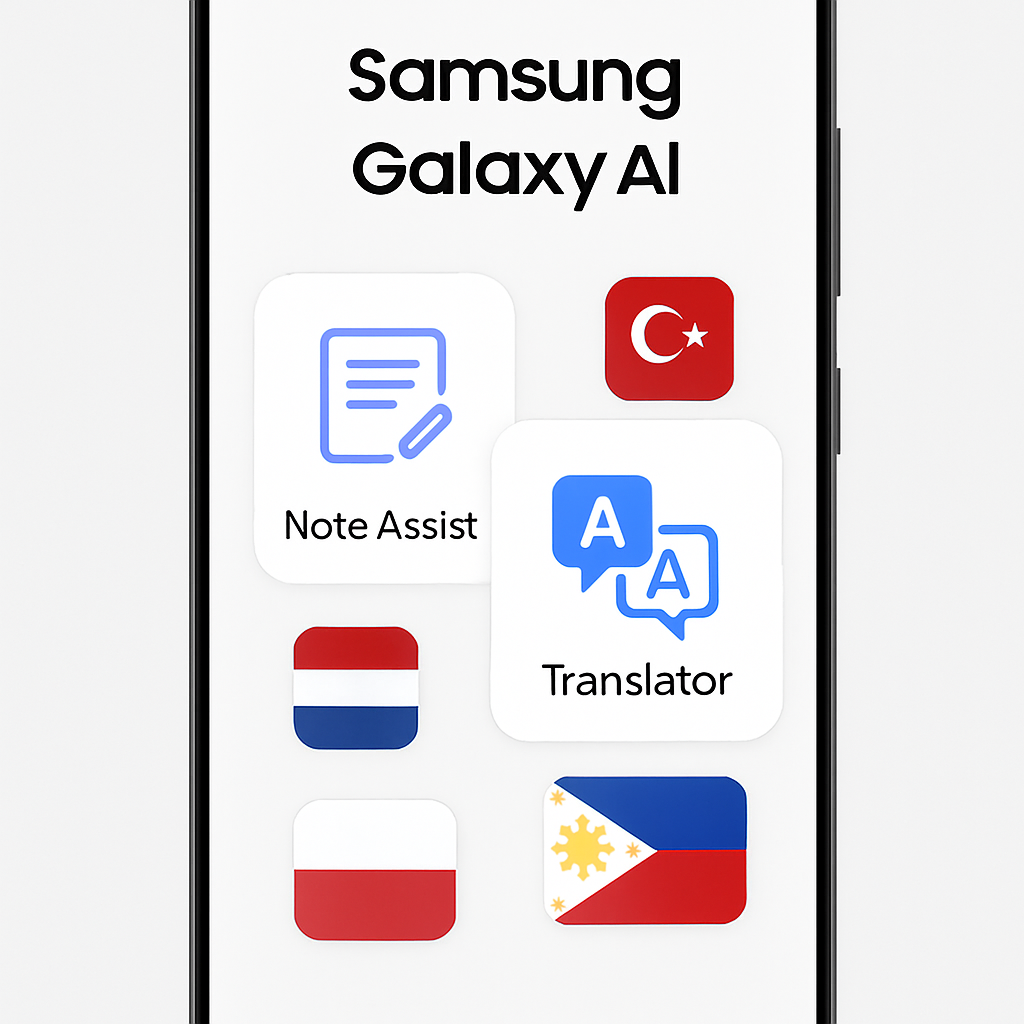
Samsung is widening the reach of its Galaxy AI tools by introducing support for several new languages in features like Call Assist, Note Assist, Interpreter, and Transcript Assist. Hungarian and Malay have already been added, and others are joining soon, expanding usability beyond the original core set of supported tongues.
What’s New
The “Nudge” feature in Galaxy AI will now support eight additional languages: Dutch, Filipino, Gujarati, Hungarian, Malay, Romanian, Swedish, and Turkish. This builds on earlier expansions that added Hungarian and Malay to other Galaxy AI features. Galaxy AI’s suite, now spanning 24 languages in most functions, is growing steadily. Bixby, Samsung’s voice assistant, has also expanded, now covering languages including Thai, Polish, and Vietnamese to reach a total of twelve supported languages.
Why It’s Significant
These updates aren’t simply about translating menus—many Galaxy AI tools are designed to help users bridge language barriers. With features like translation, real-time transcription, or call assistance expanding into new languages, a broader user base can access these tools more effectively. That means more seamless communication and capability in multilingual contexts.
Samsung noted that the new language support won’t be available everywhere immediately. The rollout is set to occur “in the coming weeks” across additional regions, although no precise timing or list of locations was provided. Users should expect gradual availability rather than an instant universal release.
Overall, this marks another step in Samsung’s strategy to make its AI tools not just flashy but genuinely practical across diverse linguistic communities. By incrementally adding languages, the company ensures key features like interpreters and assistants are more inclusive and useful.
It’s worth watching whether Samsung can keep up this rate of expansion, especially into high-gap languages. Also worth noting is how competitors—both in hardware and pure AI software—address similar global needs. The key metric is no longer how many features exist, but how many people in which places can actually use them.