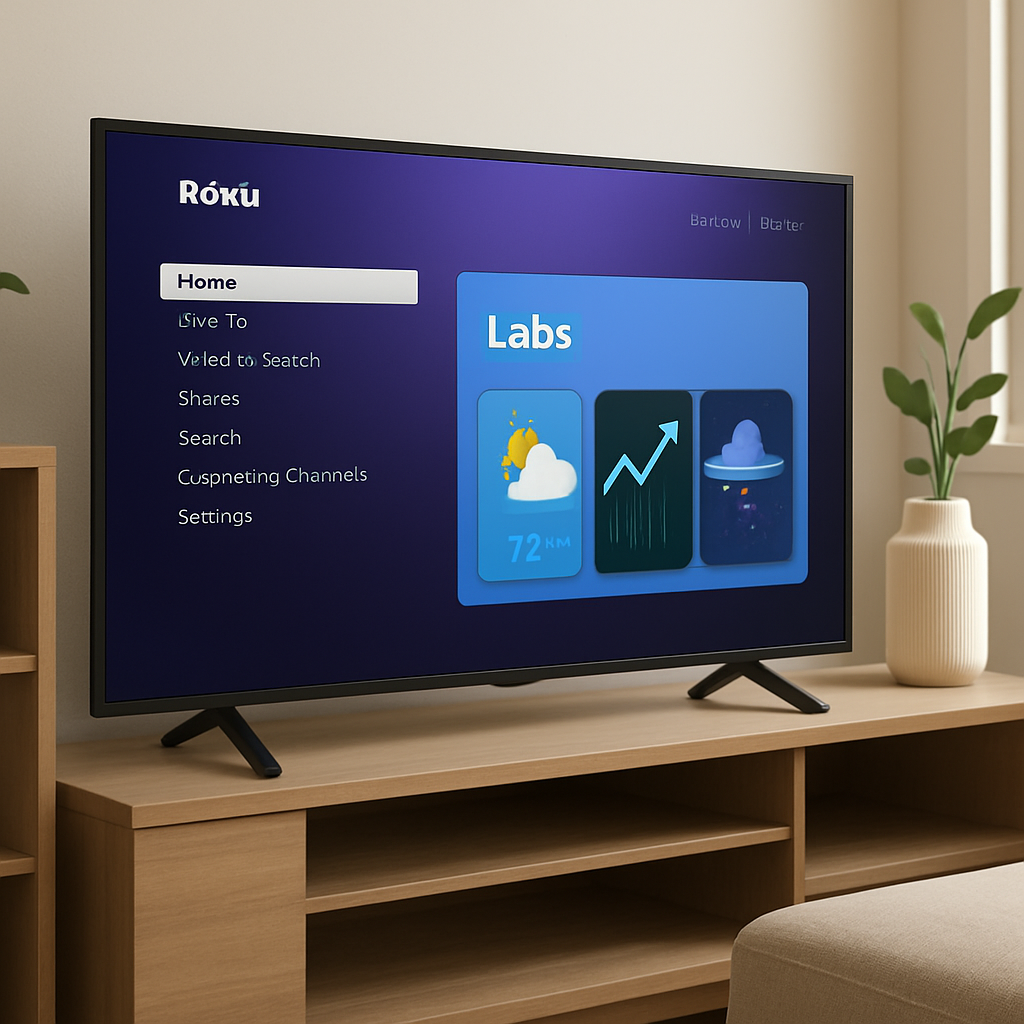
Roku is rolling out a new feature today in its OS — called Roku Labs — that opens the door for users in the U.S. to try out apps that are still in development, right on their TVs. The company is planting these experimental apps directly into a dedicated tile on the Home Screen, letting users explore features before they’re fully polished.
What’s Inside Roku Labs
The initial lineup includes a weather app, a stocks tracker, and a game named Roku Dash. Roku Dash sends players piloting a UFO through “Roku City,” the neon purple-and-pink skyline screensaver, dodging pop culture easter eggs and ads as they go.
These Labs pieces are clearly a move toward expanding Roku’s first-party functionality — beyond streaming — and possibly building potential new revenue streams. Roku’s adding these built-in apps at a time when rivals like Google and Amazon are already leaning heavily into AI-powered TV assistants, such as Gemini and Alexa+, respectively. The addition of experimental apps gives Roku a direct pathway into competing in that domain.
Other Enhancements Alongside Labs
Roku is also extending its refreshed, personalized Home Screen experience to Mexico and Brazil. Here, users will get region-tailored content and suggestions. Meanwhile, its voice assistant gains improved capabilities, now able to respond to weather-related queries.
On the subscription front, Roku is introducing bundle deals in the U.S. and Mexico. These deals let users combine streaming subscriptions from smaller services — AMC+, Fox ONE, Hallmark+, Howdy, Starz and others — offering a potentially more affordable alternative than subscribing to each individually.
Additionally, Roku took the step of open-sourcing the software that runs its remote system (Roku LT OS), paving the way for external developers and hardware makers to build new apps and devices leveraging its remote platform.
Why Roku Is Going This Route
This move signals Roku doubling down on being more than a passive content conduit. By bringing experimental apps directly to the big screen, Roku is carving out a more interactive role in connected households. Smart TVs powered by Google and Amazon have leaned into AI assistants and diversified app ecosystems. Roku’s approach gives it a similar opportunity to own more of the TV experience.
But there’s risk: many experimental apps never move past proof-of-concept, and features in testing might frustrate users if they’re too rough. Getting the balance right between innovation and reliability will be crucial as Roku tries to keep users engaged without turning them off.