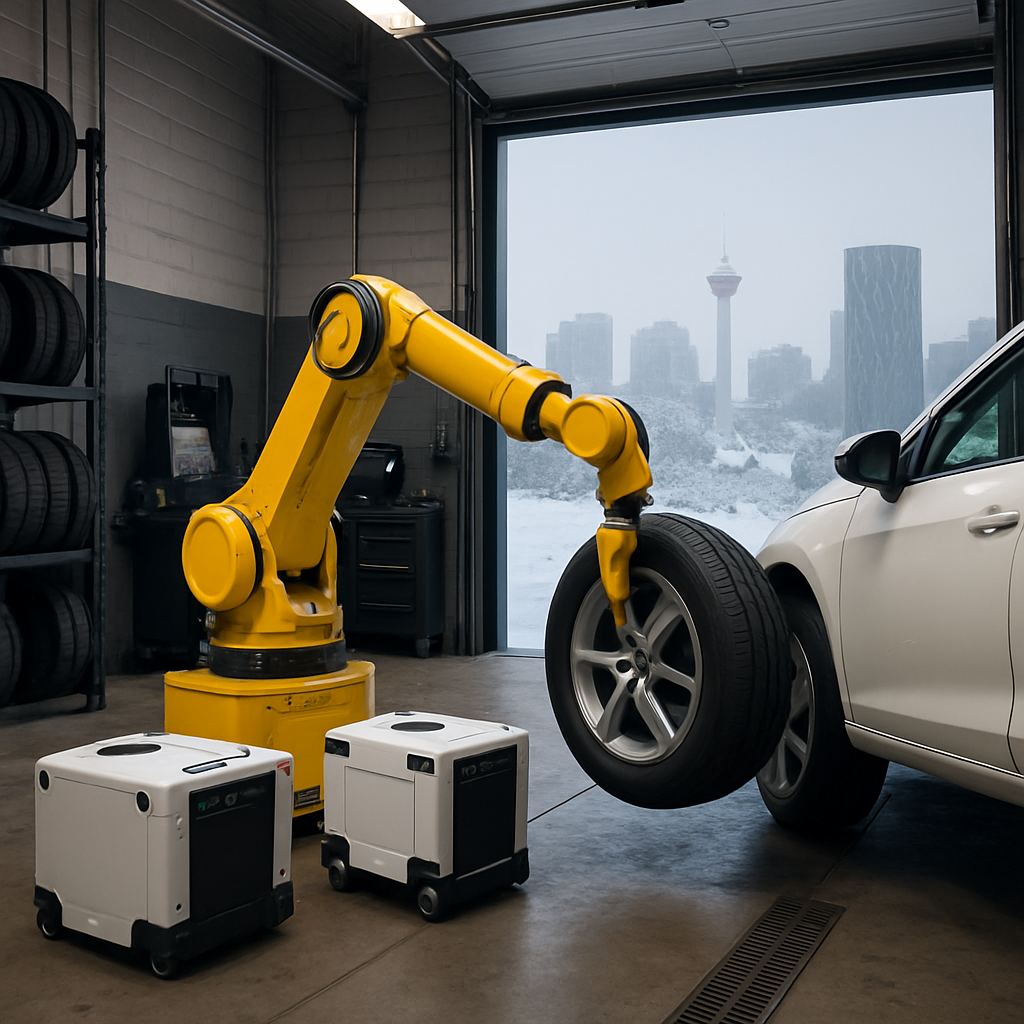
PitPro Automation has activated its first tire-changing robot in Canada at a Kal Tire shop in Calgary, Alberta. Revealed last year, the fully automated system is capable of swapping a full set of four tires in under 15 minutes. The deployment marks PitPro’s initial real-world move beyond prototypes.
Fulfilling a vision amidst labor shortages
The San Francisco-based startup aims to make tire changes far less labor-intensive. Its two robot modules—each about the size of an oven—use sensors and a robotic arm to remove lug nuts, pull off wheels, and mount new or rotated tires. PitPro designed the system to fit directly into maintenance bays already in use, letting shops continue performing other work around the robotic footprint.
The company is zeroing in on tire shops and fleet operators because of high demand—especially in regions where seasonal tire changes are required. In Canada, most drivers swap into winter tires annually, making Alberta an especially strong test case. PitPro is targeting chains rather than individual shops, since larger outfits tend to have more uniform bay layouts, allowing for more consistent, repeatable deployments.
Challenges, learnings, and strategic growth
Operating in open garage bays has introduced unexpected obstacles—dust, debris, weather, even clouds of dandelion seeds have interfered with sensors. Robustness under real-world conditions has become just as important as speed. Design tweaks were made to protect sensitive components and ensure accurate detection despite environmental exposure.
PitPro founder Jeremy Conrad notes that while commercial fleets remain a long-term goal, tire chains are central to its initial growth plan due to steady demand and better return on scaling. The company has enlisted experienced automotive players, including former Ford Pro executive Ted Cannis as an advisor, to open doors in the fleet sector. The strategy is to balance immediate deployments in shops that switch tires seasonally with future expansion into fleet maintenance.
PitPro’s Calgary deployment signals more than a product launch—it’s a proof that robotic tire service can work outside the lab. Seeing one system in action means future installations could move faster, especially in areas where the labor pool is shrinking and customer demand is cyclical.
Why it matters: this rollout may reshape expectations for automotive maintenance. If PitPro’s robots can maintain reliability, speed, and low cost, they could take over much of the manual work in tire shops. For the automotive industry and the chain-retail sector, this could mean higher throughput, less labor dependency, and possibly lower prices. Keep an eye on how quickly other shops adopt the technology, and whether PitPro can prove its system’s viability beyond seasonal wear and conditions.