Heat pumps—an established technology stretching back nearly two centuries—may finally be getting a makeover. Massachusetts-based startup Pascal has unveiled a refrigeration and heat-pump system that swaps out traditional gaseous refrigerants in favor of a novel solid-state approach paired with carbon dioxide, promising around 20% greater energy efficiency.
How Pascal’s System Works
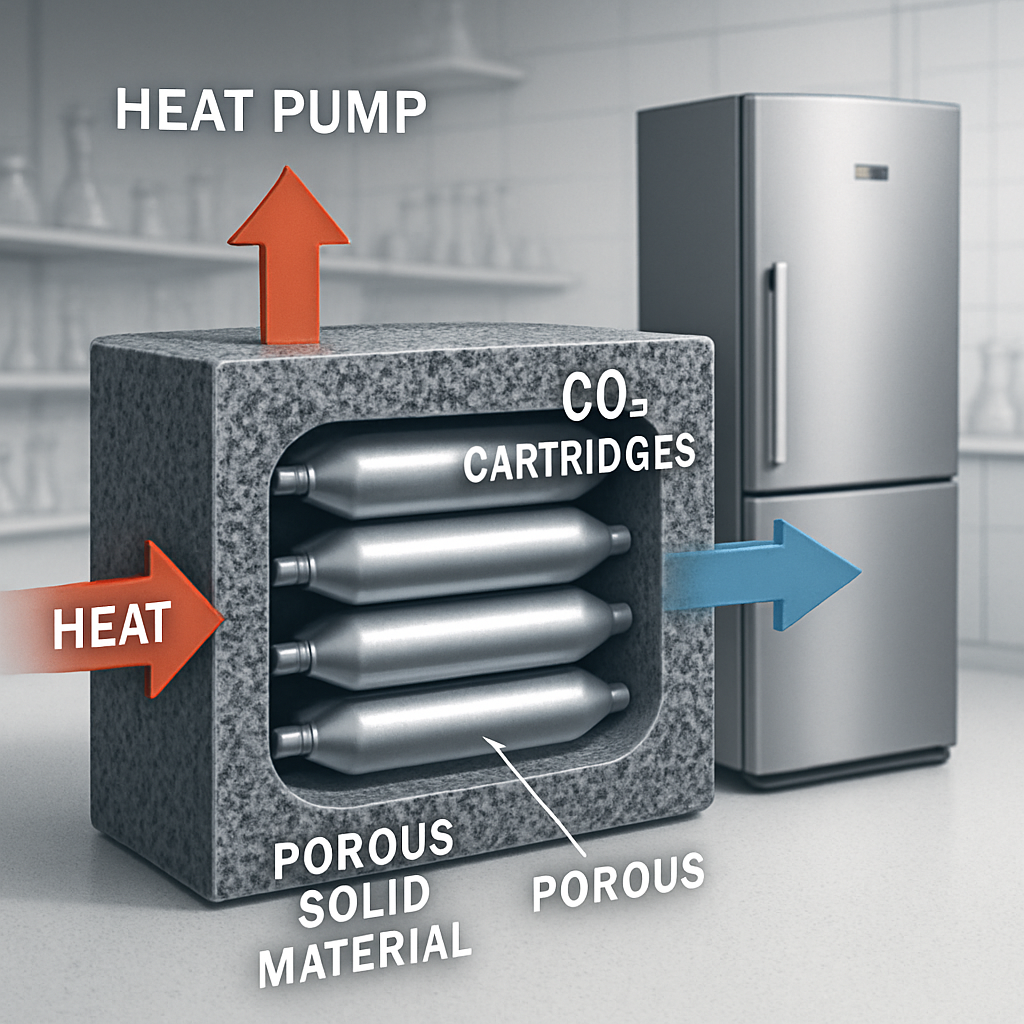
The crux of Pascal’s architecture lies in solid-state refrigerants. Unlike conventional vapor-compression cycles that rely on harmful gases like Freon or R-134a, this new design traps carbon dioxide in a sponge-like solid material. As CO₂ molecules enter this porous matrix, they bounce off internal surfaces—generating heat through collisions that can be moved either inside or outside depending on whether the system is in cooling or heating mode.
Pascal’s setup uses two cartridges working in tandem: one module drawing heat from the threshold (e.g., inside a refrigerator), the other expelling that heat externally. When one cartridge becomes too hot and the other too cold, the cycle reverses. The solid material has been cycled up to 300,000 times—equivalent to roughly a year of continuous use—to validate durability and performance.
Why It Matters and What’s Next
Traditional refrigerants pose serious environmental drawbacks—from ozone depletion to potent greenhouse effects—though substantial effort over decades has focused on finding cleaner replacements. Solid-state refrigerants offer a promising path forward, since solids can’t leak into the atmosphere and thus sidestep many regulatory and ecological risks. What’s notable is Pascal’s material performs well without the extreme temperature swings that other solid-state concepts require.
On the business side, Pascal has just raised $8.5 million in a post-seed funding round led by Sazze Partners and LB Investment, with backing from KDB Silicon Valley. The startup has secured a customer contract with a global beverage company to pilot its tech. A prototype is expected early next year, and full production refrigerators should arrive in 2028.
Heat-pump technology has seen incremental tweaks over the decades, but the basic mechanics haven’t changed much since the 19th century. Pascal’s system—blending solid-state thermodynamics with carbon dioxide and familiar engineering components—could offer the first real leap forward for consumers and industries alike. If everything holds up—especially durability, cost, and scale—this could be the turning point for green, efficient cooling.