Pacific Fusion has broken ground on a new demonstration facility in Albuquerque, New Mexico, designed to achieve a key milestone on the path to commercial fusion energy: net facility gain. That’s when a fusion system produces more energy than the total energy input for operation—something no facility in the U.S. currently does. The company aims to prove this works by 2030 and pursue a grid-connected commercial fusion power plant during the mid-2030s.
What Pacific Fusion’s Approach Looks Like
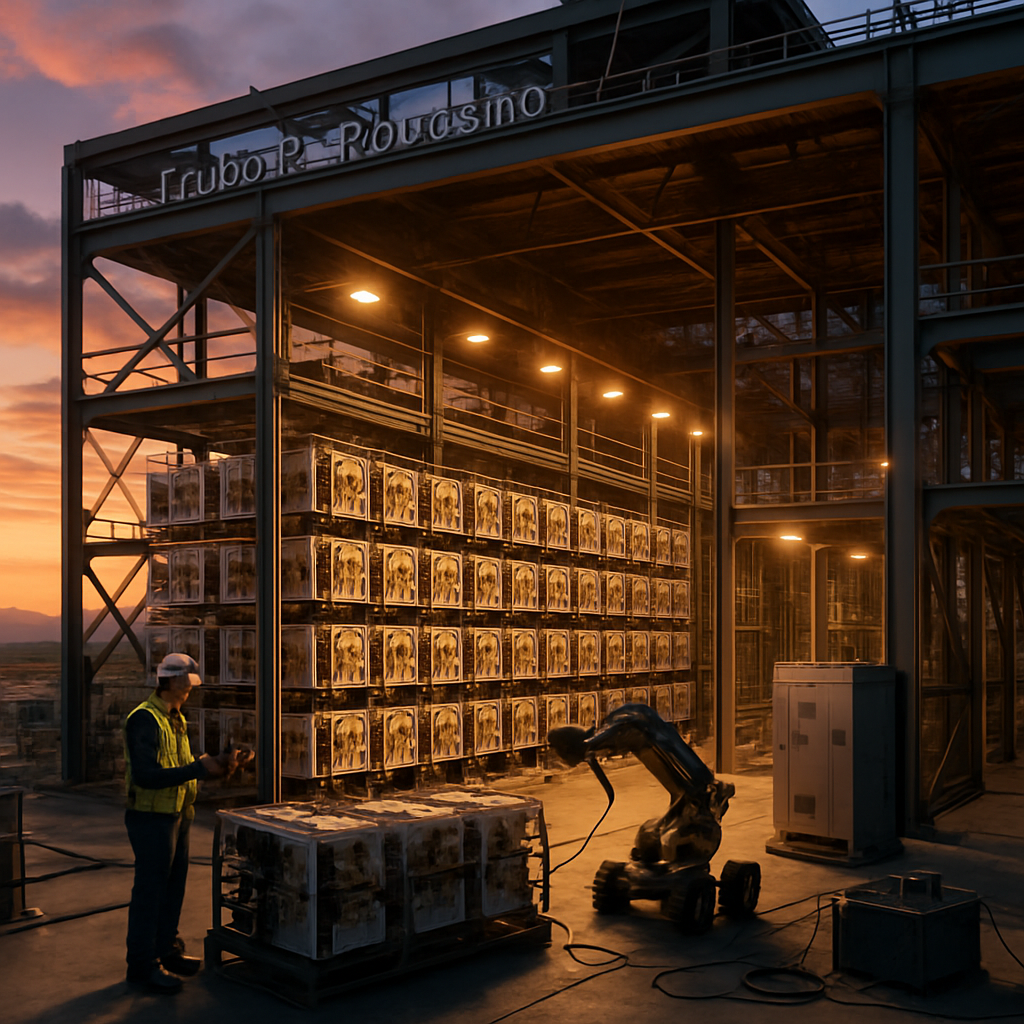
The demonstration facility will use an array of 156 pulser modules, each built from components called “stages” and “bricks.” Each brick holds two capacitors (which store electric energy) and a switch (which discharges it). When fully assembled, the system will emit short, intense pulses of electricity concentrated into tightly coordinated magnetic fields aimed at a fuel target about the size of an eraser. That fuel is then squeezed hard enough for fusion to occur.
Earlier this year, Pacific Fusion tested a single module at one-third scale. It released a peak power of 440 gigawatts in just 80 nanoseconds, demonstrating enough promise to move forward with full construction. The demonstration setup will run several shots per day; the future commercial facility would need to fire pulses at roughly one per second.
Why This Is More Than Just Another Fusion Project
Besides attempting net facility gain, the Albuquerque facility will produce pulses delivering roughly 100 megajoules each—about ten times the energy per pulse of the U.S.’s National Ignition Facility. Pacific Fusion also plans national security experiments at the site. Its founders believe no other facility in the world strikes the balance of high pulse energy, frequent shots, and the scale needed to push toward commercial power.
Since its founding in 2023, the company has raised over $1 billion in a milestone-based Series A round. That financial flexibility aims to bypass typical startup cycles of perpetual fundraising and allows long-term planning and rapid engineering progress.
Where Pacific Fusion Stands in a Crowded Field
It isn’t alone. Pacific Fusion contends with companies like Commonwealth Fusion Systems, Helion Energy, Proxima Fusion, and Inertia Enterprises—all vying for fusion power on the grid by the mid-2030s. Reaching net facility gain is the bare minimum they must clear before commercial viability is credible.
Why this matters: achieving net facility gain shifts fusion from laboratory experiment to energy infrastructure. If Pacific Fusion succeeds by 2030, it could rewrite timelines in the fusion sector and force competitors and investors to recalibrate their strategies and roadmaps. Watch closely how this demonstration facility performs on energy efficiency, shot frequency, and systems durability—those will be the real tests before fusion moves from promising technology to reliable power source.