A financially motivated hacking collective is rolling out a dangerous new variant of Overlord RAT for Windows that not only persists after using the “Reset this PC” feature but also triggers blue screen crashes if its process is terminated. These capabilities make traditional recovery steps potentially harmful rather than helpful.
Malware Resilience: Beyond Standard Recovery
Researchers at Cisco Talos discovered that Overlord establishes two primary persistence mechanisms. First, it creates a startup entry in the Windows registry under the current user profile so it launches again at every login. But more alarmingly, it jeopardizes the effectiveness of Windows’ built-in recovery tools by tampering with the Windows Recovery Environment (WinRE). The malware embeds itself in the recovery partition and modifies reset configuration settings, enabling it to run even during a full system reset.
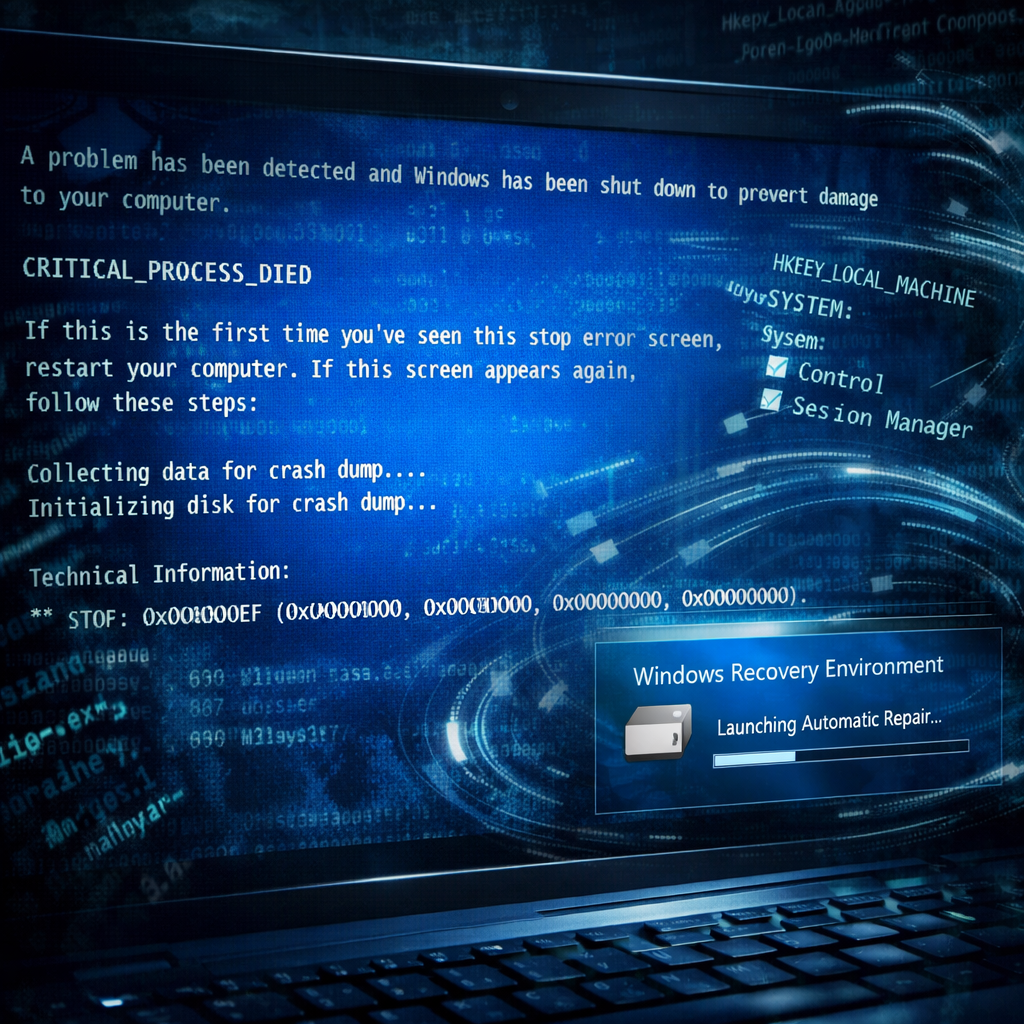
When administrators or security tools try to forcibly stop Overlord while it holds administrative privileges, the malware marks itself as a critical system process. Terminating it provokes the `CRITICAL_PROCESS_DIED` error, causing a blue screen. This combination of features means that both resetting Windows and killing the process can leave systems unusable or compromised.
Targets, Capabilities & Operations
The group appears to zero in on individuals with cryptocurrency holdings, gamers, and users of internet calling and messaging services. Decoys in recent cases used filenames related to Viber, MicroSIP, and financial statements. While exposure was found on a staging server connected to the group dubbed UAT-12643, there’s no confirmation yet of successful breaches through this specific campaign.
Overlord’s implant is built in Go and packs at least 35 commands. Capabilities include keystroke logging, screen captures, webcam and microphone access, file transfer, and other tools for surveilling and stealing data. The command-and-control (C2) architecture is sophisticated: malware retrieves encrypted server addresses hidden in Solana transaction memos, making the control servers fluid and hard to trace.
Alongside Overlord runs a broader toolkit favoring financial gain. “Good Game,” an information stealer, has been observed targeting stored browser credentials, account sessions, cryptocurrency wallet data, plus specific documents. Data archives are exfiltrated by uploading to file-sharing services and sharing links via Discord. A clipboard hijacker component has also replaced copied crypto addresses to reroute funds.
Indicators of Compromise to Watch
Talos researchers published a number of IoCs: IP and domain addresses connected to payload delivery and command-and-control traffic, file paths and registry entries used by both Overlord and its companion malware, and unusual behaviors during recovery operations. Among these are server IPs like 41[.]216[.]188:8000 and unexpected modification of ResetConfig.xml or the OEM recovery directory.
While there’s some speculation that this campaign may tie back to North Korean operators, confidence in that attribution is low. Similar Overlord deployment and blockchain-based server discovery techniques have previously been seen in other unrelated groups.
WHAT THIS MEANS: The emergence of malware that survives reset-claims and actively punishes shutdowns of its own process ups the stakes for defenders. Security architecture that relies solely on recovery tools or traditional endpoint security may no longer be enough. Organizations should examine recovery partitions, monitor for unusual registry or reset configuration changes, and preserve crash logs when blue screens occur after process terminations. Looking ahead, defenders need hardened recovery mechanisms and smarter detection of stealth persistence to stay ahead of threats like Overlord.