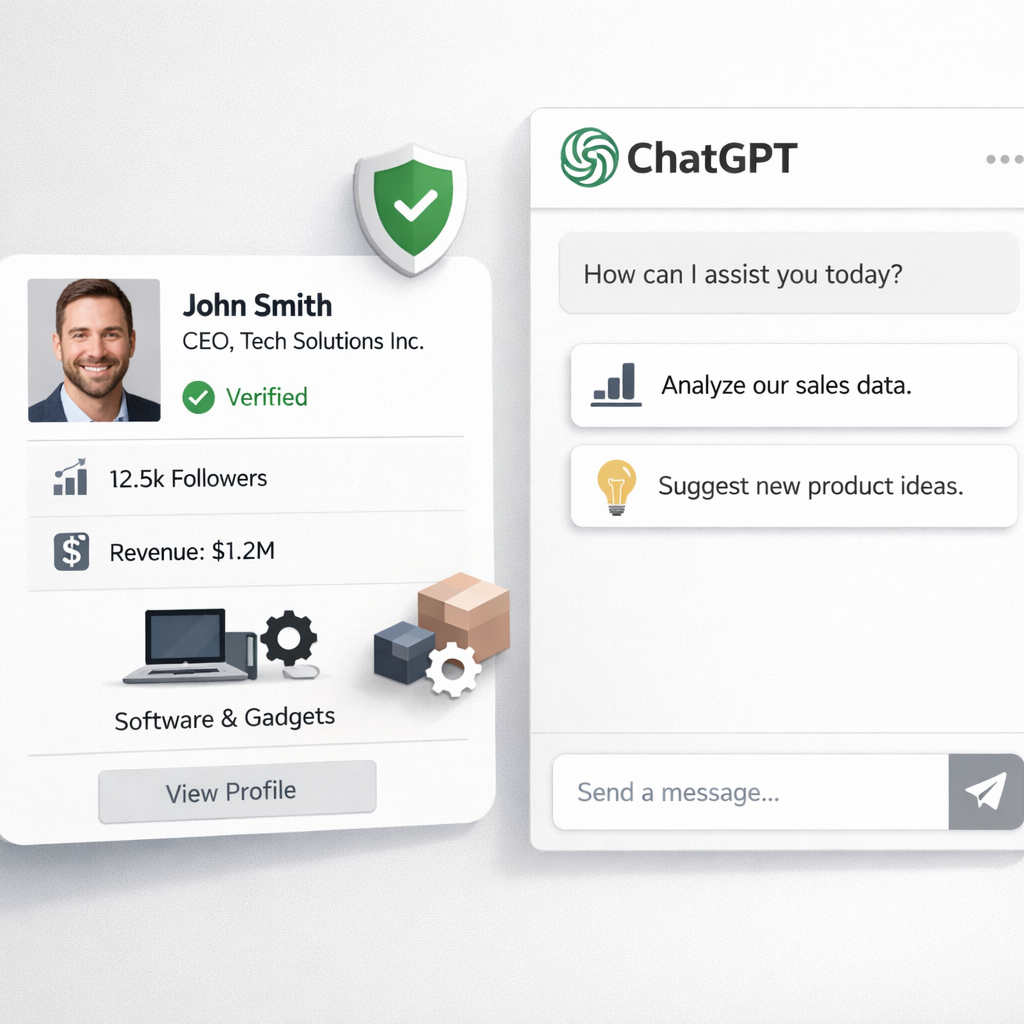
OpenAI has introduced “Business Hub,” a new suite of tools that lets companies create detailed business profiles in ChatGPT—closely mirroring the business listing models Google has long offered. In beta now, this rollout gives businesses a way to control how users find and interact with them via AI, with verification, insight tools, and even specialized agents.
What Business Hub Offers
The new Business Hub enables organizations to build a profile that outlines their products or services, which they can verify and keep updated. This feature is designed to make ChatGPT act more like a search engine for businesses—allowing companies to manage how they appear when users discover them through the platform.
Verified firms can also create a business agent, which functions as a ChatGPT interface specifically trained to answer questions about the company and its offerings. Alongside this, firms will access metrics such as how many people view their profile, mentions in chats, clicks to their website, and other engagement data—similar to what Google Analytics provides for web presence.
Strategic Background and Previous Experiments
OpenAI had earlier experimented with turning ChatGPT into an e-commerce hub where users could directly buy products and services via the app. That included building out a shopping cart and commission model. However, that effort didn’t gain enough traction, and in March OpenAI retired the project entirely.
This new business profile approach marks a shift away from trying to own commerce flows directly, instead letting businesses present themselves and interact with potential customers through profile visibility and conversational engagement. It still leans on verification methods (which vary by type of business and region), though exact requirements haven’t been detailed yet.
With these profiles, ChatGPT seems to be stepping up as a discovery tool—not just for general information, but for commerce and local business visibility. Users are now more likely to turn to ChatGPT when researching companies or comparing options, rather than going directly to Google or other search engines.
The Business Hub rollout is currently in beta and only available to eligible firms, with OpenAI promising verification and business insights to those who take part. How broadly and quickly this expands will be a key part of its ultimate impact.
This move could redraw lines in how people use AI for discovery and decision-making. By allowing businesses to control their presence and converse with users through AI, OpenAI is staking a claim in the marketplace of discovery—not just conversation or productivity. We’ll be watching closely whether this turns ChatGPT from a smart assistant into a real alternative to search engines.