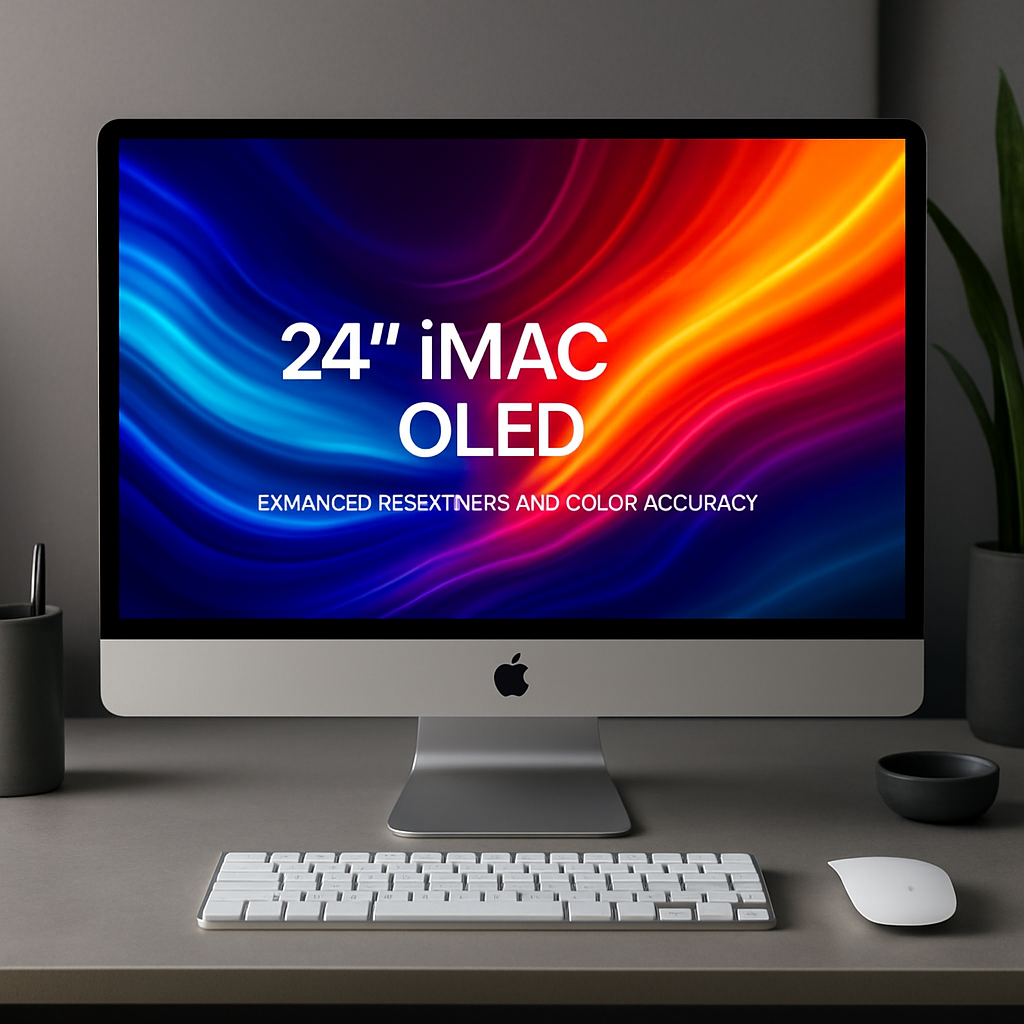
Apple is reportedly planning to introduce OLED displays to its 24-inch iMac lineup by 2029. This move aligns with the company’s broader strategy to incorporate OLED technology across its product range, enhancing display quality and energy efficiency.
Currently, Apple utilizes LED-backlit displays in its iMacs. The transition to OLED is anticipated to offer several advantages, including improved brightness, higher contrast ratios, and more accurate color reproduction. These enhancements are particularly beneficial for professionals in fields such as graphic design and video editing, where display precision is crucial.
To achieve this upgrade, Apple has engaged with leading display manufacturers, including Samsung Display and LG Display. Both companies are developing advanced OLED panels suitable for larger screens like the iMac. Samsung is focusing on Quantum Dot OLED (QD-OLED) panels with a pixel density of approximately 220 pixels per inch, while LG is working on White OLED (W-OLED) panels. LG’s development includes a new five-stack panel that adds an extra green layer to boost brightness, though it has yet to reach mass production.
Apple’s interest in multi-stack OLED technology stems from its potential to extend display lifespan and enhance image quality. The company previously encouraged Samsung to develop two-stack OLED panels for the iPad, despite initial reluctance due to the high costs associated with the technology. This insistence underscores Apple’s commitment to adopting superior display technologies across its devices.
While the transition to OLED for the iMac is still a few years away, it reflects a significant shift in Apple’s display strategy. The company has already introduced OLED screens in its iPhone and iPad Pro models, and plans are underway to equip future MacBook Pro models with OLED displays by 2026. The iMac’s adoption of OLED technology is expected to follow, with a projected timeline extending to 2029 or 2030.
In addition to hardware advancements, Apple is reportedly considering adopting the BT.2020 color gamut for future OLED displays. This standard offers a wider color range and improved color accuracy, which would be a substantial upgrade over current display capabilities. Implementing BT.2020 would require new OLED emissive materials capable of delivering higher color purity while maintaining brightness and power efficiency.
As Apple continues to innovate its display technologies, the anticipated introduction of OLED iMacs by 2029 signifies a commitment to providing users with superior visual experiences. This development is particularly noteworthy for professionals who rely on high-quality displays for their work. However, the extended timeline suggests that consumers will need to wait several more years before these advancements become available in the iMac lineup.