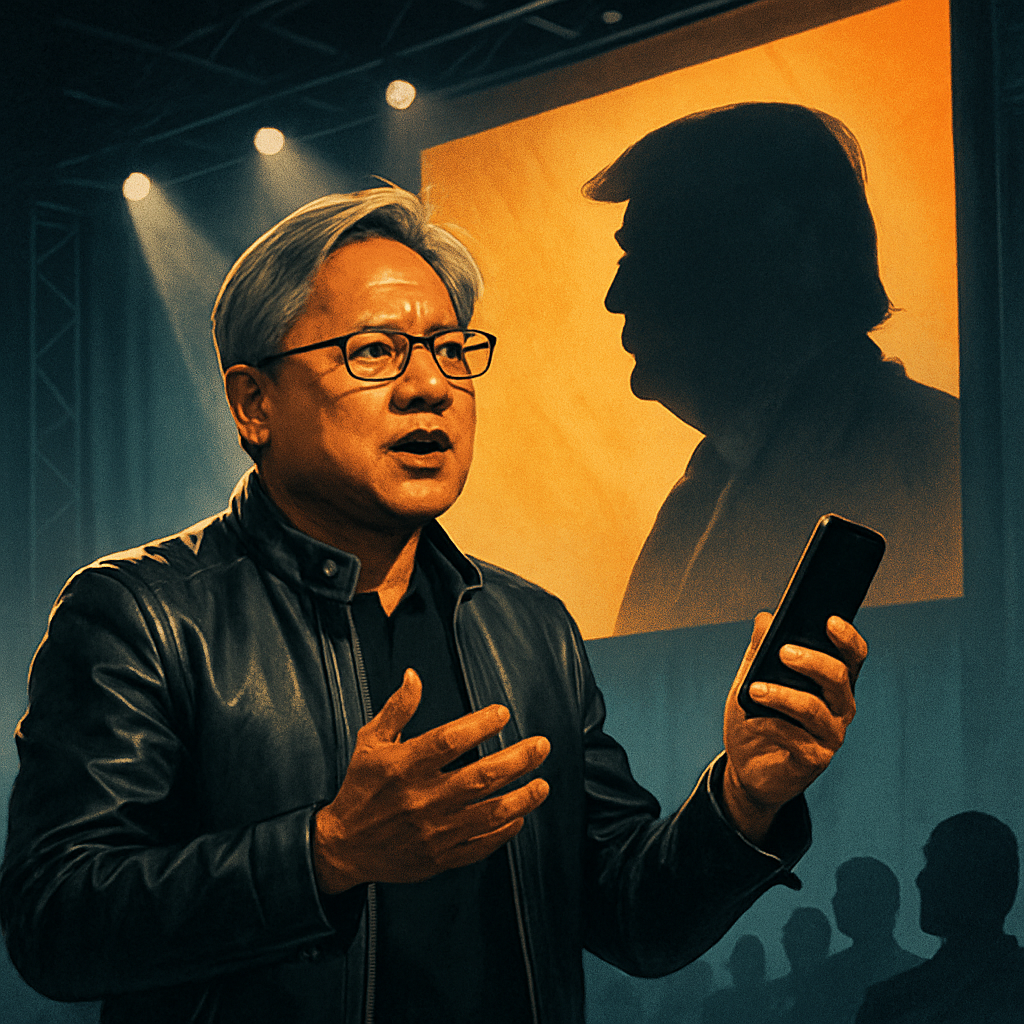
During the All-In Summit today, Nvidia CEO Jensen Huang took the stage—not just to discuss AI in theory, but to push back loud and clear against the narrative of slowing down AI development. The moment that landed front and center: a surprise live phone call from former President Donald Trump, heard by attendees when Huang put the call on speaker.
Trump and Huang Reject Calls for Slowing AI Progress
Earlier in the event, the summit’s hosts had been dissecting remarks by Anthropic’s CEO, Dario Amodei, who recently urged the industry to decelerate efforts to advance AI capabilities. Notably, leaders at OpenAI and SpaceX had expressed shared concerns, supporting a more cautious pace. Huang, on the other hand, made his position very clear when Trump rang in: he refused to accept the idea of pausing or delaying AI development.
On the call, Trump asserted that opposition to AI acceleration was being driven by forces—political, international—that aim to torpedo America’s position in the race. Huang responded in kind, saying the idea of slowing down would not be tolerated. Encouragingly for supporters of unfettered AI growth, the audience broke into applause upon Huang’s stand.
Data Centers, Public Concern, and the Stakes in AI Infrastructure
A central thread through Huang’s pushback was the role of data center construction. Trump and counterparts like Y Combinator’s Garry Tan have claimed that opposition to building more data centers is part of a coordinated effort to undermine U.S. growth—labeling it an “international psyop,” in some public assertions. Meanwhile, polling reveals a complex picture: more than 70% of Americans oppose building data centers in their vicinity, citing environmental harm and strain on local resources. Over half also note worries about rising costs of living and decreasing quality of life.
Trump reassured that, while construction and policy should be handled carefully, they absolutely should not be stopped. He made a point that America must lead, and Huang echoed that resolve: AI will not be sidelined. Intriguingly, Huang had to cajole stagehands to rig an extra microphone so the audience could hear Trump’s on-stage words loud and clear—highlighting how deliberate the moment was for public impact.
The clash isn’t just about speed versus caution—it’s about perception, regulation, and where public trust (or mistrust) is heading. Amodei’s call for slowing reflects concerns in both policy circles and the broader tech community about AI’s risks: from safety and fairness to environmental impact. On the flip side, Nvidia—now synonymous with powerful AI hardware—stands to lose if momentum stalls, whether due to regulatory pushback or public backlash.
Deep background: Nvidia has become central to AI’s rapid rise thanks to its GPUs powering data centers, large-language models, and generative AI. Many in the tech world argue that slowing innovation amounts to giving ground to international competitors. Others say caution is due to ensure safe, equitable AI development—and to protect environmental and local community interests.
What to watch: Will federal or local governments respond to rising community pushback against data centers? Will regulators adopt stricter environmental or zoning rules in key AI-infrastructure hubs? And how will companies balance innovation with responsibility?
The moment Huang refused to accept calls for an AI cooldown matters: it signals not just a company’s strategy, but a direction in which much of the U.S. tech industry seems willing to push forward aggressively, not cautiously. With tensions growing around regulation, environment, and fairness, whether that forward-charge will pay off—or backfire—depends heavily on how watchdogs, policymakers, and communities respond in the coming months.