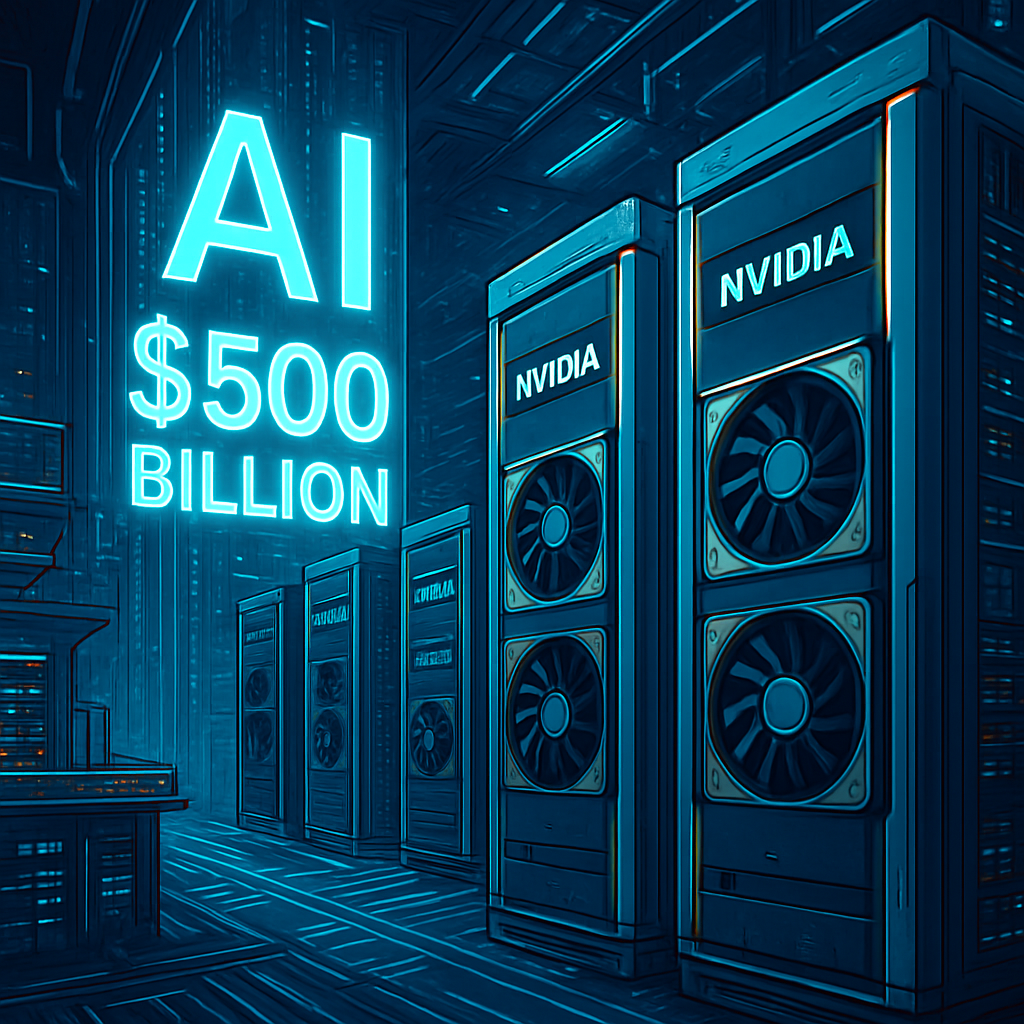
Nvidia has unveiled an ambitious initiative to collaborate with major financial institutions—including Apollo, BlackRock, Blackstone, Brookfield, Goldman Sachs, and KKR—to invest up to $500 billion in the construction of AI data centers. This substantial commitment underscores Nvidia’s strategic efforts to bolster AI infrastructure development.
A pivotal aspect of this plan is Nvidia’s guarantee concerning the residual value of its GPUs used as collateral in these financing arrangements. Specifically, Nvidia has pledged to cover up to 25% of any shortfall if the GPUs fail to maintain their projected value. This assurance aims to mitigate potential losses for investors, thereby encouraging substantial capital infusion into AI data center projects.
However, this strategy introduces a financial risk known as “wrong-way” risk. In scenarios where demand for Nvidia’s GPUs declines, the company’s financial obligations under these guarantees could escalate, potentially coinciding with a downturn in its revenue streams. This dual exposure could pose significant challenges to Nvidia’s financial stability.
Drawing parallels to historical precedents, some analysts have likened Nvidia’s approach to that of Lucent Technologies during the dot-com era. Lucent extended financing to customers for purchasing its equipment, a practice that contributed to its financial difficulties when the market contracted. Nvidia’s current strategy involves substantial financial commitments to entities such as OpenAI, Anthropic, CoreWeave, Nebius, Firmus, and Lambda, raising concerns about the sustainability of such investments.
In response to these concerns, Nvidia CEO Jensen Huang emphasized that the initiative is designed to attract independent, long-term institutional capital into the AI infrastructure market, thereby reducing reliance on traditional financing methods. This approach aims to diversify funding sources and mitigate the risks associated with direct financing.
As the AI industry continues to evolve, Nvidia’s strategy reflects a calculated effort to sustain demand for its hardware, even as it ages. By facilitating a secondary market for used AI hardware, Nvidia seeks to ensure the longevity and relevance of its products in a rapidly advancing technological landscape.
In summary, Nvidia’s $500 billion plan represents a bold and innovative approach to financing AI infrastructure. While it carries inherent risks, particularly concerning the valuation of aging GPUs, it also offers the potential to significantly accelerate the development and deployment of AI technologies. Stakeholders will need to closely monitor the execution of this strategy and its impact on the broader AI ecosystem.