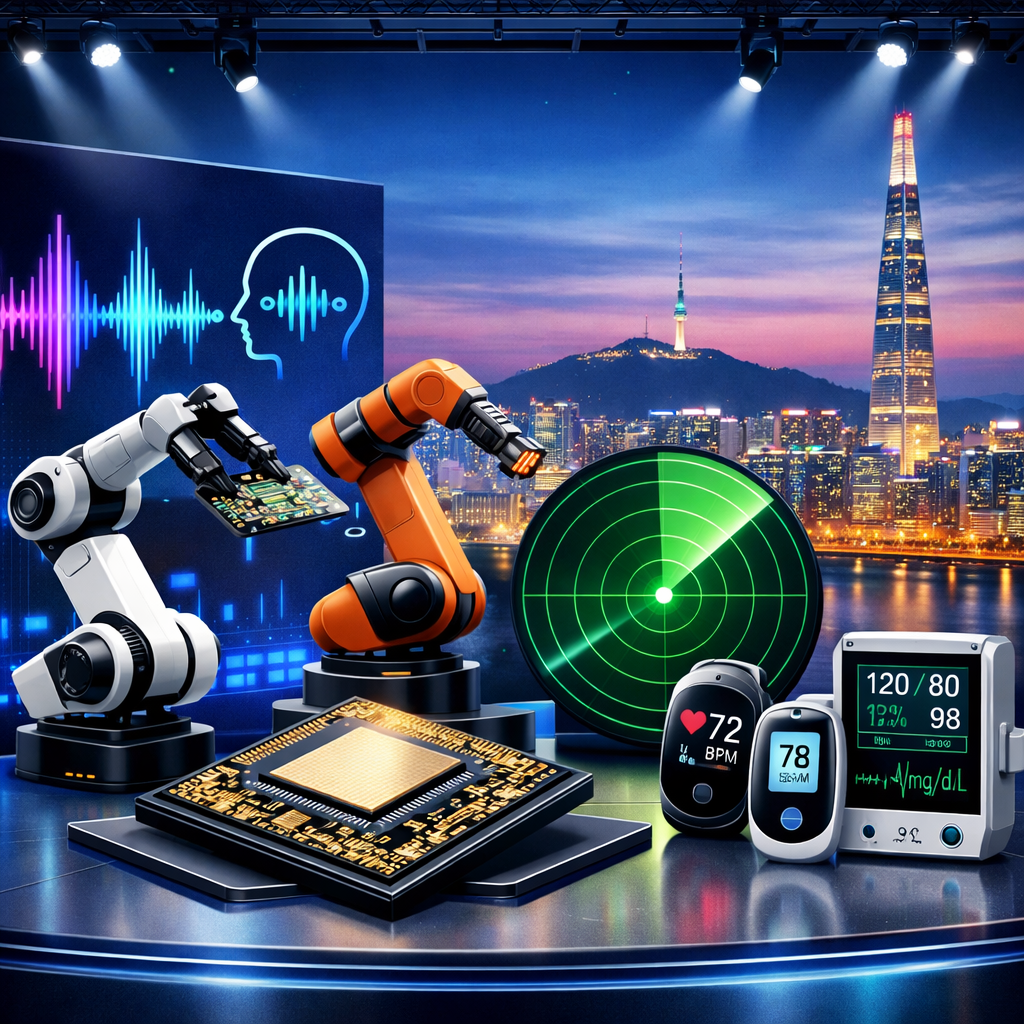
A diverse group of nine early-stage South Korean startups recently competed in Seoul at DETO 2026 for a coveted slot in Disrupt 2027’s Startup Battlefield 200, the global showcase where rising startups pitch to investors, media, and tech leaders.
The Winner: Voinosis
Voinosis emerged victorious in the competition with its AI-based tool designed to monitor brain health through voice. By analyzing speech characteristics like pitch, pauses, rhythm, and response times, the startup aims to detect changes in cognitive function. Each voice assessment takes under five minutes. Notably, the system reportedly works across languages—Greek, Japanese, English—without needing separate training for each. Clinical trials involving 146 participants showed it achieving 88% accuracy in screening for potential cognitive issues. The company plans to work with hospitals, senior living communities, insurers, and consumers and hopes to connect voice assessments with cognitive training, evaluations, and treatment programs. Founded by otologic surgeon Grace Shin, the startup is in the midst of a Series A funding round and has already secured a medical firm in South Korea as a strategic investor.
The Contenders: Eight Startups to Watch
Also vying for the Battlefield 200 slot were companies from sectors ranging from energy and semiconductors to robotics and edtech. All are eyeing U.S. market entry as part of a broader global expansion.
Awesome Lab develops ThermoFlux, a system using water electrolysis and ionization to generate heat for buildings, water supply, and industrial use—with promises of lower energy consumption and emissions. Its U.S. strategy involves supplying core OEM modules and collaborating with boiler, water heater, and HVAC firms on product development.
Crosshub’s platform, IDBlock, combines identity verification with payments using self-sovereign identity (SSI) and zero-knowledge proof. The goal is to help travelers and international users confirm identity without oversharing personal data, while integrating with payment systems to enhance financial access across borders.
DeepFusion AI builds a 4D radar imaging system fused with sensors for use in autonomous mobility, robotaxis, maritime surveillance, and defense. By combining RF sensors, radar, and lidar, the unit claims the ability to detect objects and movement even without direct line-of-sight in a customizable single package.
Eflow focuses on motors and actuators for mobility-related applications like robots, drones, and satellites. Their designs aim to offer higher torque in smaller form factors and improved control over motion in robotics joints.
Otiton Medical has created two devices: one measures body temperature; the other captures ear canal images and examines the eardrum. Its AI model was trained on around 55,000 eardrum images, and it has cleared medical certification in South Korea.
Riibotics promises fast warehouse automation—deploying robots within a day—by streamlining infrastructure, mapping, safety compliance, and integrating middleware and task programming.
Ternell is developing T-SRAM, a novel memory system for AI chips. Unlike typical binary memory, its three-state design boosts memory density and trims energy for data access. Tests with 28-nanometer chips revealed a 33%–102% increase in capacity per area and a 55%–71% energy use drop relative to standard SRAM.
Testbank, an edtech player, developed Solve, an app that turns printed study materials like workbooks and prep books into interactive content. Using AI to detect question and answer fields in PDF layouts, users can write answers directly and have them graded automatically.
Why It Matters
This competition highlights South Korea’s growing strength in deep tech fields—from health tech and semiconductors to AI, robotics, and identity systems. Winning a spot in the Startup Battlefield 200 can open doors to investment, partnerships, and international visibility.
Voinosis’s win signals increasing demand for non-invasive diagnostics powered by AI and voice data. Several runners-up—especially in autonomous systems (DeepFusion AI), semiconductors (Ternell), and edtech (Testbank)—are also building tech aligned with high-growth global needs.
— What to Watch: Can Voinosis secure its U.S. expansion and finish its Series A? Will any of the runners-up land U.S. partners or customers that help them reach that market? Also worth tracking is how governments and regulators respond—especially in healthcare and identity verification—as these startups push into the global stage.