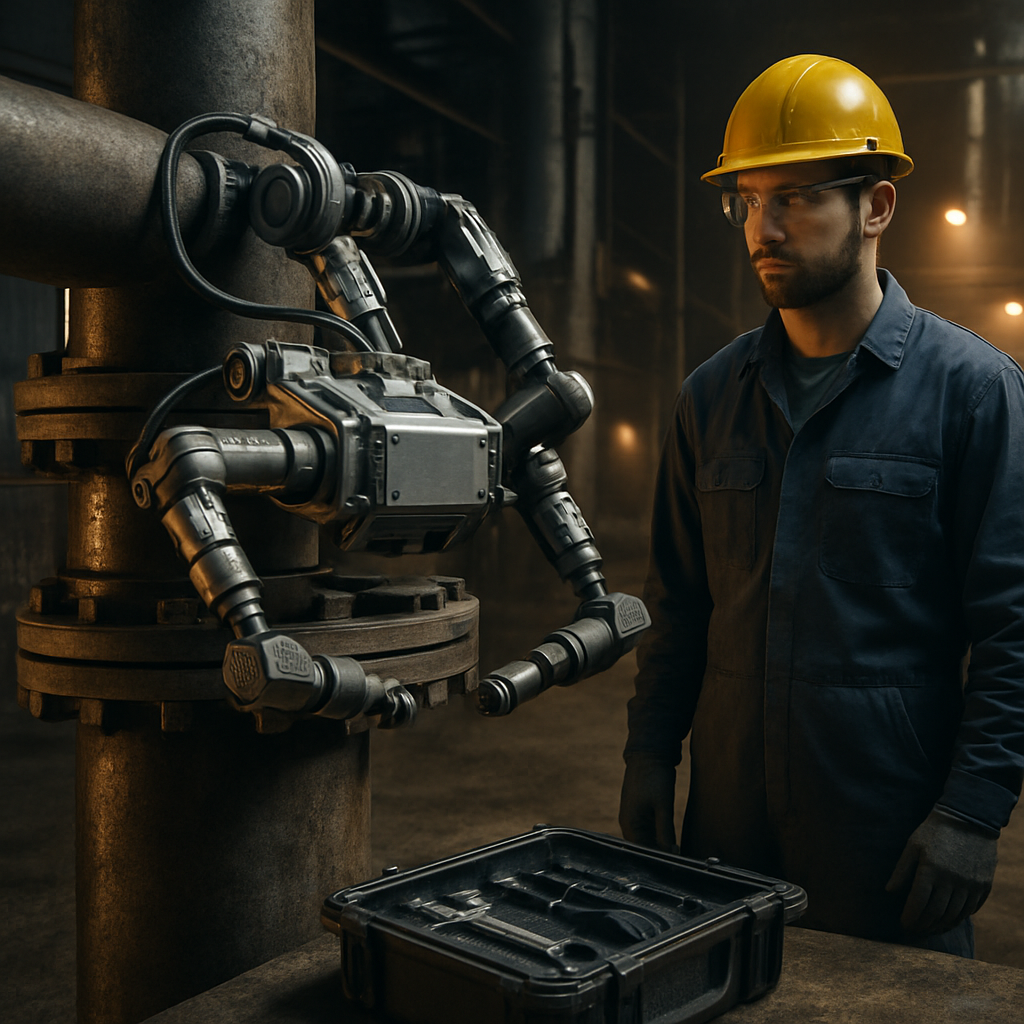
Nexterity, a company led by former ExxonMobil engineer Lindsey Elliott, is introducing a robot designed to automate one of the riskiest, most labor-intensive tasks in pipefitting: loosening and tightening bolted flange joints. These bolts connect sections of piping inside infrastructure used by oil, gas, petrochemical, and other industrial sectors—jobs that currently demand both strength and endurance under tough conditions. The manual work involved causes fatigue and exposes workers to injury risks, worsened by labor shortages and low productivity.
Robotic Solution Built for Efficiency & Safety
The robot consists of two parts that clamp around a pipe and can traverse it once mounted. Powered by batteries, it can simultaneously loosen and tighten four bolts at a time. While variations exist to adapt to different standard pipe sizes, the compact models are small enough to be carried in a single Pelican case—for portability and fast deployment.
The design focuses on a common subset of pipework: pipes with diameters between two to eight inches (NPS2 to NPS8). These sizes make up about 80% of piping across many industries, making them promising targets for automation. Employees from pressure vessel and piping engineering circles like the American Society of Mechanical Engineers helped inform the product strategy.
Market Opportunity & Business Model
While the spoken need often comes from petrochemical plants and oil/gas refineries, potential users span far beyond. Water systems, wastewater treatment, food and beverage factories, mining, nuclear plants, and green manufacturing facilities all rely on bolted piping systems—often the same flange joint types the robot is designed to handle.
Rather than selling outright, Nexterity is positioning the robot like construction equipment you can rent. The portability and set-up flexibility are part of that model. Because worksites vary in size, location, and infrastructure, being able to dispatch the robot quickly and carry it easily plays into widespread adoption.
Elliott estimates that far more attention needs to be paid to these ‘‘invisible’’ parts of industrial infrastructure—underscoring that even utilities and manufacturing sectors often under-invest in the systems that keep things flowing. Bolted flanges may not be glamorous, but they are everywhere, and often where risk and labor costs are highest.
— The startup’s prototype joins the TechCrunch Disrupt Startup Battlefield 200 this year. It reflects the growing intersection of robotics, infrastructure, and safety innovations.
Why this development matters: Automation in heavy industry has long focused on large-scale processes or novel forms of AI, while manual trade work—especially infrastructure maintenance—has lagged. This robot offers a concrete solution for a dangerous, repetitive task that impacts many sectors. Challenges ahead include proving durability in harsh environments, ensuring compatibility with non-standardized pipes, and navigating adoption by conservative industries. If successful, the model may start to shift how manual industrial labor is perceived—and automated—across infrastructure-intensive sectors.