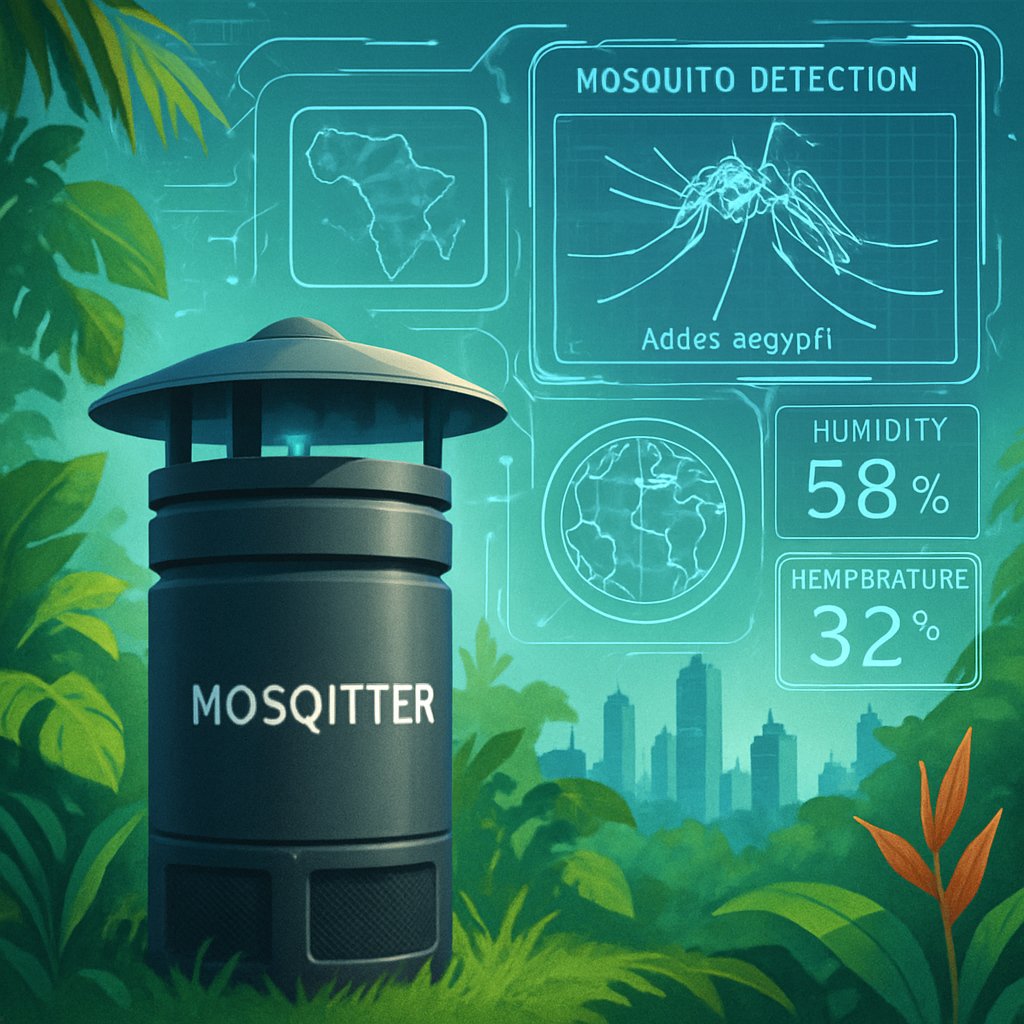
As mosquito-borne illnesses surge globally, a Pennsylvania startup has evolved its chemical-free traps into an AI-powered surveillance network aimed at identifying species, tracking populations, and predicting disease risk. Mosqitter, which makes traps that lure female mosquitoes using imitation of human heat, scent, breathing, and in high-end models, added carbon dioxide to mimic breathing, now operates over 5,000 units across five continents—up from just 250 in 2022. These devices were developed with sustainability in mind, as an alternative to pesticide-heavy mosquito control methods.
Growing Beyond Trapping: AI Identification & Risk Forecasting
Alongside hardware, Mosqitter is developing a computer vision system that classifies the species of trapped mosquitoes. Images are run through neural networks, compared to external datasets, and validated by entomologists. Confidence scores are assigned based on consistency among these inputs. Environmental sensors—measuring temperature, humidity, wind and weather—are being integrated to help forecast mosquito population changes and potential health risks.
The company’s portfolio includes two core devices: the Mosqitter Grand, built for large public spaces, and a smaller, portable Mosqitter Mini for residential or individual use. Next month it plans to officially launch its Febris Monitoring System. Febris isn’t designed to diagnose disease—but by identifying presence of particular mosquito species known to transmit dengue and other illnesses, it hopes to provide early warning of heightened risk.
Markets, Revenue & Expansion
Mosqitter targets both consumers and institutions. The Mini device sells for $199, while the professional Grand goes for $1,999. Its Febris solution adds subscription elements through dashboards, analytics, and data services, appealing to governments, health agencies, airports, municipalities, and universities that must monitor mosquito dynamics continually. Already operating in Brazil—where it has local manufacturing and sales operations—and targeting markets such as the U.S., India, Greece, Ukraine, and Nigeria, the company adapts different sales channels per region. For example, in Greece it partners with a pest-control company; in the U.S., it sells directly via Amazon and its website.
Financially, Mosqitter expects to cross $1 million in revenue for 2026. Its data services business, powered by Febris, could generate over $3.5 million next year based on current contract bids. The startup is raising $5 million in funding, structured in two tranches: the first $1 million up front, followed by $4 million tied to milestones associated with its monitoring system. To date, Mosqitter has raised $1.9 million.
Founded in Ukraine in 2019 and officially in market in 2021, the company has focused its early traps on mimicking cues female mosquitoes respond to just before laying eggs—heat, odor, light, and in higher-end models, carbon dioxide—to catch them preemptively. The name “Mosqitter” blends “mosquito” and “eater,” reflecting its original mission when trapping was the core focus.
What this means: Mosqitter is transforming its trap hardware into a broader environmental health monitoring platform. If its AI models prove accurate at scale, and if cities and health agencies adopt its Augmented Surveillance System, there could be earlier warnings for outbreaks of dengue, Zika, West Nile and other diseases. Key challenges will include ensuring dataset diversity (different regions, climates, mosquito species) to avoid misclassification, maintaining device reliability, balancing privacy concerns, and securing enough institutional clients willing to pay for continuous monitoring. As mosquito ranges shift with climate change, this kind of tech could become an essential front in global health defense. Watch for how Febris fares commercially and scientifically in the coming year—not just in Brazil but in all its target markets.