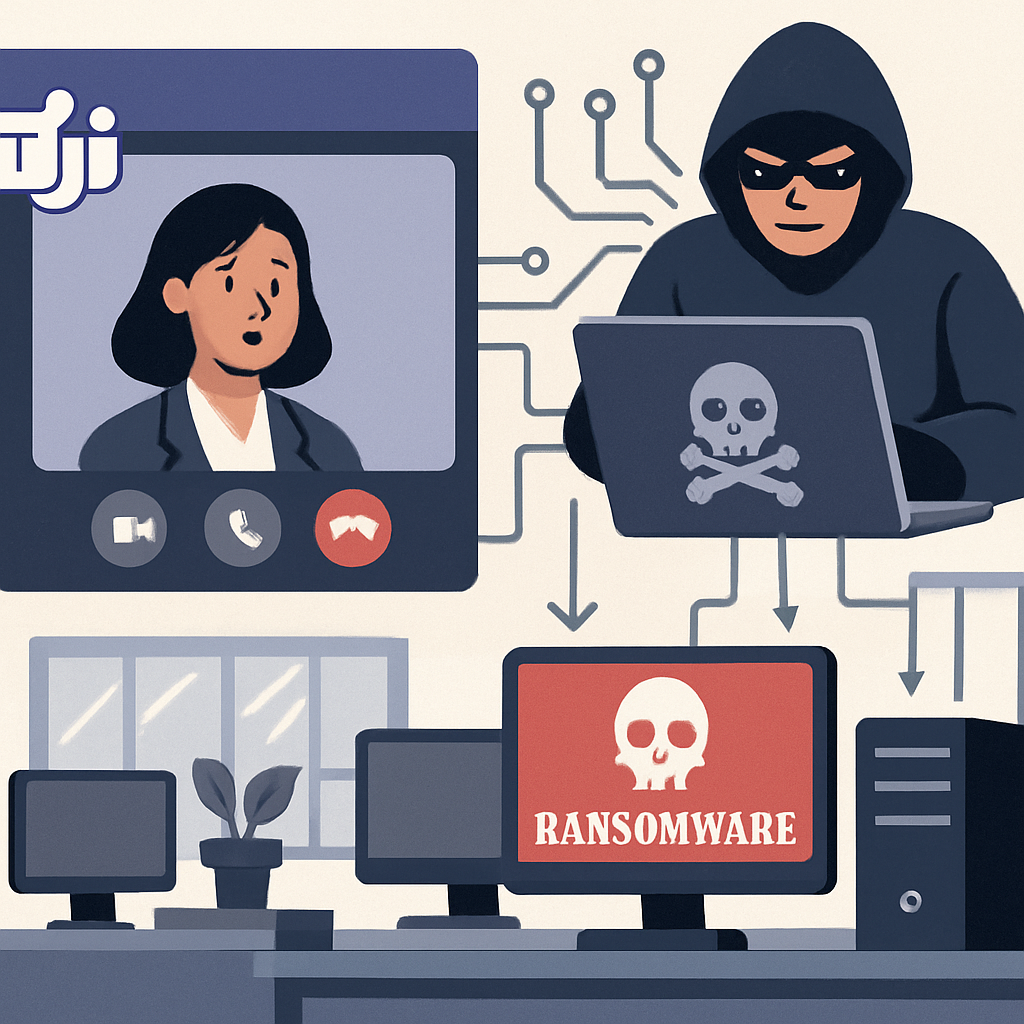
Recent incidents have revealed that brief Microsoft Teams calls can serve as the initial vector for ransomware attacks. Cybercriminals, masquerading as IT support personnel, are persuading employees to grant remote access, subsequently infiltrating networks and deploying Chaos ransomware.
Between February and June 2026, a campaign identified as STAC4749 targeted numerous organizations across North America. These deceptive calls typically lasted between two to two-and-a-half minutes, underscoring the efficiency of social engineering tactics in compromising systems.
Security analysts have characterized this operation as financially motivated, combining Teams-based voice phishing, custom malware, and legitimate remote administration tools. The attackers continually adapted their methods to evade detection, highlighting the evolving nature of such threats.
Exploitation via Microsoft Teams
STAC4749 operators initiated their attacks through Teams chats and voice calls, impersonating helpdesk or IT staff. They employed convincing employee-style names and IT-themed cloud domains to enhance their credibility. Victims, accustomed to receiving support requests online, were more likely to trust these communications.
The attackers sought access through Microsoft Quick Assist, a built-in remote-support utility, or alternative remote-management applications when Quick Assist was unavailable. This strategy mirrors previous incidents where trusted workplace tools were exploited to gain control over endpoints swiftly.
Upon gaining access, attackers executed commands to gather information about the compromised system, identify security products, and establish persistent access. They also attempted to enable Remote Desktop Protocol (RDP) to facilitate lateral movement within the network.
Rapid Deployment of Ransomware
After securing access, the attackers deployed additional tools to maintain control and expand their presence within the victim’s environment. In several cases, this led to the deployment of Chaos ransomware. Notably, one incident progressed from initial access to ransomware deployment in less than 17 hours, leaving minimal time for defenders to respond.
Chaos ransomware has been active as a ransomware-as-a-service operation since at least February 2025. Its use of voice phishing and remote-management tools aligns with broader trends in ransomware attacks, where attackers seek stealthy access before initiating disruptive encryption stages.
Organizations are advised to treat unexpected external Teams messages and calls with suspicion, especially when requests involve initiating remote-support software, installing applications, or sharing access. Employees should verify support requests through known internal channels rather than relying solely on the caller’s identity.
Security teams should monitor Teams activity, suspicious PowerShell usage, unusual command-line activity, and unauthorized remote administration or tunneling tools. Reviewing common Windows persistence locations, such as registry Run keys, can help uncover hidden access points before attackers escalate their activities.
These incidents underscore the importance of vigilance and robust security protocols in the face of increasingly sophisticated social engineering attacks. Organizations must prioritize employee training and implement stringent access controls to mitigate the risk of such rapid and damaging ransomware attacks.