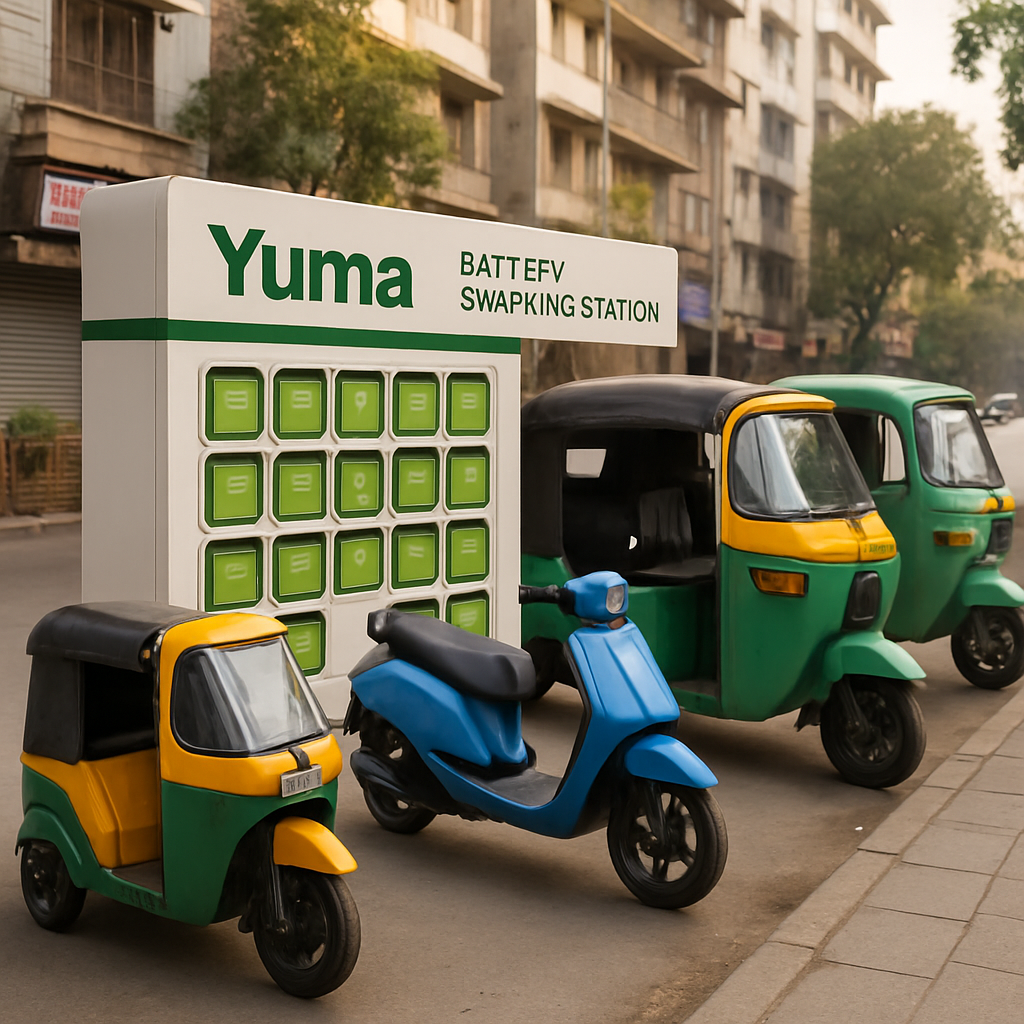
Magna International is deepening its commitment to battery swapping in India by pumping an additional $35 million into its joint venture with Yuma Energy, a network operator for electric two- and three-wheelers based in Bengaluru. This latest funding boost increases Magna’s equity in Yuma beyond the 51% it acquired during the original joint venture; Yulu, which owns the remaining stake, will see its share diluted. The specific post-investment ownership split remains undisclosed.
Scaling to Serve India’s EV Delivery Boom
Yuma Energy emerged as a spinout from Yulu in early 2023 and has already handled over 60 million battery swaps, with some 100,000 battery units deployed across its network. Despite its rapid growth, Yuma is not yet profitable, though some of its older swapping stations are generating positive EBITDA. In the fiscal year ending March 2026, the company reported revenues of approximately ₹1 billion (around $10.5 million) and aims to reach EBITDA break-even within the coming two quarters.
The infusion of new capital will be used to expand Yuma’s infrastructure—adding more stations and dramatically increasing its battery fleet over the next 12 to 18 months. Currently operating more than 400 stations and over 2,500 charging units, the company plans to scale further in existing markets and enter new ones. Cities such as Chennai and Pune are on the expansion roadmap, building on an existing presence in locations from Bengaluru and Mumbai to Kolkata and Coimbatore.
Why Swapping Might Outperform Fast Charging for Delivery Riders
High-utilization gig-economy riders in India spend long hours on the road. Slow charging means lost income. Battery swapping, which takes less than two minutes, offers a compelling alternative to even rapid charging, which typically takes 20 to 30 minutes. With only about 10–15% of India’s gig vehicle fleets currently electric, there’s a large addressable market if EV adoption increases.
Yuma’s model hinges on managing both sides: hardware and operations. The startup designs and manufactures its own battery packs and charging infrastructure. Battery packs are made at its Chennai facility, while charging units are produced in Bengaluru. The aim is to own the effectiveness of the full system—from batteries to swapping stations.
The customer base is gradually diversifying. Yulu remains the largest user of Yuma’s services, but now 15–20% of recent swaps come from fleets outside Yulu. Platforms like Kinetic Green, Motovolt, BGauss, and Quantum Energy are already using Yuma’s battery systems. The company projects that within two years, roughly a quarter of its swaps will originate from non-Yulu customers.
Looking beyond India, Yuma is eyeing international expansion. Southeast Asia—Vietnam and Thailand in particular—alongside select African markets, present promising opportunities due to their large two-wheeler demand. However, for now, the focus remains on consolidating in India over the next 12 to 18 months.
The investment follows Magna’s broader involvement in India’s EV landscape. In 2022 Magna committed a total of $77 million split between Yulu and the battery-swapping joint venture, including $52 million directly into Yuma. Magna confirms these are its only startup investments in India to date.