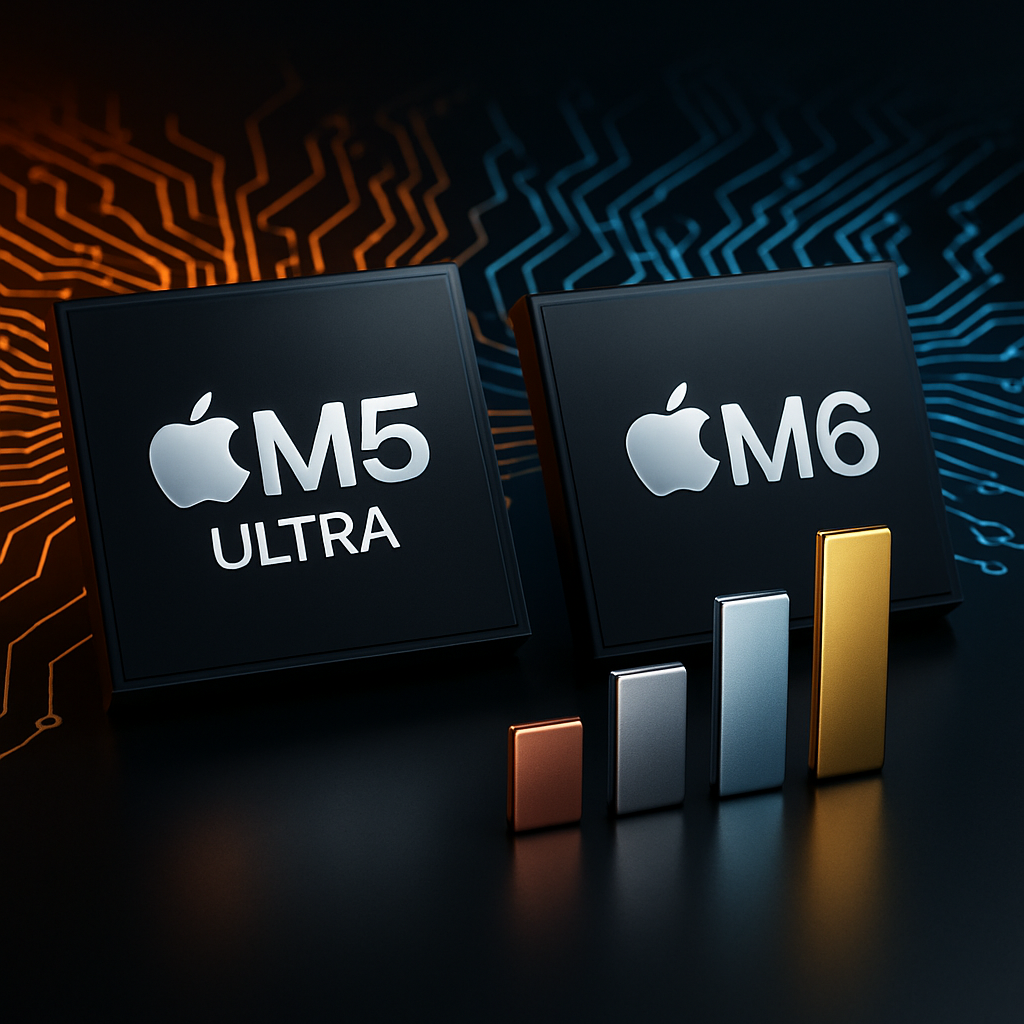
Apple’s upcoming M5 Ultra and M6 chips have landed early GPU benchmark scores on Geekbench 7, offering what may be the first real peek at their graphics potential before the official debut of the new Mac Studio and Mac mini models, arriving Tuesday. These early figures focus solely on metal and OpenCL performance.
Strong Showings for M5 Ultra
The M5 Ultra posted a Metal score of 366,744, which is about 59% above the M3 Ultra’s average score of 230,420. In comparison to earlier Apple chip GPUs, the Ultra version of M5 outpaces chips like M5 Max, M2 Ultra, and M1 Ultra by large margins. The M5 Ultra’s OpenCL score is reportedly closely aligned with that of the NVIDIA GeForce RTX 4080, signaling it could challenge discrete desktop GPUs in certain workloads.
M6 Chip Delivers Moderate Jump Over M5
The M6 chip also shows gains in Geekbench 7’s Metal test: 93,217 points, which roughly corresponds to a 34% uplift over the standard M5’s 69,563 average. While it doesn’t reach the heights of the Ultra-class chips, it clearly steps up past its predecessor in graphics throughput.
Comparative Scoreboard & What It Means
Here’s how multiple chips stack up in Geekbench 7 Metal, from the highest to the more modest performers:
• M5 Ultra: 366,744
• M3 Ultra: 230,420
• M5 Max: 225,606
• M2 Ultra: 201,144
• M4 Max: 189,301
• M1 Ultra: 150,098
• M6: 93,217 (vs. standard M5 at 69,563)
• Others scale down further—M2 Pro, M5 Pro, down through the M1 and M2 generations.
These early benchmark numbers suggest the M5 Ultra may reach discrete GPU levels for some users, especially creative professionals or those running demanding graphics workloads. Meanwhile, M6 appears targeted more toward mainstream or midrange use, with a focus on balancing performance and efficiency.
As with all benchmark leaks, real-world performance will vary depending on software optimization, thermal limits, and power delivery. Though the numbers are impressive, they aren’t the full story.
What this means: The M5 Ultra appears to be Apple’s likely contender in high-end GPU applications, potentially challenging dedicated cards. The M6, while less ambitious, still promises a meaningful improvement for users upgrading from M5—or older silicon. Either way, the bump in Metal scores underscores Apple’s ongoing push to narrow the gap between integrated and discrete graphics.