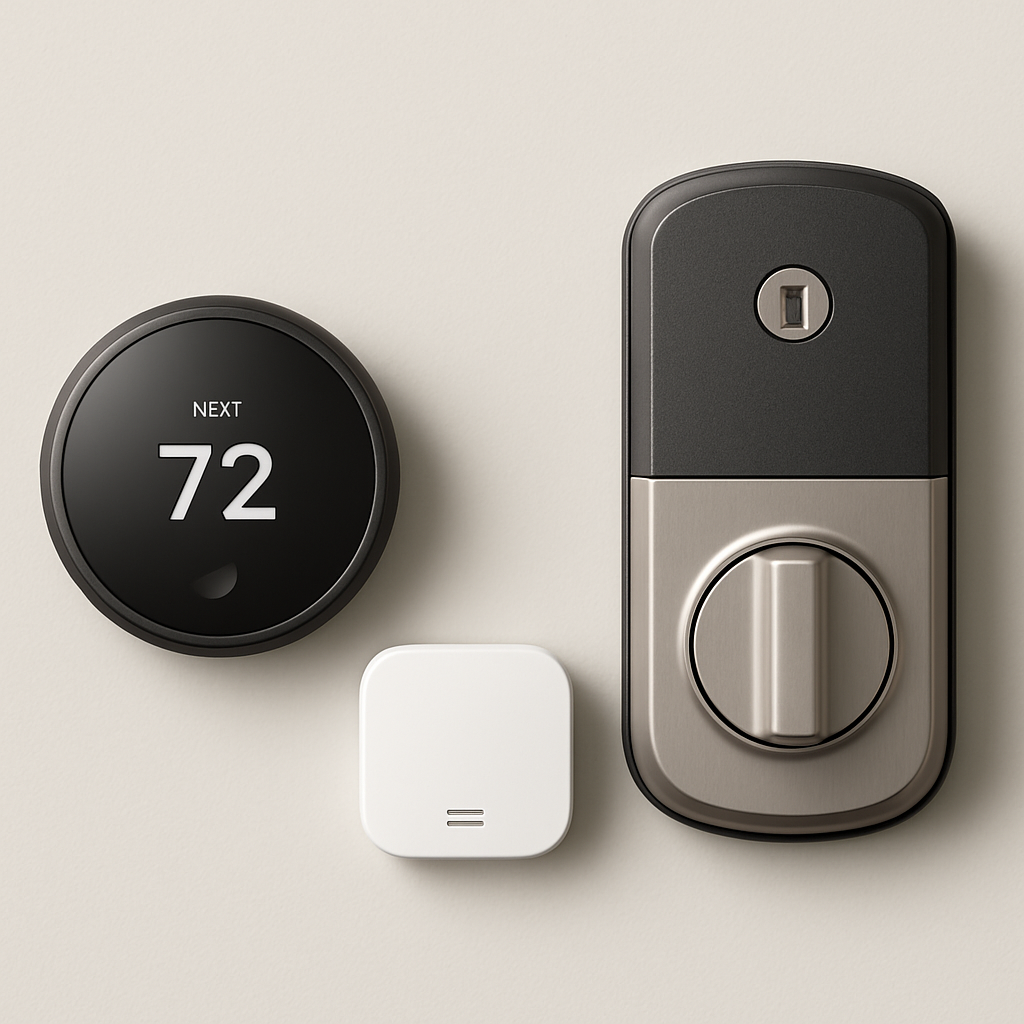
FCC filings have unveiled designs and specs for three LG smart home accessory prototypes reportedly developed with Apple’s input: a thermostat, a temperature/humidity sensor, and a smart deadbolt lock. These are part of a broader suite of seven upcoming HomeKit-compatible devices that include cameras, a doorbell, and more. LG will sell them under its own brand while Apple contributes design and engineering guidance. The public first learned of Apple’s involvement through a Bloomberg report, but the FCC paperwork seen here gives richer detail.
New LG Thermostat: Radar, Thread & Matter Built In
The LG thermostat (model TMCTAW5W) departs from traditional boxy panels with a puck-like profile featuring a raised edge. Its back hosts two rounded pegs and a central socket. It’s designed for a 24-volt AC power supply. Connectivity spans 2.4 GHz and 5 GHz Wi-Fi, Bluetooth, Thread, and a surprising inclusion: 60 GHz radar—likely for presence detection or approach sensing.
Additional features reportedly include a “Far Sight Display” mode, optional humidity readouts, screen brightness and language settings, and controls for temperature calibration/offsets. The Matter logo and QR setup code appear prominently on its rear.
Temperature Sensor & Smart Lock: Thoughtful Function Meets Secure Access
The round sensor (model TMST2A6W) runs on a CR2477 coin cell battery, which is replaceable. It measures temperature and humidity, offers alerts when the battery is low, and includes mounting options—with a magnetic steel back and adhesive metal plate for non-metal surfaces. It supports Bluetooth Low Energy and Thread. Its back bears the Matter setup code and safety marks.
The deadbolt lock comprises a vertical interior unit available in Graphite and Silver finishes (models TMCDD15G and TMCDD15S). Power comes from four AA batteries arranged vertically. Below lies a large rotating circular element. The battery compartment sits above the lock’s rotating part; setup code and compliance info are placed above the batteries.
Security features include support for Bluetooth, Thread, NFC, and ultra wideband (UWB). The device reportedly performs access verification first via Bluetooth, then refines unlock authorization using UWB-based proximity detection. A keypad flips open, with a swivel hinge that limits its motion to avoid contact with walls. Settings allow adjustment of lock and touchpad lighting, alarm behavior, audio feedback, master codes, and it even includes physical keys. Bracket sizes of 2.375 inches (60.3 mm) and 2.75 inches (69.9 mm) are compatible.
Strategic Move by Apple & LG in HomeKit Expansion
Although Apple is not named within the FCC documents, multiple sources confirm its involvement, especially in designing features and defining standards. The accessories are built at Hyundai HT Global’s factory in Vietnam.
The upcoming seven-device lineup advertisement also includes a wired video doorbell, indoor and outdoor security cameras, and a floodlight camera. LG will handle production and sales, while Apple reportedly shapes engineering and design. This allows Apple to expand its smart home reach without building everything in-house.
Apple’s smart home ambitions don’t end here. A new home hub, alongside refreshed versions of Apple TV 4K and HomePod mini, is expected on October 13. Further down the line, a premium home hub with a display mounted on a robotic arm is in development, and the company is also working on its own AI-powered security camera and sensor expected in 2027.
What this means:These filings suggest Apple is accelerating its strategy to dominate the connected home space. By partnering with LG, it can roll out more HomeKit—and Matter—devices more rapidly, bringing high-end features without owning every hardware supply chain. Radar detection, UWB, NFC, Thread—all major protocol moves—signal that the era of smarter, more context-aware home automation is coming. Keep an eye on the October 13 product event, which may flesh out these devices further—or even announce pricing and launch timelines.