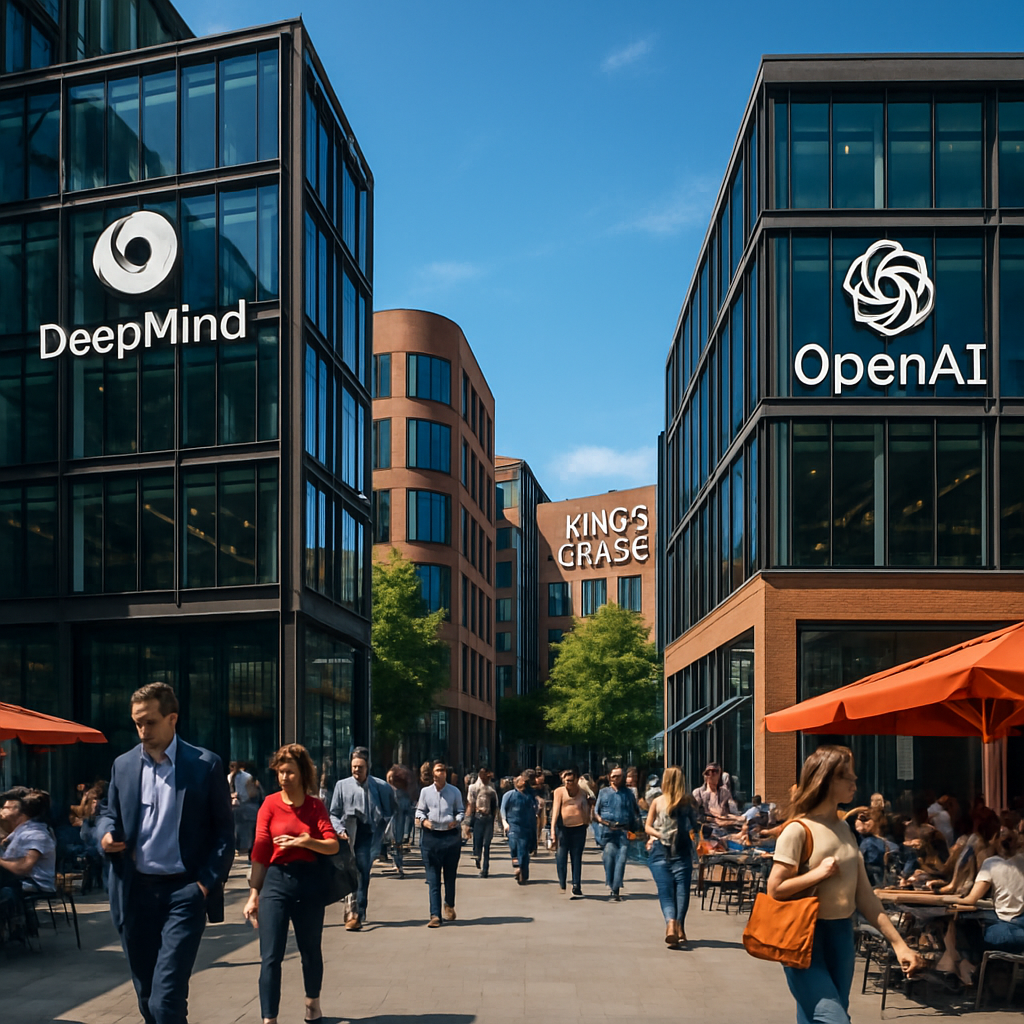
King’s Cross, once notorious for its red-light activities, has undergone a remarkable transformation to become a leading hub for artificial intelligence (AI) innovation. This shift began in 2016 when DeepMind, acquired by Google, established its headquarters in the area. The presence of such a prominent AI entity attracted numerous startups eager to tap into the burgeoning talent pool.
Today, King’s Cross, often referred to as the “Knowledge Quarter,” hosts a plethora of AI-focused organizations, including OpenAI, Meta, Isomorphic Labs, Cusp AI, Wayne, Recursive, Synthesia, and Anthropic. The European Technology Network (ETN) has also set up a new office nearby, and University College London is just around the corner, further enriching the intellectual ecosystem.
The area’s appeal is not limited to its professional opportunities. Trendy eateries like Hoppers and BAO have emerged, and its strategic location offers quick access to Cambridge and Paris, facilitating talent acquisition and business expansion.
Reflecting on the area’s past, investor Hussein Kanji of Hoxton Ventures recalls the 1980s when King’s Cross was plagued by drug-related issues and crime. The transformation over the past two decades is nothing short of extraordinary.
Approximately 18 months ago, BioCorteX, a company in Kanji’s portfolio, relocated to the Jellicoe building in King’s Cross to be closer to the AI action. Co-founder Nik Sharma notes the influx of major players into the area, including reports of Jeff Bezos’ AI company, Prometheus, considering a move to the Jellicoe.
London is now home to around 3,600 AI startups, collectively raising approximately $12.1 billion of the $14.8 billion secured in the city since late July, according to Dealroom. Since June, AI-related companies have leased over 1 million square feet of office space in London, as reported by real estate firm Knight Frank. This surge has led to an 18% increase in prime rents in King’s Cross over the past three years, with a current vacancy rate of just 0.9% for conventional office spaces.
Recent events, such as Anthropic’s decision to restrict access to its AI models, have sparked discussions about the importance of maintaining sovereignty in AI development. Saul Klein, co-founder of VC firm Phoenix Court, emphasizes the need for self-reliance in the ecosystem. Phoenix Court, located in King’s Cross, has three portfolio companies in the vicinity, including Olix, Early Health, and CoMind.
The evolution of King’s Cross from a troubled neighborhood to a thriving AI hub underscores the dynamic nature of urban development and the pivotal role of strategic investments in technology and infrastructure. This transformation not only revitalizes the area but also positions it as a significant player in the global AI landscape.