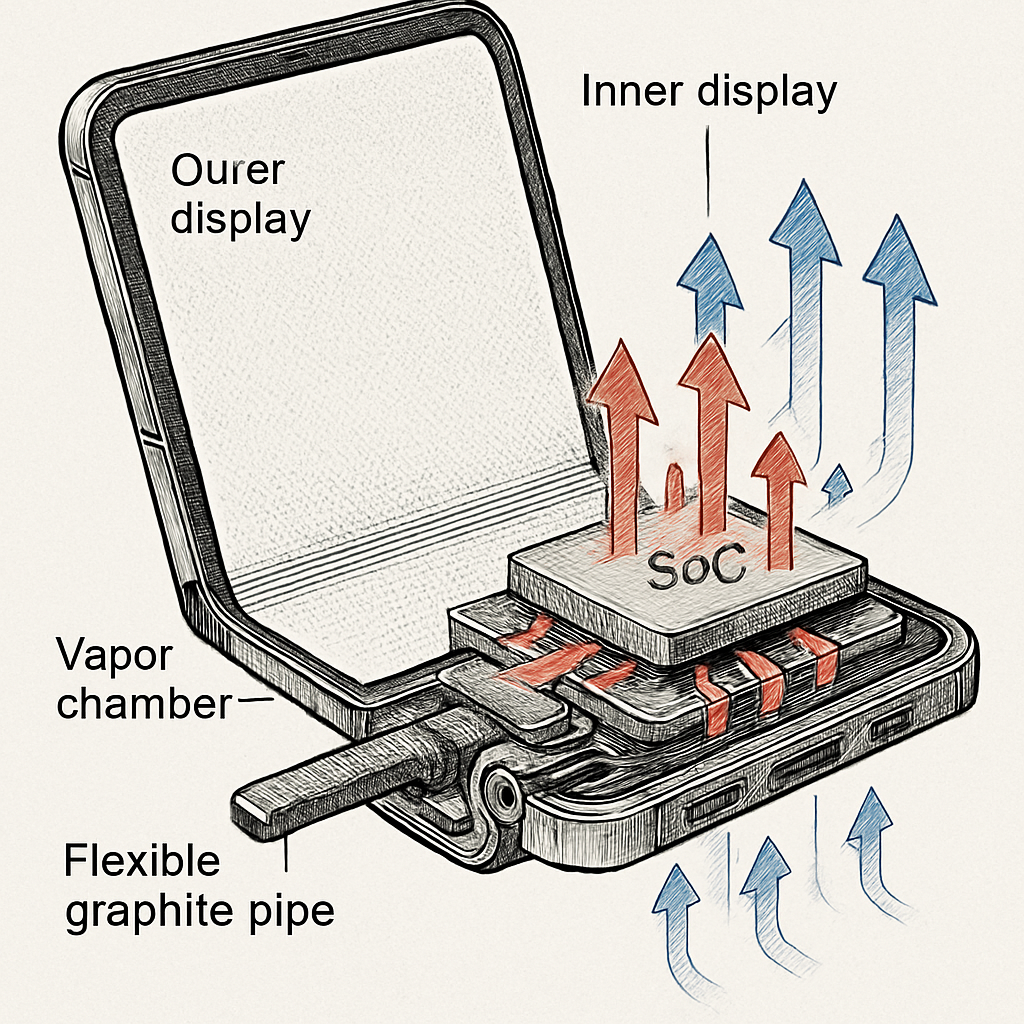
Apple’s new foldable phone—the iPhone Duo—solves one of the biggest thermal challenges in folding phones using a hidden trick inside its hinge. A flexible graphite pipe routed through the hinge helps draw heat away by connecting the two halves of the device, increasing the total surface area for cooling. That hinge-integrated ductaging had to balance durability with thermal performance, since the pipe must survive thousands of opens and closes without losing its ability to transfer heat.
How Apple’s Hinge Tech Works
The heart of the system is a material called “metal over foam,” which acts as a thermal and mechanical bridge between the chip (SoC) and the vapor chamber beneath. This sandwich-like construction sits above Apple’s A20 Pro chip—the same processor used across the new iPhone 18 Pro, 18 Pro Max, and iPhone Duo—bringing cooling efficiency and strict structural integrity at once.
On the surface that’s similar to other recent iPhones, but the Duo adds something unique. To keep performance when folded—where traditional thermal paths get pinched or blocked—Apple routed a flexible graphite tube through its hinge. That pipe carries heat between the two halves of the phone’s body, expanding the available real estate to shed heat, which helps preserve performance across its outer and inner displays.
A20 Pro Chip, Cooling, and Design Synergies
The A20 Pro chip represents Apple’s move to a 2-nanometer manufacturing process, improving energy efficiency and performance. That allows more aggressive clock speeds while limiting energy waste—but only if the cooling can keep up. That’s where Apple’s vapor chamber comes into play, paired with the metal-over-foam material to tightly couple the chip to a broad heat sink.
For the Duo specifically, Apple engineered a variant of the A20 Pro that can drive displays on both the inside and outside simultaneously—plus support for a hidden FaceTime camera behind the inner display. All this increases heat production, making the hinge cooling trick even more vital. Mechanical teams worked closely with thermal engineers to design the hinge so it preserves thermal connectivity across folding cycles.
This is one of the trickier aspects of the foldable form factor. Folding phones tend to trap heat where two halves join, while hinges can act like insulators or weak points if not managed correctly. The graphite pipe helps bridge that gap without compromising the structure or usability—ensuring that the Duo can sustain demanding loads without overheating.
Apple’s design reflects growing attention in the industry toward thermal engineering. As phones pack more power into thinner, more complex shapes—foldables being among the most challenging—innovations in materials and architecture matters more than ever.
What this means: Apple’s hinge-embedded graphite pipe is a clever engineering trade-off, merging thermal performance with folding durability. It could set a new standard: future foldables will need cooling solutions that deal not just with chips, but with joints and moving parts. We’ll be watching how this design performs long-term—heat, wear and tear, hinge lifespan are now as critical as screen clarity or chip speed.