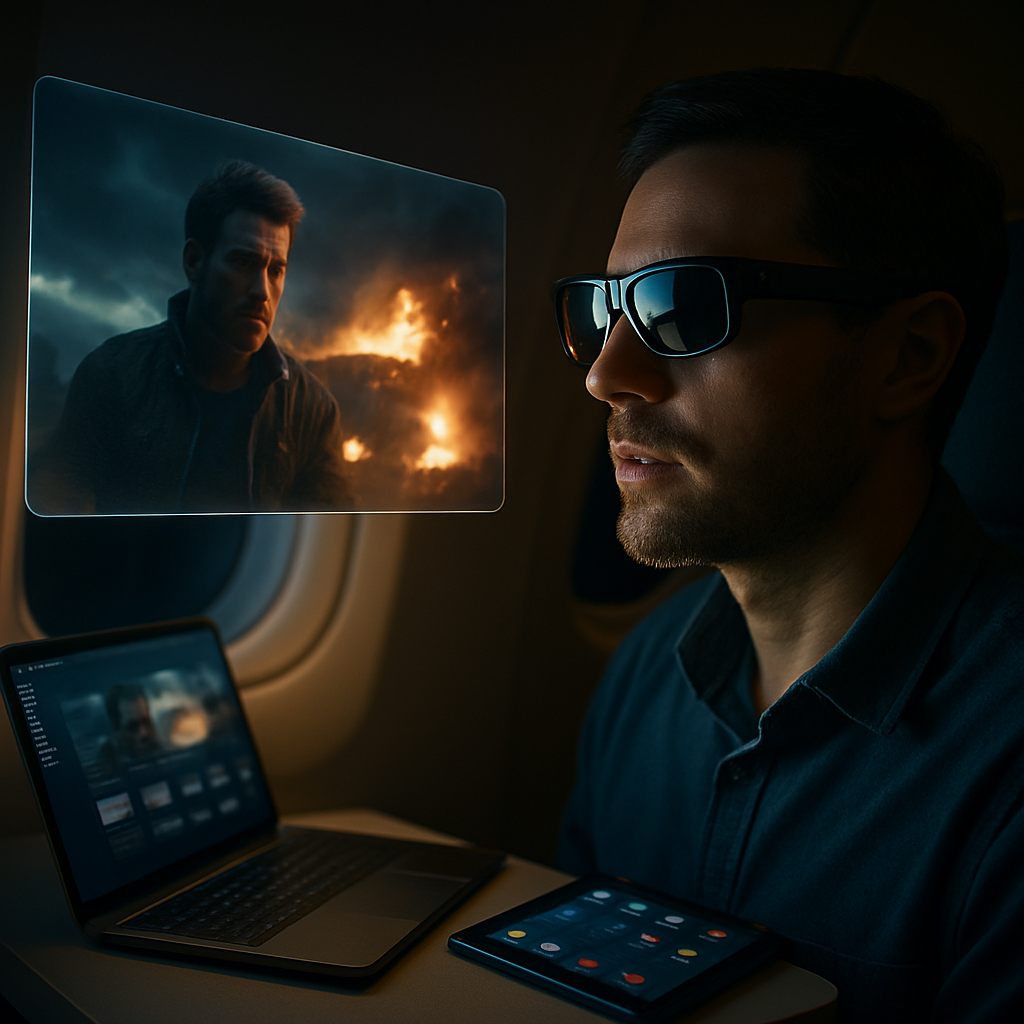
XREAL is staking its claim at the forefront of Android XR development with the One Pro smart glasses. After spending time with the device, paired with devices like the Galaxy Z Fold 7, MacBook, and Redmagic Astra 2 tablet, one thing is clear: this hardware has the potential to elevate Android XR to a new level. The promise lies in its ability to project a giant, customizable floating screen—up to 157 inches—for anything from movies to laptop displays wherever you go. The experience, especially during travel, offers a level of immersion that flat screens just can’t match.
Comfort and portability are major advantages. Unlike full VR headsets, the One Pro is far less bulky. Although the design stands out—it pokes out from the face more than traditional eyewear—its compact form and briefcase-ready portability make it a practical travel companion. Users reported comfort even after hours, such as on flights.
Real-world performance: strengths and hiccups
The display experience often dazzles once you fine-tune brightness and positioning. Mirroring a laptop yields a remarkably immersive workspace—no more chasing the glow of someone reclining in front of you. Still, not everything is perfect. Motion tracking works well on stable ground, but in-flight turbulence can throw off stability. Input devices have limitations too. Without a secondary device, functionality is minimal. While there are gesture add-ons and an optional companion phone that adds a UI layer, the One Pro still depends heavily on what it’s connected to.
Certain apps don’t play nicely. Video apps like Fandango at Home and even Google TV ran into problems on the Redmagic tablet—though on the Galaxy Fold (over DeX) those same apps functioned properly. Likewise, the 3D conversion mode, which transforms 2D content to a pseudo-3D view, worked only on the Fold and not on the Redmagic.
Where Aura and other models come in
XREAL’s future is leaning heavily into Android XR. Aura, the next-gen device slated for release later this year, will support it directly. Aura won’t replace the capability to plug in other devices—One Pro and other models already do—but Android XR promises to provide its missing core user interface, freeing hardware from too much dependency on phones or PCs.
Meanwhile price tiers offer different entry points. The A01+ model, priced at $299, caters to users wanting entertainment or casual use without breaking the bank. The One Pro runs hotter on price—roughly $600—geared for power users craving premium display and form. There’s also the midrange 1S at $450, which the author found capable almost on par with One Pro for many everyday uses.
XREAL’s current lineup is available now, including One Pro, 1S, and A01+, while Aura arrives later in the year. With Android XR coming into full play, what’s available now is just the beginning.
What this means: XREAL appears to have built exactly the kind of hardware Android XR needs to succeed. The One Pro demonstrates that the right blend of portability, display quality, and app compatibility can make the idea of wearable big screens more than a novelty. If Aura delivers on its promise of native Android XR integration, it could be the turning point for smart glasses as a useful, everyday extension of devices, rather than a niche accessory. Keep an eye on how well Android XR runs standalone, how app makers optimize for different hardware tiers, and how comfort evolves—especially for longer sessions or travel.