Infinity, an AI infrastructure startup, has successfully raised $15 million in funding, achieving a valuation of $100 million. The investment round saw participation from Touring Capital, Principal VC, and researchers affiliated with leading AI organizations such as OpenAI and Anthropic.
The company’s primary focus is on developing software solutions that enhance the performance of AI models across various hardware platforms. Traditionally, Nvidia has dominated this space, not only due to its high-performance GPUs but also because of its proprietary CUDA software. CUDA enables GPUs, originally designed for graphics processing, to function as general-purpose processors, facilitating the execution of AI workloads. Major AI frameworks like PyTorch and TensorFlow are built atop CUDA, allowing developers to seamlessly run applications on Nvidia hardware using popular programming languages like Python.
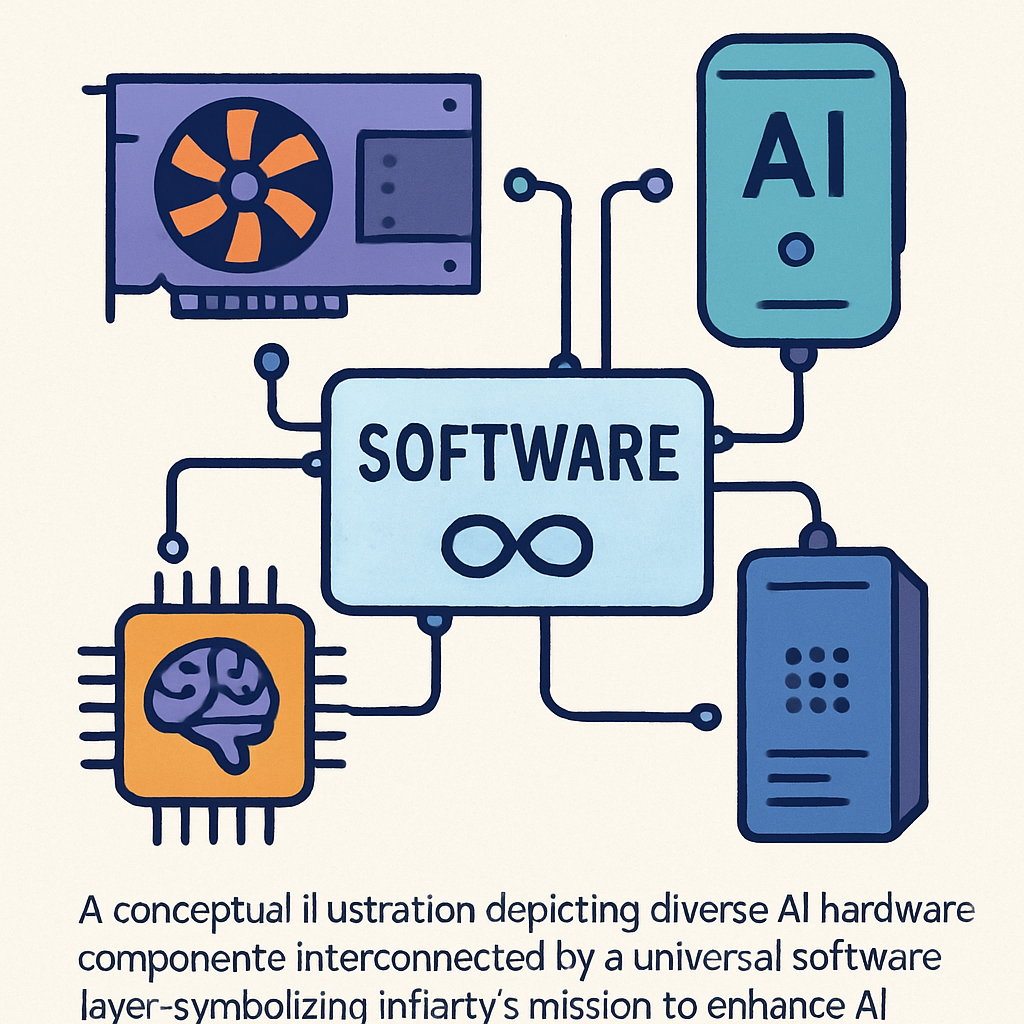
However, many AI application developers lack the resources or expertise to create low-level software, known as kernels, necessary for porting applications to alternative hardware platforms. Infinity aims to address this challenge by creating a universal inference library compatible with a wide range of chips, including SRAM, GPUs, mobile processors, and Systolic Arrays. This initiative positions Infinity among a new wave of startups striving to reduce Nvidia’s market dominance by offering versatile and accessible software solutions.
At the heart of Infinity’s innovation is its AI research agent, Ignition. This agent is designed to autonomously generate the low-level code required for AI inference on non-Nvidia hardware. Ignition performs tasks such as testing, debugging, and measuring hardware performance, iteratively refining the code to optimize efficiency. Its self-optimizing nature allows it to continuously learn and adapt to various chip architectures, regardless of their proprietary designs, effectively creating a software stack comparable to CUDA.
Infinity’s clientele includes D-Matrix, an AI chip manufacturer aiming to challenge Nvidia’s dominance. The startup is also engaged in discussions with other prominent chip and cloud service providers. While human oversight remains integral, providing strategic direction, Ignition handles the more labor-intensive aspects of code generation and optimization. In practical applications, this approach has significantly accelerated development timelines, reducing processes that traditionally took months or years to mere hours or days.
Infinity’s business model deviates from conventional licensing fees, opting instead for a performance-based pricing structure. This model aligns the company’s success with the tangible benefits delivered to its clients, fostering a collaborative and results-oriented partnership.
By democratizing access to high-performance AI inference across diverse hardware platforms, Infinity is poised to catalyze innovation and competition in the AI hardware ecosystem. This development could lead to more cost-effective and efficient AI solutions, benefiting a broad spectrum of industries and applications.