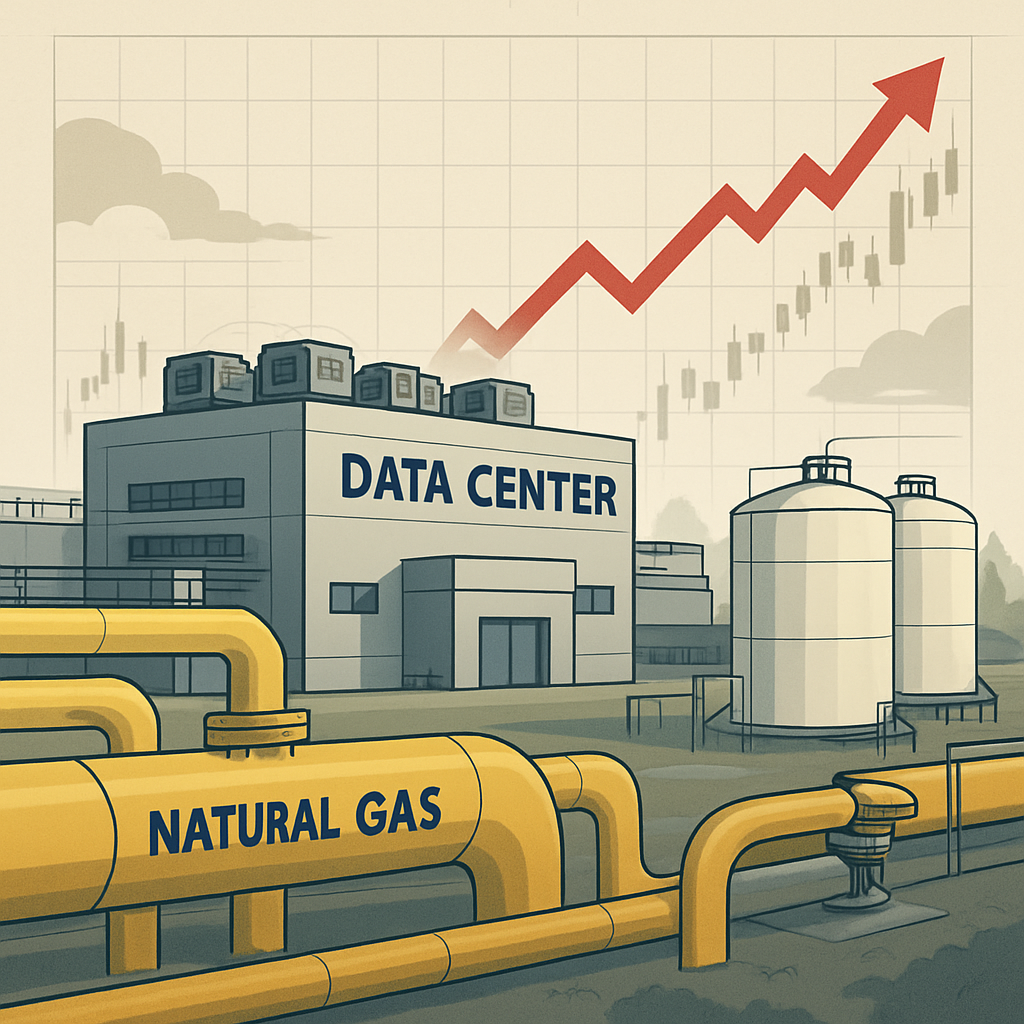
Major technology companies, known as hyperscalers, including Amazon, Google, Meta, and Microsoft, have recently shifted their energy strategies by investing heavily in natural gas to power their expansive data centers. This move aims to support the growing demands of artificial intelligence (AI) and other data-intensive operations. However, emerging forecasts suggest that this reliance on natural gas may lead to significant financial and operational challenges in the near future.
Potential Surge in Natural Gas Prices
According to a recent report by energy research firm Noreva, natural gas prices in certain U.S. regions could triple in the coming years. This anticipated increase is attributed to a combination of factors: escalating demand from hyperscalers, a slowdown in supply growth, and a rise in liquefied natural gas (LNG) exports. Peter Gardett, CEO of Noreva, highlighted that the energy market’s current stability might be misleading, as simple arithmetic points to a much tighter gas market than observed in recent years.
Hyperscalers’ Investments in Natural Gas Infrastructure
In recent months, several tech giants have announced substantial investments in natural gas infrastructure:
- In March, Meta unveiled plans to construct a 7.5-gigawatt natural gas power plant in Louisiana to support its Hyperion data center.
- Shortly thereafter, both Microsoft and Google announced their intentions to build gigawatt-scale gas power plants in Texas.
- Amazon also revealed plans for a 7.6-gigawatt gas power plant in Texas.
These investments mark a significant departure from the companies’ previous strategies, which predominantly focused on renewable energy sources. The shift underscores the pressing need to meet the immense power requirements of AI and other advanced computing technologies.
Financial Implications and Market Risks
The decision to invest heavily in natural gas comes with inherent financial risks. Currently, natural gas prices range from approximately $2 to $4.50 per million British thermal units (BTUs), with the widely traded Henry Hub in Louisiana priced just under $3. However, Noreva’s projections indicate that prices could soar above $10 per million BTUs in certain hubs. Given that fuel costs constitute about half the expense of electricity generation from large power plants, such a price surge could significantly increase operational costs for data centers relying on natural gas.
Furthermore, the stability of natural gas prices has been maintained due to relatively flat demand and consistent supply additions. However, the landscape is changing. The domestic gas market is increasingly connected to the global market, and the burgeoning demand from AI applications is exerting additional pressure. While futures contracts currently suggest stable prices, experts like Gardett remain skeptical, emphasizing that the market may not be fully accounting for these evolving dynamics.
In summary, while the move towards natural gas infrastructure by hyperscalers addresses immediate energy demands, it exposes these companies to potential price volatility and supply constraints. As the energy market evolves, it is crucial for these tech giants to reassess their strategies and consider diversifying their energy portfolios to mitigate future risks.