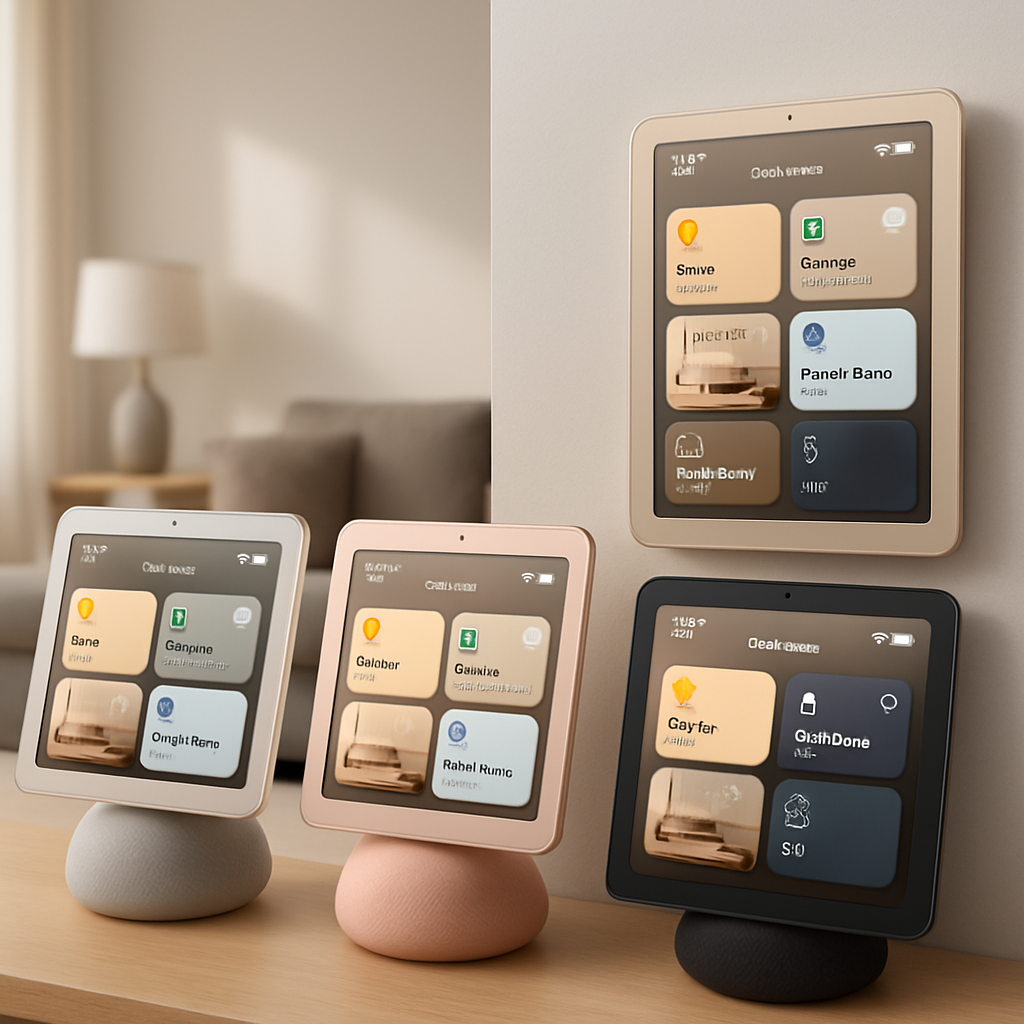
Apple today unveiled HomeView, its newly announced smart home hub, a 6-inch square dashboard device that blends AI-powered control with familiar features like FaceTime and Safari. Priced at $299, the product launches in two versions—the tabletop model with an integrated base speaker, and a wall-mounted variant—offering a pivotal shift in how Apple envisions the smart home. Shipments begin November 13 and pre-orders are open now in the US and select countries.
Two Styles, One Vision
The countertop HomeView rests on a speaker base featuring dual custom full-range drivers, a down-firing woofer, and passive radiators, aiming to deliver room-filling Spatial Audio. The wall-mounted version mirrors this acoustic focus with two full-range drivers and customized computational audio tuned for wall placement, though omitting the base or woofer design. Both models share the same screen experience and pricing, but use different mounting hardware. A wall mount from Schneider Home is sold separately, starting at about $59.95 for a USBC Power Mount; wired and AC versions cost more.
AI, Personalization & Home Integration
HomeView is powered by Siri AI running on Apple’s A18 chip. It serves as a shared device—recognizing up to six users and automatically switching between personalized home screens—while limiting sensitive content to each user’s private space. The interface leans heavily on data displays and widgets rather than full apps; there’s no App Store for downloading third-party apps. Instead, information flows from users’ own devices. When idle, the screen shifts to static displays like clocks or screensavers.
Other capabilities include FaceTime calling, messaging, Safari browsing, and smart home control via the new Apple Home Collection accessories. HomeView handles end-to-end encryption of HomeKit Secure Video, recognizing people, pets, vehicles, and more; video descriptions will summarize activity like arrivals or unfamiliar faces.
The Home Collection hardware includes a lineup of cameras, thermostats, temperature sensors, video doorbells, and a Matter-compatible lock designed alongside LG Electronics and Schneider Electric. Devices are set up via a tap in the Home app—no separate apps or accounts—and work with shared scenes and automations like “Good Morning,” adjusting temperature, tilting cameras, or unlocking doors, all orchestrated through HomeView or other Apple devices.
Pricing, Colors & Availability
HomeView is priced at $299 in the US (and similarly in Australia, Canada, India, UK, and New Zealand). Both the tabletop and wall-mounted versions carry this price. Pre-orders begin today, and the first shipments hit homes starting November 13. Choose from Silver, Space Gray, Rose Pink, and Starlight finishes. Wall-mount accessories are extra, priced between roughly $60 and $80 depending on model.
Meanwhile, the Home Collection accessories will roll out starting in December through Apple’s own stores and online, with wider availability—some pieces—in early 2027.
Apple Intelligence is central to all of this: Siri AI uses personal context drawn from users’ iPhones and supports privacy, on-device processing, and intelligibility of smart home operations. Every component in the Home Collection lineup connects with HomeView or other Apple Home hubs for full compatibility, including Thread support and continuity even if Wi-Fi fails.
Analytically, HomeView marks a major move for Apple into smart home hardware that sits between the HomePod mini and iPad but is distinct in purpose. By centering privacy, shared usage, and on-device intelligence, Apple is betting consumers will value a dedicated control surface instead of doing everything from smartphones or tablets. The real test will be whether HomeView’s limited app model and higher price point can compete with more established hubs backed by open ecosystems. If Apple nails reliability, seamless automation, and ease of setup, HomeView could become the standard for Apple-centric smart homes. — What to watch: speed of updates, compatibility, and whether the promised AI features live up to the demos.