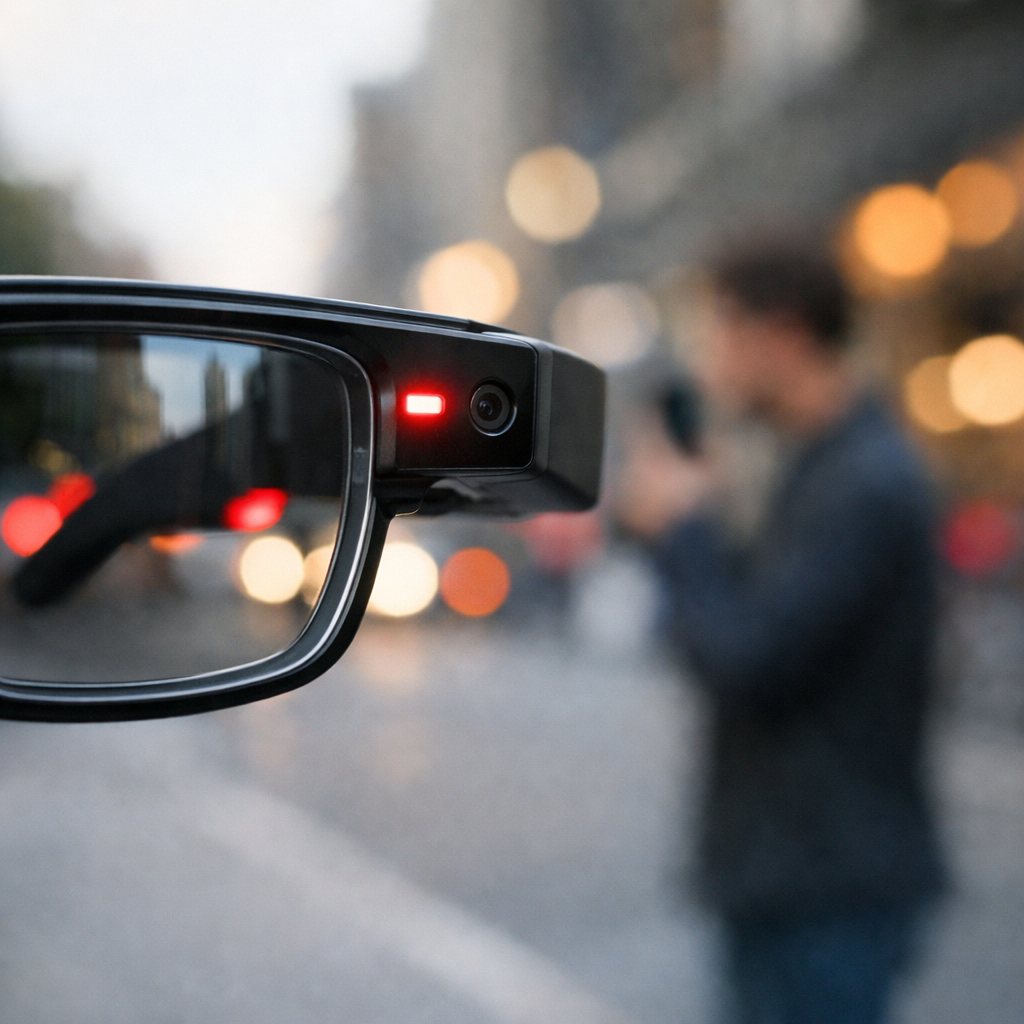
Google’s upcoming Android XR “Intelligent Eyewear,” developed alongside Warby Parker and Gentle Monster, is introducing a privacy-focused design for its camera and audio features in ways that aim to differentiate from past smart glasses missteps. With a key emphasis on transparency and control, Google hopes to rebuild trust in a field that still struggles with perceptions of surveillance.
Indicator Light and Recording Limits
Each pair of Android XR glasses includes an outward-facing “recording light” that activates only when photos or videos are being captured. The light stays off during casual use of onboard AI features—such as Gemini’s context understanding—where content is immediately deleted and never visible in chat logs or retained by Google. If the indicator light is found to be broken or disabled, the system disables the camera entirely. During charging, a quick blink of white and blue signals a system check making sure the hardware’s indicator functionality operates correctly.
Video recording via Intelligent Eyewear is capped at 90 seconds per session. While this may feel restrictive, Google says most user-captured footage falls under that duration anyway. For comparison, other devices like Meta’s glasses allow recordings up to five minutes, offering significantly more leeway but also inviting concerns about abuse.
Privacy of Others and Voice Filtering
Google goes to considerable lengths to protect people who are near users. Photos sent to Gemini are automatically processed on the user’s phone to redact faces before being uploaded—this redaction is local, not cloud-based. Likewise, voice data is filtered so only the user’s voice is captured; auxiliary voices are excluded.
A live translation feature demonstrates this filtering in action: It listens only to voices within a 60-degree cone in front of the user, ignoring peripheral or background speech. Additionally, Gemini aims to avoid activating the camera unless the user’s request clearly warrants vision—phrases such as “what painting is this” trigger photo capture, while vague requests like “how much money is on the table” first prompt confirmation.
Policy & Ecosystem Measures
Using Android XR Intelligent Eyewear requires acceptance of responsible use terms. Users must agree to not record others without permission, avoid sensitive locations, and never cover the indicator light. Violating these terms could lead to device deactivation. Google is also policing the supply chain: accessories that obscure the indicator light are banned in its shopping and advertising platforms.
App distribution through Google Play will be restricted: no social live-streaming, real-time face identification, or apps that override the behavior of the external light. And on YouTube, content violating the rules—such as recordings made without consent or in violation of privacy standards—will be taken down. The glasses can only be activated using Google accounts of adults (18+).
Collectively, these design and policy features show a view of privacy as a responsibility that encompasses both user dynamics and bystander safety. It marks a contrast to earlier smart-glass controversies surrounding hidden cameras, misleading indicator lights, and ambiguous recordings.
In short, Android XR’s approach is deliberate. User consent—whether explicit via physical actions or inferred from clear intent—forms the backbone. Robust limits, hardware checks, and transparent policies combine to create protections both visible and effective.
Why it matters: In a market where consumers and regulators are increasingly wary of surveillance, Google’s Intelligent Eyewear adapts to a climate that demands more than lip service to privacy. If these features work as promised, Android XR could reset expectations for what smart glasses should respect—not just for wearers, but for everyone in view. What remains to be tested is how these mechanisms perform in real settings, and whether Google’s assurances hold up under scrutiny.