Google has officially revealed its new laptop lineup, Googlebook, ahead of the October 2026 release. In response to growing demand for PCs that work seamlessly with Android phones, the company has crafted a family of laptops with distinct hardware, software, and AI-powered features—designed from the ground up to integrate with Android ecosystems.
What is Googlebook OS?
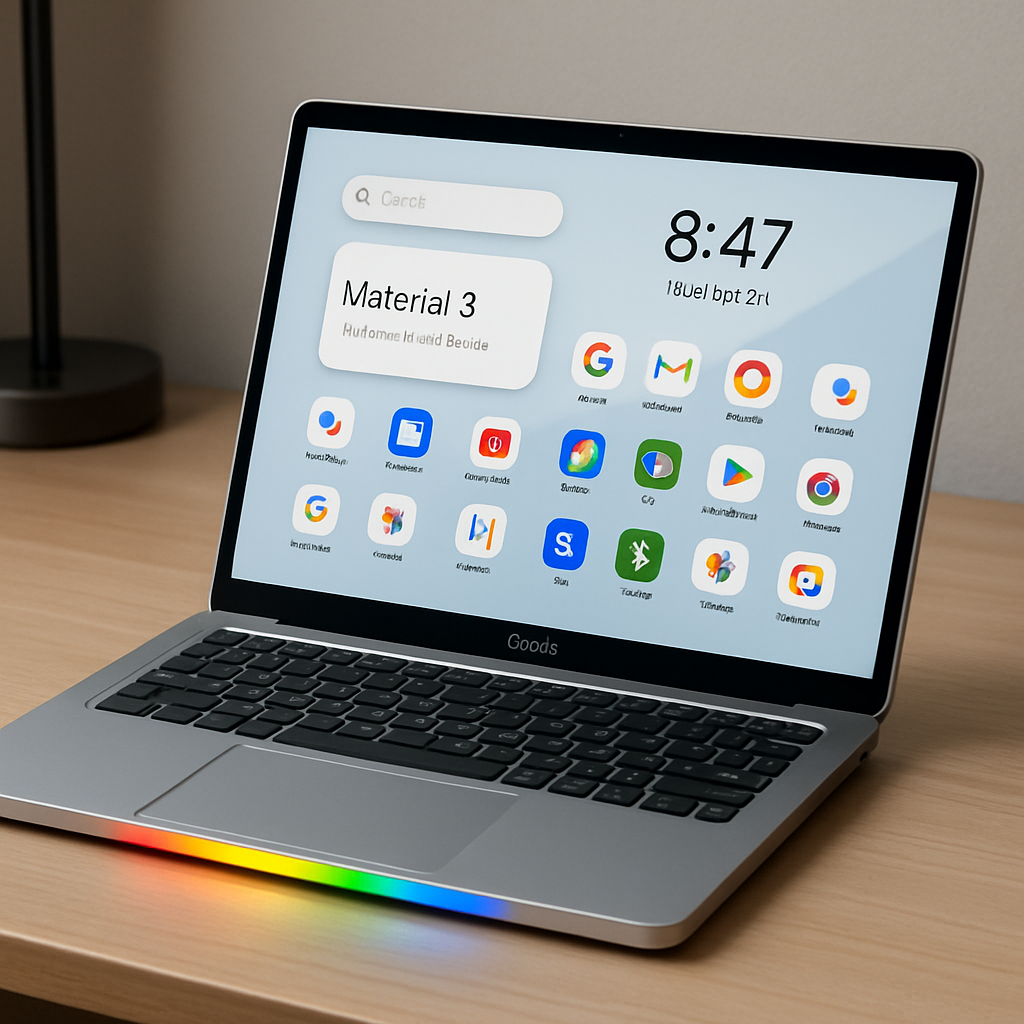
Googlebook OS is a hybrid system combining modified Android with elements of Chrome browser functionality. Its interface bears strong resemblance to Android’s Material 3 Expressive design, featuring a center-aligned bottom dock, an app drawer triggered by a “G” icon, and a top-right control panel for notifications and quick settings. The system allows users to mirror their Android phone’s Wi-Fi, saved passwords, messages, and settings automatically. A “Continue On” feature extends tasks from phone to laptop, and “Cast My Apps” enables using Android apps without installing them locally.
On-device AI plays a key role, with the Files app adding automatic descriptions to photos and documents for enhanced searchability. Additional productivity tools include “Rambler” for dictation, “Magic Pointer” and a wiggle gesture for invoking Gemini, and a “Create My Widget” function that lets users build desktop widgets via natural language. Gaming is supported too—around 20,000 mobile and PC-style titles, optimized for keyboard, mouse, and touch, are available. The Play Store will highlight apps built for desktop-class usage, and select devices ship with a year-long GeForce Now subscription.
Developers are well-served: there’s a native Linux environment powered by a certified hypervisor based on pKVM, enabling terminal access, network and port usage, and the ability to run autonomous agent workflows. Google includes developer tools like Claude Code and OpenAI’s Codex. An app called Antigravity streamlines deploying Android apps directly, while also offering tools for Linux development.
Hardware That Sets a Benchmark
Five models make up the inaugural Googlebook range, each built around either Intel Core Ultra Series 3 or Snapdragon X Elite chips with neural processing units delivering over 40 TOPS. MediaTek-powered machines are expected later. A baseline 16 GB of RAM is standard, with options for 32 GB. Displays are touchscreen, up to 2.8K resolution, in OLED or LCD panels. Slight differences emerge across models: weight ranges between 1.0–2.5 lbs, pixel density and materials (like aluminum, magnesium, carbon fiber) vary, as do chassis thicknesses.
The lineup includes:
- Acer Googlebook 14—starts at $899; 14″ 2.8K OLED; Intel Ultra 5/7; aluminum-magnesium build.
- Dell XPS Googlebook—starts at $1,199; Snapdragon X Elite; 13.4″ screen; machined aluminum casing.
- ASUS Googlebook 14—$1,299+; Intel Ultra 5/7; 14″ OLED; aluminum-magnesium chassis.
- HP Googlebook 14—$1,299+; Snapdragon X Elite; 14″ OLED; includes both fingerprint and facial authentication.
- Lenovo Googlebook 15—$1,299+; larger 15.3″ OLED display; carbon fiber with magnesium alloy; dual-auth security.
All models sport premium materials, backlit keyboards, large glass trackpads with haptic feedback, high-end sound with multiple speakers, and advanced microphones for background noise cancellation. A standout aesthetic feature across the line is the “Glowbar”—when opening or closing the lid, it lights up in Google’s signature hues. It also acts as a live indicator for charging or Gemini interactions, and third-party apps will be able to customize its behavior.
Security, Support and Pricing
Each Googlebook device features a Titan security chip, real-time malware protection, and a Level 5 security certified hypervisor to isolate critical functions. All devices receive automatic software updates over a span of 10 years, with feature drops each quarter similar to Google’s Pixel phones.
Starting at $899 for the entry-level Acer model, prices ramp up into the $1,199–$1,299 range for more premium configurations. Preorders are live through the Google Store, Best Buy, and other retailers. Buyers will receive a package of bundled services—one year of Google AI Pro, three months of YouTube Premium, Adobe Photoshop, and CapCut included.
The U.S. launch date is October 4, with availability in the UK, Ireland, France, Germany, and Australia starting October 5.
Why This Launch Matters
With Googlebook, Google is making a concerted push to unify Android and laptop experiences—competing more directly with Apple’s ecosystem advantage. The introduction of desktop-optimized Android apps, cross-device continuity features, and on-device AI tools suggests a long-term bet on AI-native laptops rather than merely adapting phones to PCs.
Consumers upgrading their tech later this year should watch whether Google books deliver smooth performance in daily tasks like multitasking, gaming, and developer workloads—especially striking is the hybrid OS approach and security measures like the hypervisor. If executed well, Googlebook could reshape expectations for what Windows and Mac alternatives look like in 2027 and beyond.