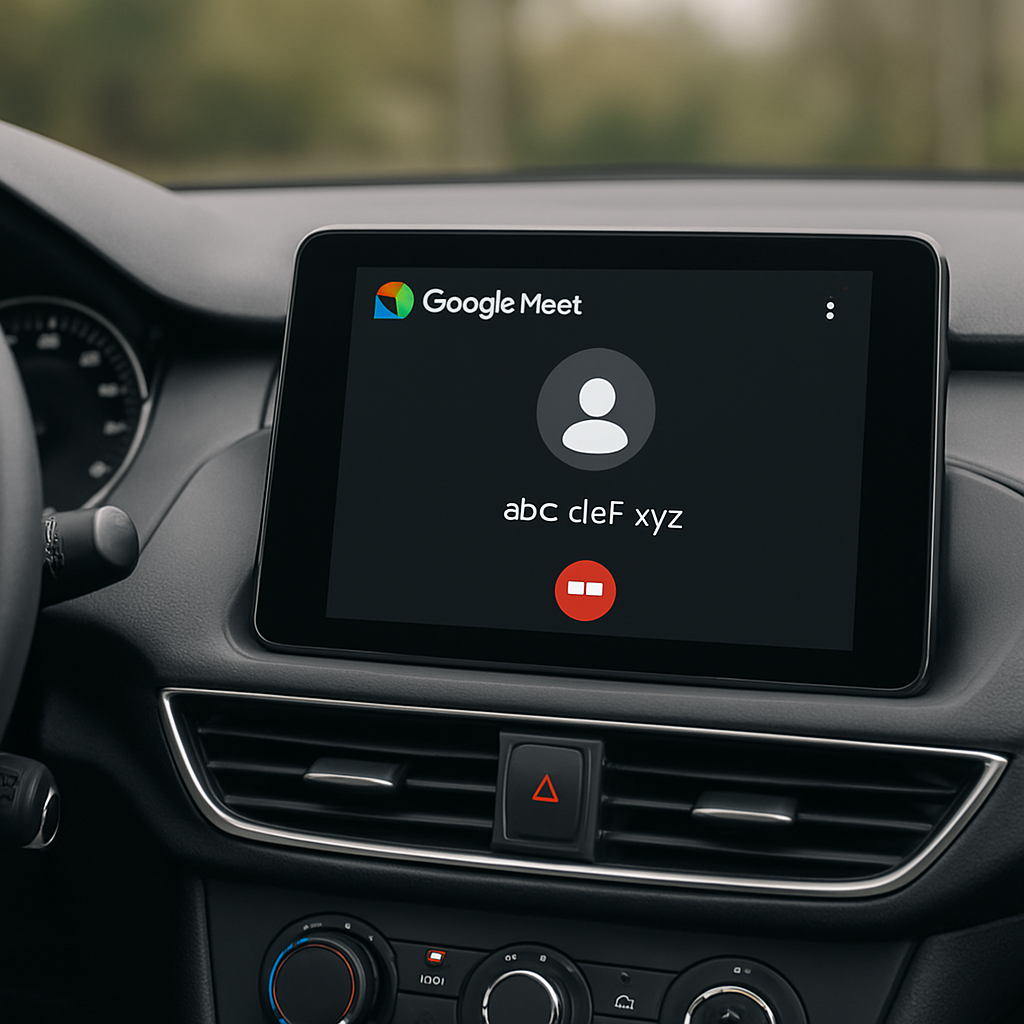
Google Meet has officially launched on Android Auto, enabling users to participate in audio-only meetings directly from their vehicle’s infotainment system. This integration allows drivers to join scheduled calls and access their meeting history through a streamlined interface designed for in-car use.
To utilize Google Meet on Android Auto, users must ensure their smartphone is connected to a compatible Android Auto head unit. Upon first use, it’s necessary to open and restart the Google Meet app on the mobile device to establish seamless integration with the vehicle’s system. Once set up, the app presents two primary tabs: ‘Scheduled’ for upcoming meetings and ‘History’ for past calls. Initiating a call is straightforward, with Android Auto managing the session similarly to a standard phone call.
For safety and to minimize distractions, the in-car interface supports audio-only participation. Video feeds are disabled, and the phone automatically switches to ‘On-the-go’ mode during calls. This mode simplifies the interface by disabling the camera and certain features, such as the ‘raise hand’ function, while still allowing users to mute/unmute, connect to Bluetooth accessories, or end the call as needed.
It’s important to note that instant meeting links are accessible solely through the ‘Scheduled’ tab, which means spontaneous meetings not added to the calendar beforehand may not appear in the interface. This design choice emphasizes the importance of planning meetings in advance to ensure accessibility via Android Auto.
To access this feature, users should update to Google Meet version 361.0.92 and Android Auto version 16.8. The rollout is expected to be completed by the end of June 2026, making the feature widely available to users with compatible systems.
The introduction of Google Meet to Android Auto signifies a significant advancement in integrating productivity tools into the driving experience. By facilitating audio-only meetings, Google aims to enhance user convenience while prioritizing safety. As remote work and virtual meetings continue to be prevalent, such integrations are likely to become increasingly valuable, offering professionals the flexibility to stay connected without compromising on-road safety.