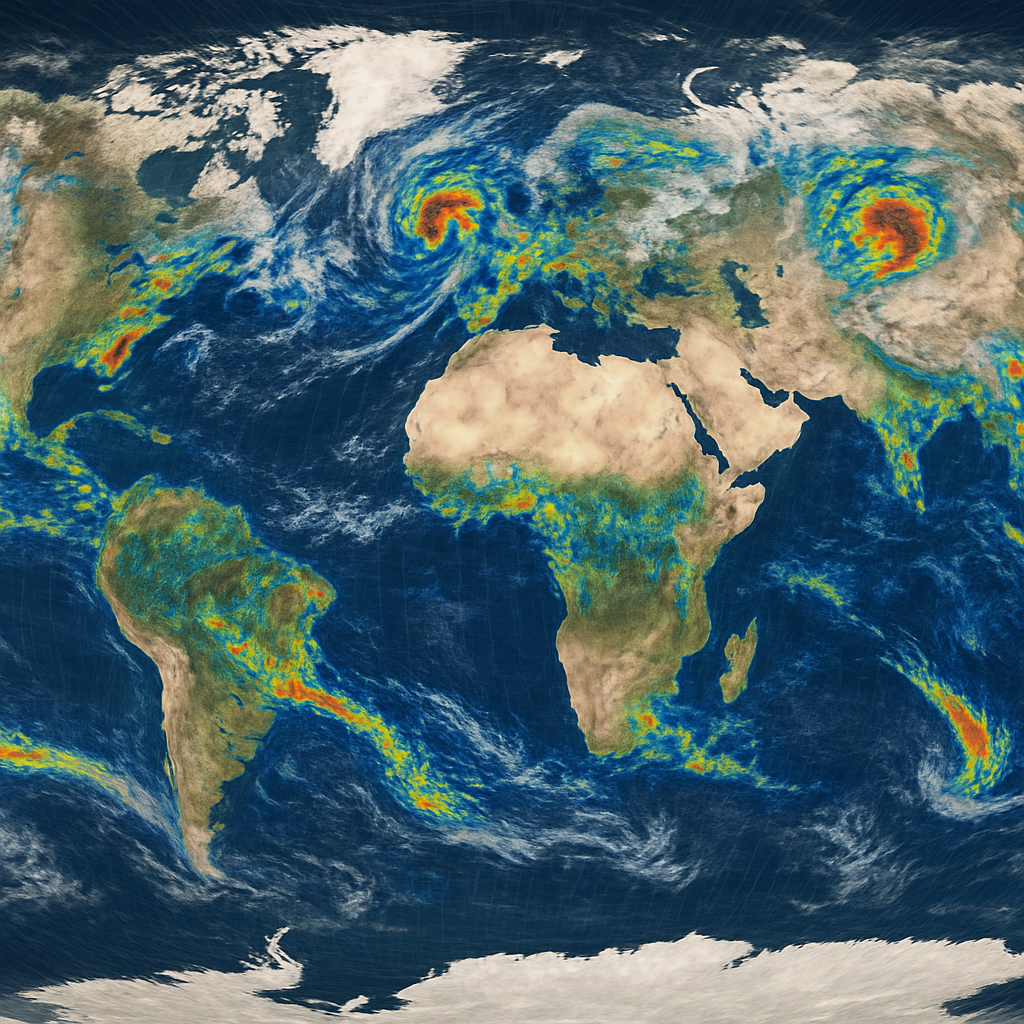
Google has introduced WeatherNext 3, its latest AI-powered weather model, built by DeepMind and Google Research, promising sharper, faster forecasts. The system is already being integrated across Google Search, Maps, Gemini, and available to users and researchers through its cloud services.
Weather forecasts traditionally depend on physics-based models running on massive supercomputers. These simulate atmospheric processes using mathematical equations, which are accurate but computationally heavy and slow. AI-based models, by contrast, learn patterns from huge volumes of weather data, offering speed and comparable accuracy. WeatherNext 3 represents a major step forward for AI-driven forecasting.
How WeatherNext 3 Outperforms the Rest
In rigorous testing, WeatherNext 3 came out ahead of models from Microsoft, Nvidia, and the European Center for Medium-Range Weather Forecasting (ECMWF), as well as traditional forecasts from ECMWF and the U.S. National Weather Service. It topped the Operational WeatherBench benchmark, which evaluates forecasts for temperature, wind speed, humidity, and other core variables.
Several upgrades distinguish WeatherNext 3 from its predecessor. Forecast resolution has been improved to about 5 kilometers, a sharp improvement over previous models covering 15–25 square km per unit. Rainfall prediction is roughly 60 percent better than with WeatherNext 2. The model also delivers hourly updates instead of forecasts every six hours, and aligns forecasts to specific weather stations, allowing stronger validation against real-world conditions.
Innovations Behind the Improvements
The enhanced capabilities stem from multiple technical changes. The model has 2.4× more parameters than its previous version. It uses tailored decoder-head targets to deliver forecasts that are more practically useful. WeatherNext 3 also pulls in raw input data—like satellite feeds and real-time observations—rather than relying solely on pre-processed datasets. This allows it to issue detailed, high-resolution global forecasts.
While WeatherNext 3 claims to be the first AI model to globally use raw observation in its higher resolution forecasts, competitors such as WeatherMesh 6—developed by startup WindBorne—have already incorporated raw environmental data from sources like weather balloons. Still, WeatherNext 3’s strength lies in its comprehensive global scale and finer resolution. It continues to rely, however, on datasets from national weather services—meaning there’s more work to be done for truly independent, direct observation–driven forecasting.
AI-based weather forecasting is already reshaping how agencies around the world operate, bringing speed and efficiency. Better forecasts can support agriculture, infrastructure, and energy sectors—especially in under-resourced regions where traditional forecasting setups are costly. For example, renewable energy projects benefit directly from more precise predictions of wind, cloud cover, and rainfall. These advancements could have immediate and long-lasting impact for users globally.
Analysis: WeatherNext 3 is more than a technical milestone—it signals Google’s move toward embedding AI in core utility services. Faster, more granular forecasts could change everything from daily weather alerts to how major industries plan operations. Challenges remain: accurate modeling depends heavily on data availability, quality, and inclusion of real-time observations. Watch how WeatherNext 3 performs in extreme weather events and in regions with sparse sensor networks—its success there may define the future of predictive meteorology.