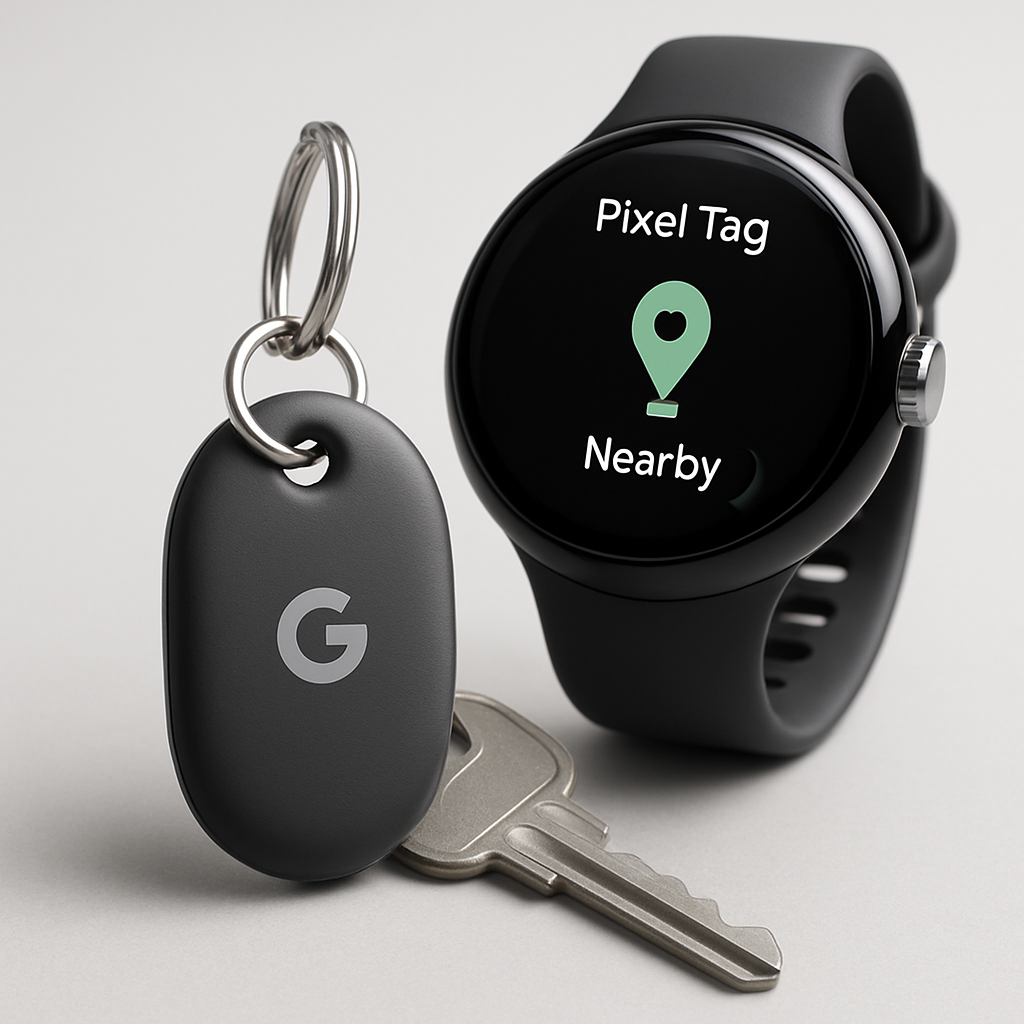
At its recent ‘Made by Google’ event, Google unveiled the Pixel Tag, a new device aimed at helping users keep track of their belongings. Priced at $29, the Pixel Tag is Google’s answer to Apple’s AirTag, offering a similar solution for locating lost items.
The Pixel Tag integrates seamlessly with Google’s Find Hub network, leveraging the vast array of Android devices worldwide to assist in locating misplaced items. Users can add the Pixel Tag to their Android Find Hub, a feature already utilized for tracking lost Android smartphones and other devices. Additionally, the Pixel Tag can be located and rung directly from a Pixel Watch, providing convenience beyond just smartphone integration.
In terms of design, the Pixel Tag distinguishes itself from the AirTag. While Apple’s device is small, round, and engravable, Google’s Pixel Tag adopts a slimmer, elongated oval shape. Measuring 1.1 inches in width and 1.8 inches in height, with a thickness of 0.2 inches, it offers a compact form factor. Weighing 0.4 ounces with the battery, it is comparable to the AirTag’s 0.39 ounces. Both devices boast an IP67 rating, ensuring resistance to splash, water, and dust, capable of withstanding submersion up to 1 meter for 30 minutes.
The Pixel Tag features connectivity via Bluetooth and Ultra Wideband for precision finding, though it lacks NFC capabilities. It includes a built-in speaker to aid in locating the device when nearby and is powered by a user-replaceable CR2032 coin cell battery, the same as used in the AirTag. This battery setup allows the Pixel Tag to function for approximately a year before requiring a replacement.
Designed to be attached to items like keychains and bags, the Pixel Tag will be available for purchase starting November 11, 2026, at $29 for a single unit and $99 for a four-pack.
With the introduction of the Pixel Tag, Google is expanding its hardware ecosystem, offering Android users a native solution for item tracking. This move not only enhances the functionality of Google’s device lineup but also intensifies competition in the item tracker market, challenging Apple’s established AirTag. Consumers now have more options tailored to their preferred platforms, potentially driving further innovation and integration in personal item tracking technologies.