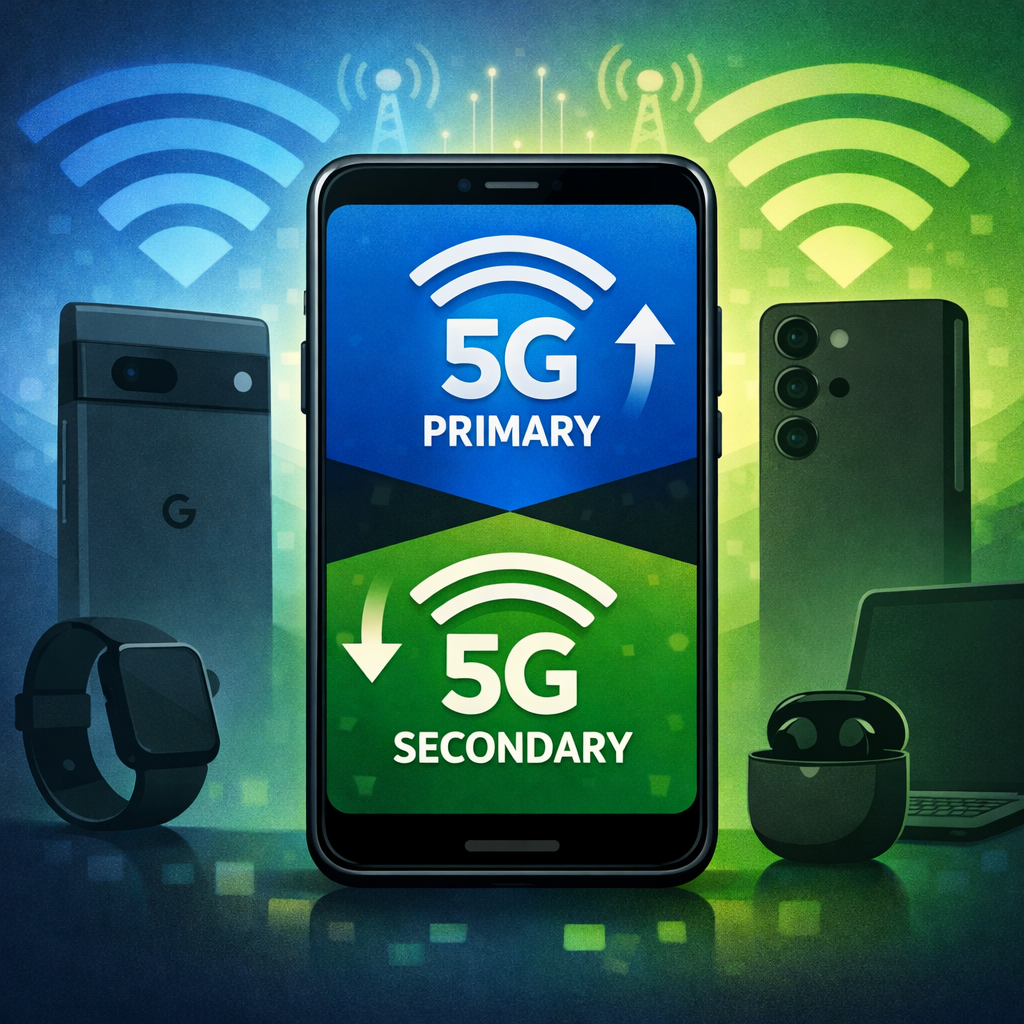
Google Fi is reactivating its network switching system through a newly added “secondary” partner, part of a broader revamp dubbed its “super network.” Traditionally, Fi offered access to multiple carrier networks, but the second partner faded out over time, leaving one dominant provider.
Today’s update brings back that dual-network setup. By default, users operate on a designated Primary network. But if performance dips—based on “smart thresholds”—Fi will switch them to its Secondary network to maintain better service. Manual switching is not yet available.
How the System Works
The identity of the new Secondary network hasn’t been disclosed, though Google confirms Ultra Wideband 5G is supported. The idea is both networks are among the fastest in the U.S. Performance hierarchy has been preserved: Fi isn’t deprioritizing data on the Primary network and boosts voice/data priority when using the Secondary, minimizing slowdowns during congestion.
This dual connectivity extends beyond national borders—for users with Flexible or Unlimited Premium plans—where Fi will partner with local networks overseas when possible.
Device Compatibility & New Features
Network switching will initially be limited to Pixel 9 and newer phones that use a Fi eSIM and have no other active SIM cards. This leverage Android’s Multiple Enabled Profiles (MEP) eSIM tech, which allows the device to maintain two carrier profiles on a single SIM chip.
Alongside switching, Fi is expanding Wi-Fi Auto Connect+ beyond its own Pixels. Samsung Galaxy models (S23, Fold/Flip 5, and newer) and select Motorola phones now qualify for automatic connection to premium Wi-Fi networks across airports, malls, and commercial venues. All connections are encrypted via Fi’s Virtual Carrier Network.
The companion Fi app is also gaining a new AI-powered help tool called Ask Fi. It handles common issues with guided troubleshooting, and when needed, passes users to human support without losing the chat context. A new “Your super network” card appears in the Home tab, showing whether you’re on the Primary or Secondary network, along with a log of when switches happen and whether you’re near a W+ network.
These updates begin rolling out today, though network switching will become available gradually. Fi is also launching special promos: new subscribers can receive $500 off upfront and $599 spread over 24 months when buying a Pixel 11 Pro with an Unlimited Premium plan, plus $10/month credits for two years. Non-Fi Pixel owners can get 50% off certain unlimited plans for 12 months. The deals expire November 18 and December 1, 2026, respectively.
Analysis: Reintroducing network switching marks a significant shift for Google Fi—it’s a return to its roots and an aggressive move to improve coverage and performance without relying on a single carrier. The expansion of premium Wi-Fi support and AI help tools also show Fi is aiming for quality-of-service differentiation. What’s next: seeing which partner network Fi is using as the backup, and whether this system holds up under real-world usage like rural or high-traffic environments.