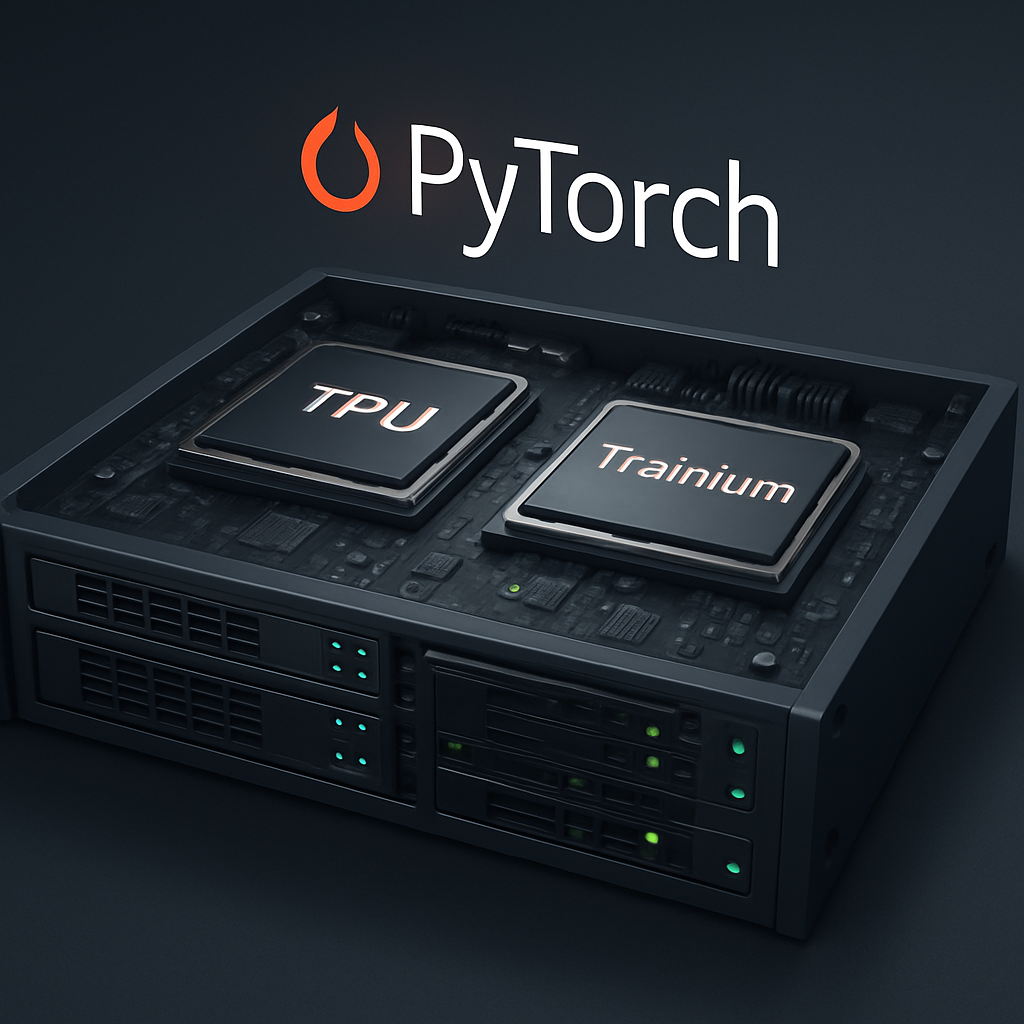
Google has stepped into the ring alongside Amazon in a strategic push to loosen Nvidia’s dominance over AI application development. The cloud giant announced today the open‐source release of TorchTPU — a version of PyTorch modified to run seamlessly on Google’s proprietary TPUs. This move enables developers to port existing PyTorch apps to Google’s hardware in the cloud with just a configuration tweak, eliminating the need for rewrite efforts.
PyTorch, a widely used open‐source framework originally built by Meta and now maintained by the Linux Foundation, powers the vast majority of AI apps in production. Its close alignment with Nvidia’s GPU architecture has, until now, solidified Nvidia’s pervasive role in AI development. TorchTPU’s compatibility brings cloud‐based alternatives into sharper view.
Amazon Fires Back with TorchNeuron
Not far behind, Amazon unveiled its own variant: TorchNeuron. With this, Amazon allows developers to shift PyTorch workloads to Trainium, its in-house chip, and to deploy via AWS without massive retooling. In parallel, Amazon is contributing upstream code aimed at decoupling certain PyTorch components from Nvidia’s GPU assumptions, giving future hardware vendors a better shot at interoperability.
Tooling, Partnerships & Developer Experience
Google’s launch isn’t just about chips; it comes backed with a suite tailored to ease the transition. The company collaborated closely with core players in the AI development ecosystem — including Meta, Hugging Face, Inferact, and RadixArk — to ensure TorchTPU’s libraries and features align with existing tools. To smooth migration headaches, it rolled out a TPU agent suite to spot and resolve compatibility issues, and improved its LiteRT tooling (used for mobile, embedded, and edge AI) to better support PyTorch models. These moves signal a real seriousness in competing with GPU-centric norms.
That said, this doesn’t guarantee an immediate shift away from Nvidia’s hardware. Decades of software, infrastructure, and developer habit entrenched around GPUs won’t reverse overnight. Still, with both Amazon and Google offering lower friction access to alternative chips, Nvidia’s traditional grip is being challenged in new ways.
What this means for the broader AI-infrastructure landscape is significant: hardware diversity is accelerating. As more development frameworks become hardware-agnostic, competition intensifies. Cloud costs, performance trade-offs, and ecosystem lock-in will come under increasing scrutiny. Stay tuned for how third-party tool makers and chip designers—like those behind custom inference & training hardware—respond.