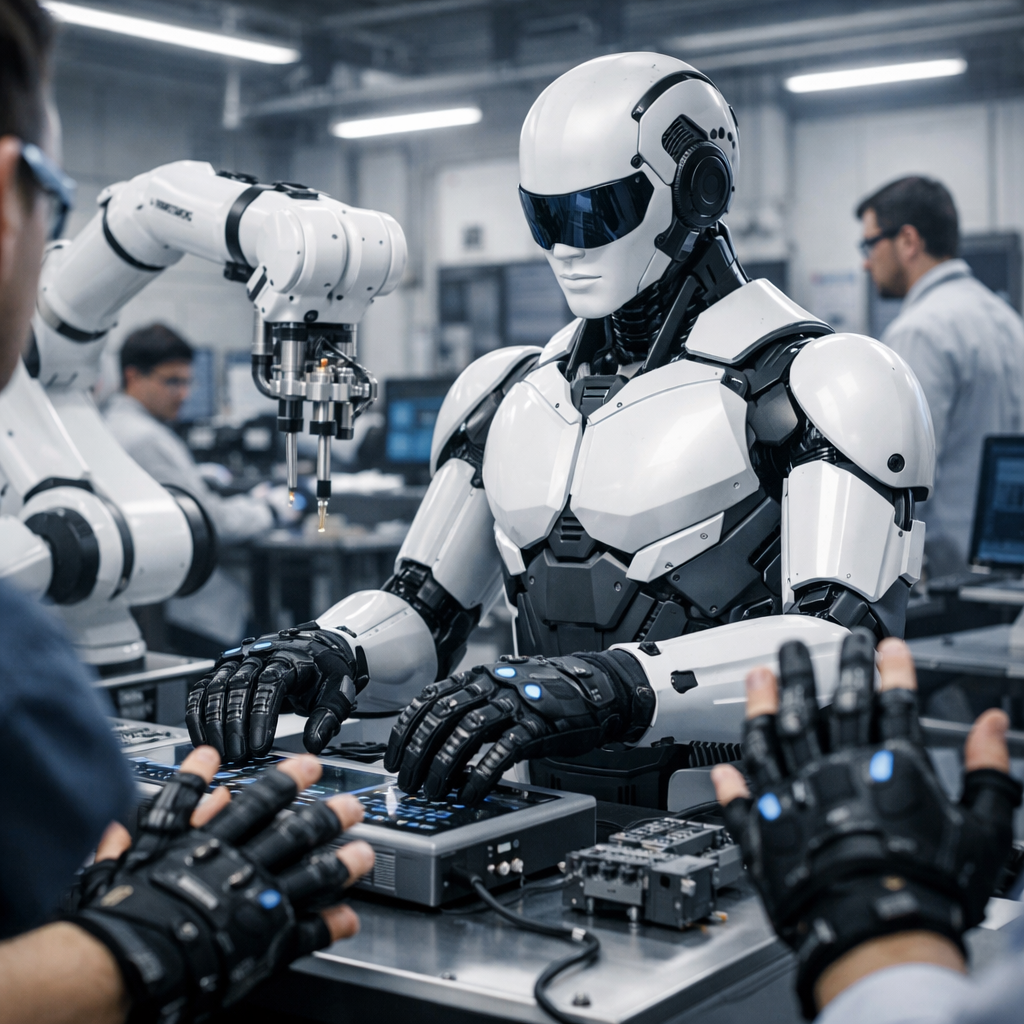
Genesis AI has secured $500 million in Series A funding to advance its development of humanoid robots equipped with dexterous manipulation capabilities. The round, co-led by Khosla Ventures, Premji Invest, and Eclipse, will help the company refine both its hardware and software infrastructure as it seeks to commercialize robots that mimic human hand functions. The Series A follows a $105 million seed round raised in mid-2025.
How Genesis AI Builds Dexterity
The startup, founded in 2024 by Zhou Xian and Théophile Gervet—who crossed paths during their graduate studies at Carnegie Mellon—takes a vertically integrated approach. It develops its own training data, generative AI model, and mechanical designs in tandem. A key differentiator is its focus on hands: the company uses sensor-equipped gloves and headset cameras on over 100 workers globally to collect force and motion data. Robots themselves wear identical gloves, and their hands are modeled to match human proportions to enable tasks like wire manipulation and complex sorting.
Genesis AI also leans heavily on simulation. It employs a physics algorithm developed by one of its advisors to generate vast numbers of detailed, realistic robot experiences. These simulations are meant to complement physical training data and improve the model’s reliability across edge cases.
Building — and Delivering — Its Robots
Genesis built 30-40 pre-production units of its flagship humanoid robot, Eno, though it hasn’t disclosed production targets yet. The design for mass manufacture is finalized, and a U.S. contractor has been selected to begin production next year. Eno is currently deployed in pilot programs with select customers, though not all capabilities have been made public or demonstrated.
The company recognizes its hardware remains a bottleneck. Particularly, the robot hands—while capable—only last a few weeks under regular work before they require replacement. Supply chain constraints for industrial grade components also pose challenges. There’s no expectation for a major scientific breakthrough; instead, Genesis insists what it needs now is execution: high-quality data, strong infrastructure, and reliable hardware. According to leadership, model architecture contributes maybe 10% to the end result, while data and data infrastructure make up the bulk.
During a demo at the Genesis facility in Silicon Valley, the physical AI model ran a workflow that included picking up small packages, scanning, packing, closing, taping, and labelling boxes—workflows that today’s robots typically can’t do end-to-end. In that setting, a misstep occurred (a sticky label wasn’t peeled precisely)—a minor glitch, but one that the team views as useful “hiccup data” to feed back into the system.
With this injection of capital, Genesis AI aims to tackle the gap between lab demos and reliable, real-world automation. It is pushing to scale both robot production and the underlying AI so that its humanoid systems can operate dependably in industrial settings.
Analysis: Genesis AI is stepping into a crowded field of humanoid robotics with a clear bet: mastery of dexterity will be the gatekeeper for practical utility. By using human workers to generate data through sensor gloves and by designing robotic hands that mimic ours, it addresses one of the most stubborn problems in robotics—the gap between manipulation in simulations or controlled environments and handling real, messy objects in the wild. The true test will be whether the hardware can keep up: durability, component quality, and supply chain resilience will all be under scrutiny. If they pull it off, Genesis could push humanoid robots toward broad adoption in warehouses, labs, or service settings.