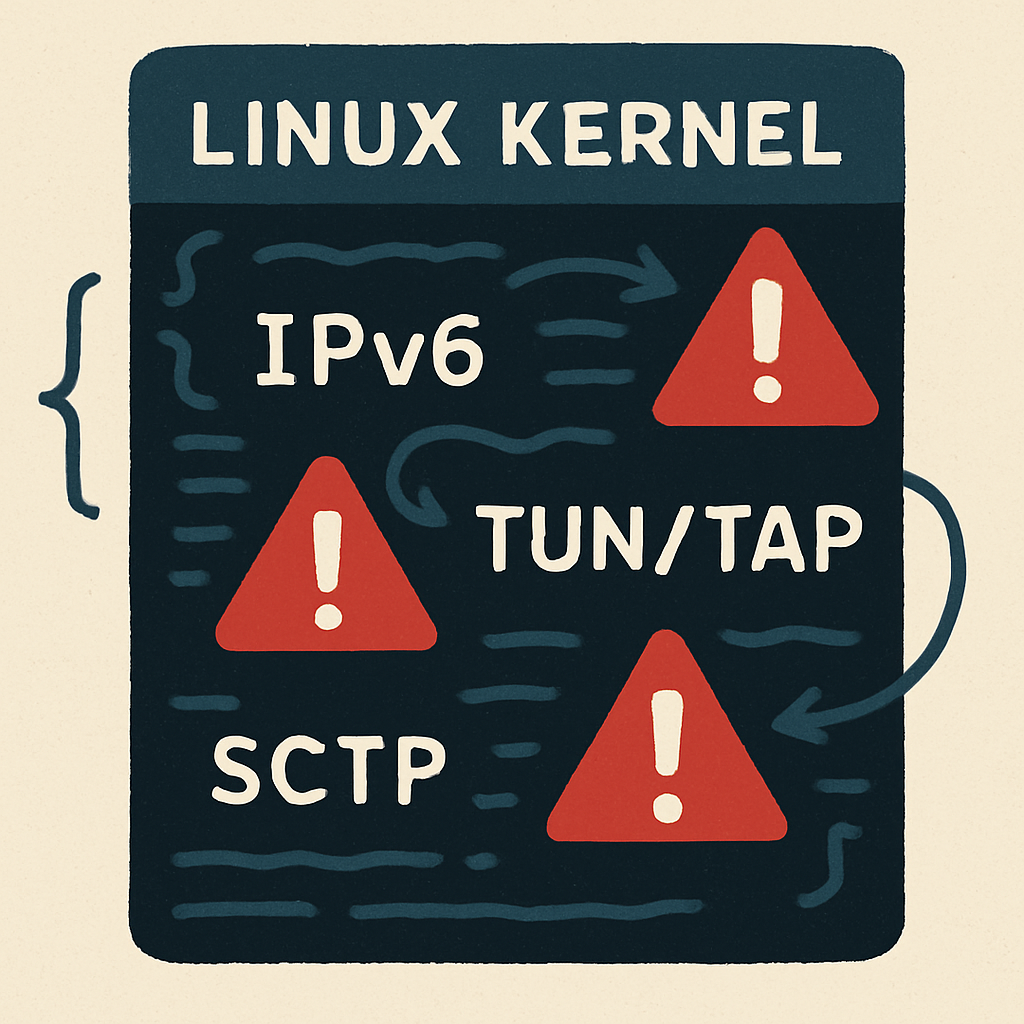
Your Linux systems are at risk: four newly identified kernel vulnerabilities can let attackers escalate to root privileges by exploiting defects in core networking features. The flaws—DirtyAH6, TUNderflow, PPPoEject, and DiagSpill—were disclosed recently, with fixes now available upstream. Upgrading is strongly advised.
The Four Vulnerabilities Explained
DirtyAH6 (CVE-2026-80844) impacts IPv6 Authentication Header processing in the Linux IPsec/XFRM stack. It arises when malformed IPv6 routing-header fields bypass proper validation of the segments_left field. This misstep can lead to pointers working beyond their intended memory bounds, causing out-of-bounds memory operations. Local attackers who control network namespaces are most at risk; in special router or gateway configurations that enable AH in transport mode, a remote denial-of-service attack might also be triggered. An actual remote root exploit was demonstrated under controlled lab conditions, though replicating that in the wild remains unlikely.
TUNderflow (CVE-2026-81000) resides in the TUN/TAP virtual network device subsystem. It occurs when oversized receive-headroom values are assigned in certain network device setups, such as those using Open vSwitch. This triggers an integer underflow during socket buffer allocations, allowing packet data to leak outside its intended memory area—opening both read and write safety issues.
PPPoEject (CVE-2026-68121) is a use-after-free flaw in the PPP over Ethernet implementation. It happens in the pppoe_sendmsg() function, which retains a pointer to a PPPoE header and then calls into lower-level device header routines. Those routines may reallocate the socket buffer, invalidating the old pointer. Subsequent use of this stale pointer can corrupt kernel memory. Patches now reload and reset the header pointer after device-header creation to prevent this error.
DiagSpill (CVE-2026-74469) affects diagnostics via sock_diag and SCTP reporting. One edge case: an SCTP association may contain up to 65,536 peer transports, but the counter tracking them is only 16 bits—when it wraps to zero, it causes under-allocation of buffer space for peer data. This leads to buffer overflows during Netlink message handling. Unlike the other three, DiagSpill doesn’t require unprivileged user namespaces or special privileges to exploit, assuming SCTP and its diagnostic interfaces are enabled. Default settings usually disable some of the risky features, but the underlying vulnerability remains.
Patches, Version Fixes & Mitigation
The vulnerabilities were all reported in mid-July and fixed in a coordinated disclosure by the Linux kernel security team. The first kernel versions including all four patches are: 5.10.270, 5.15.221, 6.1.188, 6.6.157, 6.12.109, 6.18.50, and 7.2.4. Administrators should upgrade to at least one of these stable releases immediately.
Where immediate upgrading isn’t feasible, mitigation steps include disabling or restricting unprivileged user namespaces, and turning off unused features like AH6, TUN/TAP, PPPoE, SCTP, or sctp_diag. Note, though, turning off user namespaces does not defend against DiagSpill, so that patch is essential.
Root‐level privilege escalation in the Linux kernel represents a significant threat because it undermines the foundational security model of operating systems. These flaws are more dangerous than many common bugs, since they allow full system compromise under certain conditions—and a determined attacker could leverage them with tools like memory grooming or crafting malformed network traffic.
Monitoring kernel lists for updates, deploying patches swiftly, and auditing which networking and diagnostic options are enabled are crucial defensive moves. Keep an eye especially on routers, gateways, and servers running IPv6, SCTP, PPPoE, or virtual networking stacks.