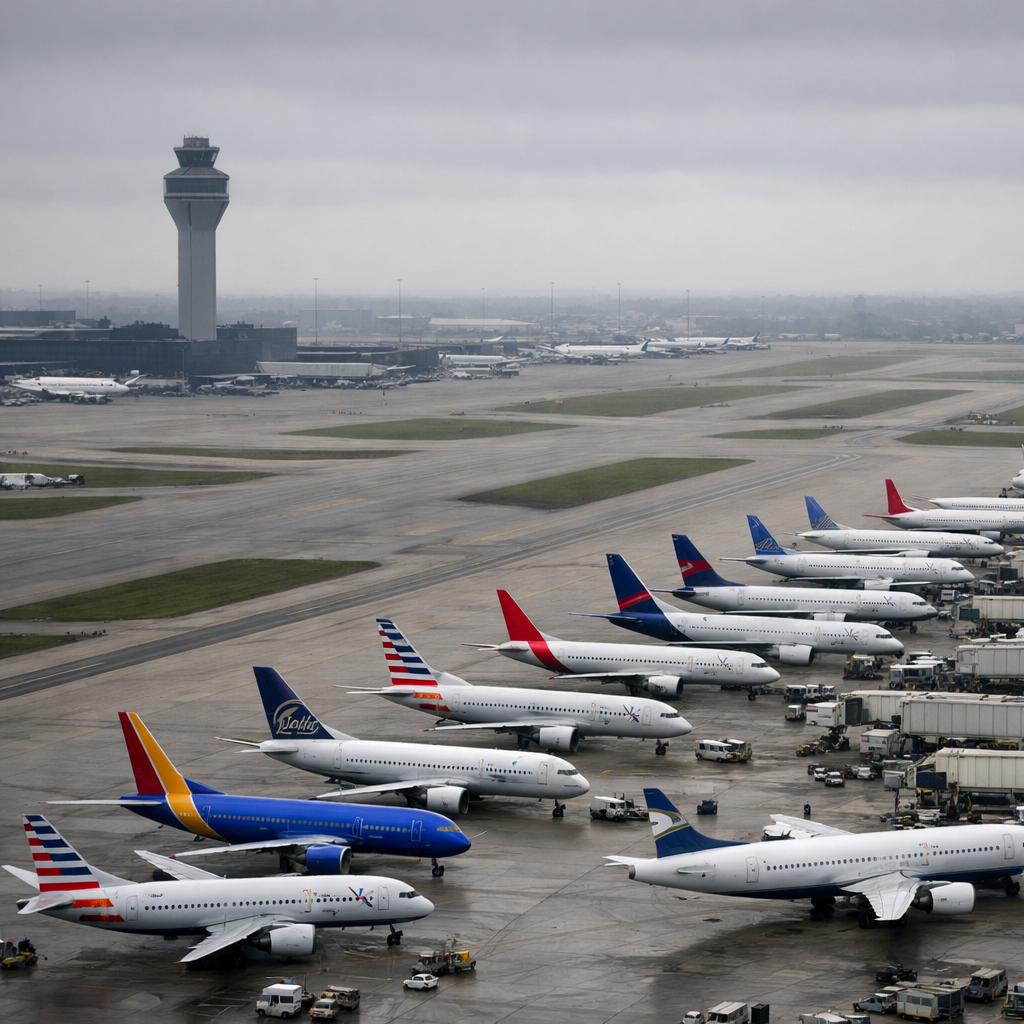
On the afternoon of November 13, 2026, the Federal Aviation Administration (FAA) instituted a nationwide ground stop, halting all flight departures across the United States. The FAA cited “extraordinary circumstances” and safety concerns as the reasons behind the decision. Incoming international flights will be handled individually. Airlines were instructed that no new departures should leave their gates until further notice.
What’s Causing the Disruption?
An FAA advisory attributed the halt in operations to an equipment failure alongside communication breakdowns impacting multiple Air Route Traffic Control Centers (ARTCCs), the entities responsible for managing airspace between airports. While the government’s public-facing website experienced technical difficulties during the outage, FAA engineers are investigating the root causes.
Transport Secretary Sean Duffy confirmed the disruptions are under review by FAA technicians, but provided no firm estimates for resolution. Notably, earlier this week an AI-powered tool intended to help air traffic controllers with fuel and flight-time efficiencies was introduced — though there is no indication this system’s rollout is connected to the current outage.
When Was the Last Time?
This national ground stop marks one of the rare times all U.S. flight departures have been suspended. A similar incident occurred in January 2023, triggered by a massive outage in one of the FAA’s core computer systems. Prior to that, a nationwide ground stop as sweeping had not been seen since the aftermath of September 11, 2001.
Under FAA traffic management rules, a ground stop is among the most restrictive tools available for maintaining air traffic safety. Such measures override all other traffic initiatives, requiring aircraft to stay grounded and forbidding departures during the stop. Equipment-specific failures are among the recognized triggers for these actions.
Schedules are in disarray, and there is widespread uncertainty for travelers. Major airports including Chicago O’Hare and Midway had already enacted localized ground stops due to equipment outages earlier in the day. These seemingly localized failures escalated into a broader national disruption.
As of now, the FAA has not provided a return-to-service timeline. Passengers are being directed to check directly with their airlines for the latest updates.
What this event underlines is the fragility of air travel’s backbone—communications and control infrastructure. With increasing reliance on interconnected systems, one equipment failure in a core network translates quickly into country-wide disruption. What to watch now: the FAA’s findings will likely prompt calls for infrastructure audits, redundancy improvements, or regulatory changes. The speed of recovery—and the transparency around causes—will set the tone for public trust in aviation safety going forward.