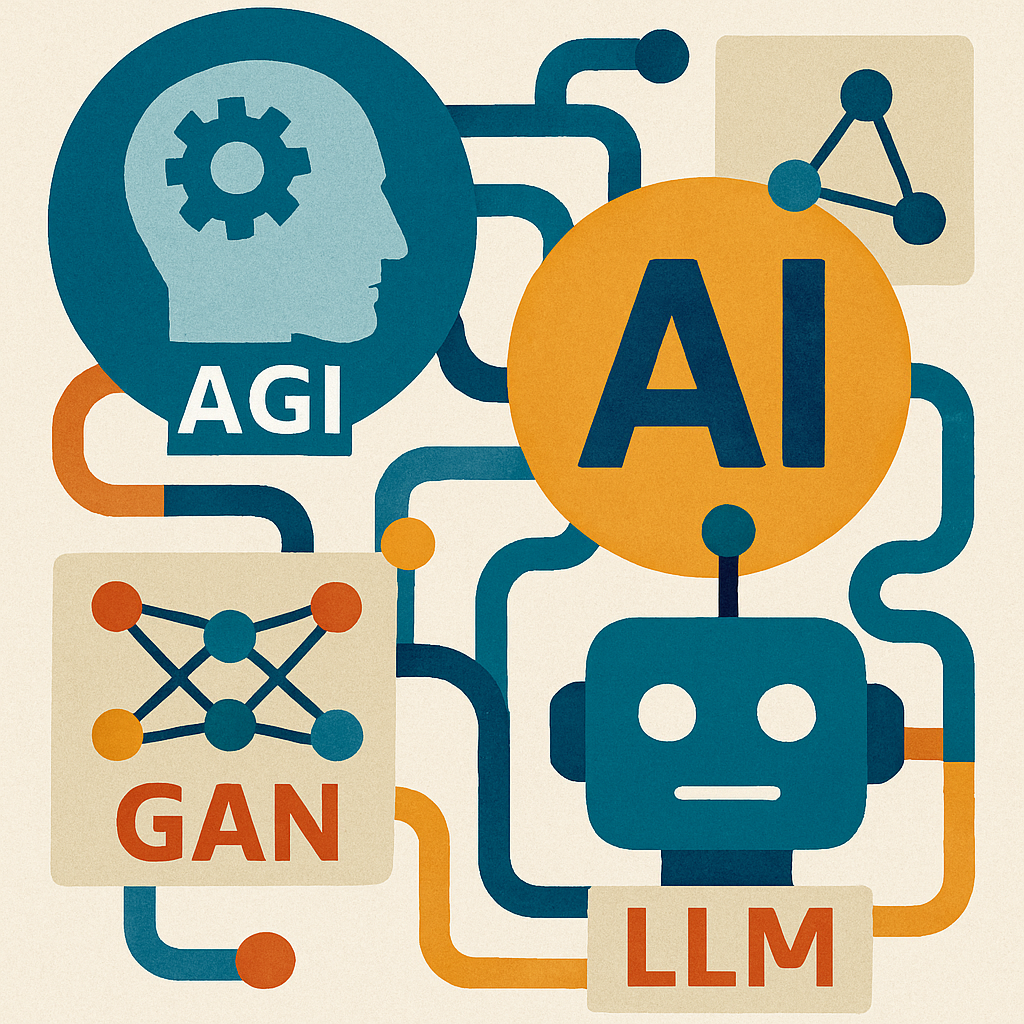
Artificial intelligence (AI) is rapidly transforming various sectors, introducing a plethora of specialized terms that can be overwhelming. To help navigate this evolving landscape, we’ve compiled a glossary of key AI concepts, providing clear explanations to enhance understanding.
Artificial General Intelligence (AGI)
AGI refers to AI systems with the capacity to perform a wide range of tasks at or above human proficiency. Unlike narrow AI, which is designed for specific functions, AGI aims to replicate the versatility and adaptability of human intelligence across diverse activities.
AI Agent
An AI agent is a system that autonomously performs tasks on behalf of users, extending beyond simple chatbot interactions. These agents can handle complex, multi-step processes such as managing schedules, booking services, or even writing and maintaining code, often by integrating multiple AI technologies.
API Endpoints
API endpoints are specific channels through which software applications communicate and interact with each other. They allow developers to build integrations, enabling one application to access or control features of another. In the context of AI, agents utilize these endpoints to automate tasks across various platforms without direct human intervention.
Chain of Thought
This concept involves AI models processing information through a series of logical steps, akin to human reasoning. For example, solving a math problem may require breaking it down into intermediate steps, allowing the AI to arrive at the correct solution systematically.
GAN (Generative Adversarial Network)
GANs are a class of machine learning frameworks consisting of two neural networks: a generator and a discriminator. The generator creates data samples, while the discriminator evaluates them against real data. This adversarial process enhances the generator’s ability to produce highly realistic outputs, such as images or videos, without human intervention.
Hallucination
In AI, hallucination refers to instances where models generate incorrect or nonsensical information. This issue arises due to gaps in training data and poses significant challenges, especially when AI outputs are used in critical applications like healthcare. To mitigate hallucinations, there’s a trend toward developing specialized AI models tailored to specific domains, reducing the risk of misinformation.
Inference
Inference is the process by which an AI model applies learned patterns from training data to make predictions or decisions. This operation can be performed on various hardware platforms, from smartphones to specialized AI accelerators. The efficiency and speed of inference depend on the model’s complexity and the computational resources available.
Large Language Model (LLM)
LLMs are extensive neural networks trained on vast text datasets to understand and generate human-like language. They power AI assistants by processing user inputs and generating contextually relevant responses. LLMs learn the relationships between words and phrases, enabling them to produce coherent and contextually appropriate text.
Understanding these terms is crucial as AI continues to integrate into various aspects of daily life and industry. Familiarity with this vocabulary empowers individuals to engage more effectively with AI technologies and appreciate their capabilities and limitations.