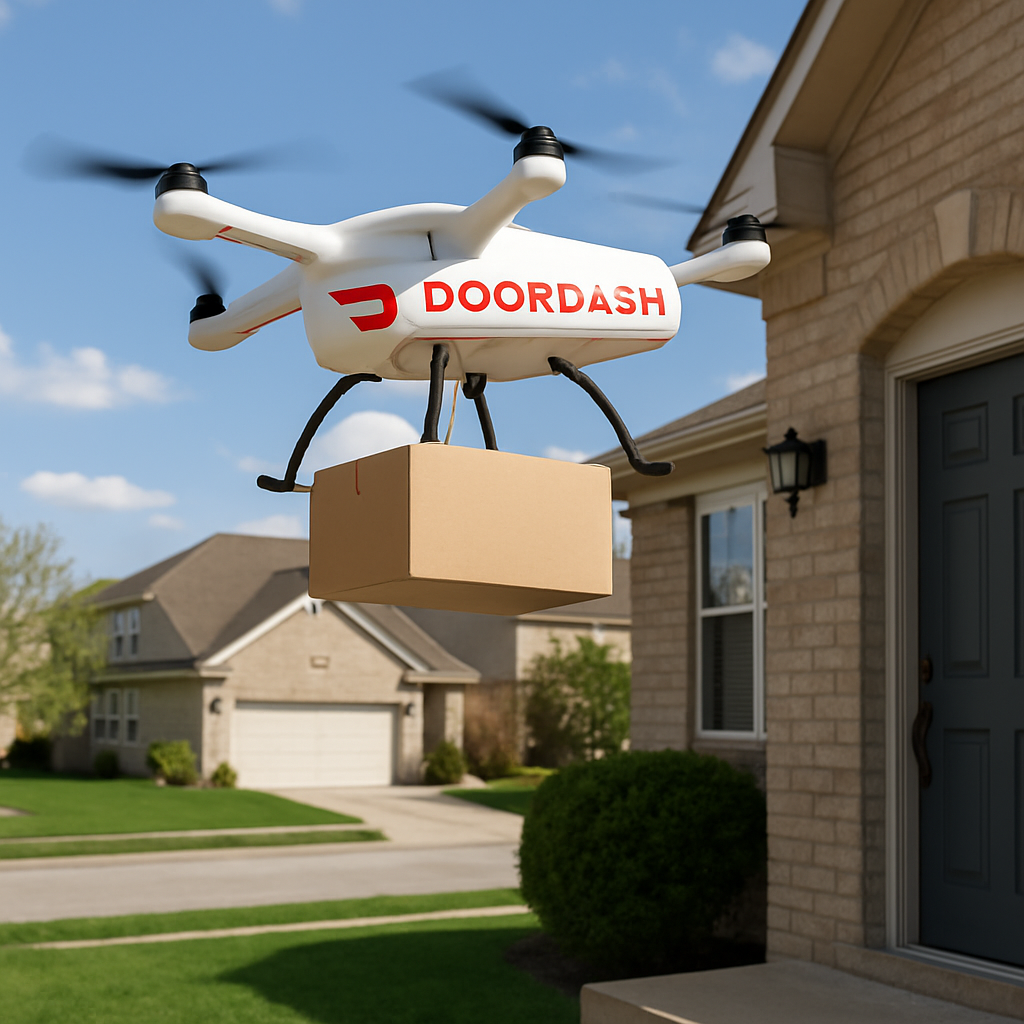
DoorDash has unveiled its proprietary drone delivery initiative, DoorDash Air, following the acquisition of Part 135 air carrier certification from the U.S. Federal Aviation Administration (FAA). This certification authorizes the company to operate commercial drone delivery services within the United States.
While specific timelines for the deployment of DoorDash’s custom-built drones remain undisclosed, initial operations are expected to commence with pilot programs featuring short-distance flights within the operator’s line of sight. To achieve autonomous, long-range deliveries, DoorDash will need to secure FAA approval for Beyond Visual Line of Sight (BVLOS) operations, a certification already obtained by companies such as Amazon, Wing, and Zipline.
Despite launching DoorDash Air, the company intends to maintain its existing collaborations with drone delivery firms Wing and Flytrex. DoorDash partnered with Alphabet’s Wing in 2022 for a drone delivery program in Australia, later expanding the partnership to U.S. cities, including Dallas-Fort Worth, in 2024. Additionally, DoorDash and Flytrex launched a drone delivery service in the Dallas-Fort Worth metroplex in June 2025, offering deliveries from local and national restaurants to over 30,000 households.
DoorDash Air was developed within DoorDash Labs, the company’s research and development division responsible for innovations like Dot, the autonomous sidewalk delivery robot introduced in September 2025. Dot is currently operational in Phoenix suburbs such as Tempe, Mesa, Gilbert, and Chandler, as well as in Fremont, California.
According to DoorDash’s co-founder and chief product officer, Stanley Tang, the company’s focus is on addressing customer needs rather than pursuing technology for its own sake. He emphasized that drones and sidewalk robots are integral components of a broader delivery network aimed at enhancing efficiency and customer satisfaction.
To manage the complexities of integrating various delivery modes, DoorDash Labs has developed the Autonomous Delivery Platform. This software system coordinates deliveries across human drivers, drones, and sidewalk robots, determining the most efficient method for each order in real-time.
By investing in autonomous delivery technologies, DoorDash aims to optimize its logistics network, reduce delivery times, and offer customers more flexible and efficient service options. The success of DoorDash Air will depend on the company’s ability to navigate regulatory challenges, technological advancements, and consumer acceptance of drone deliveries.