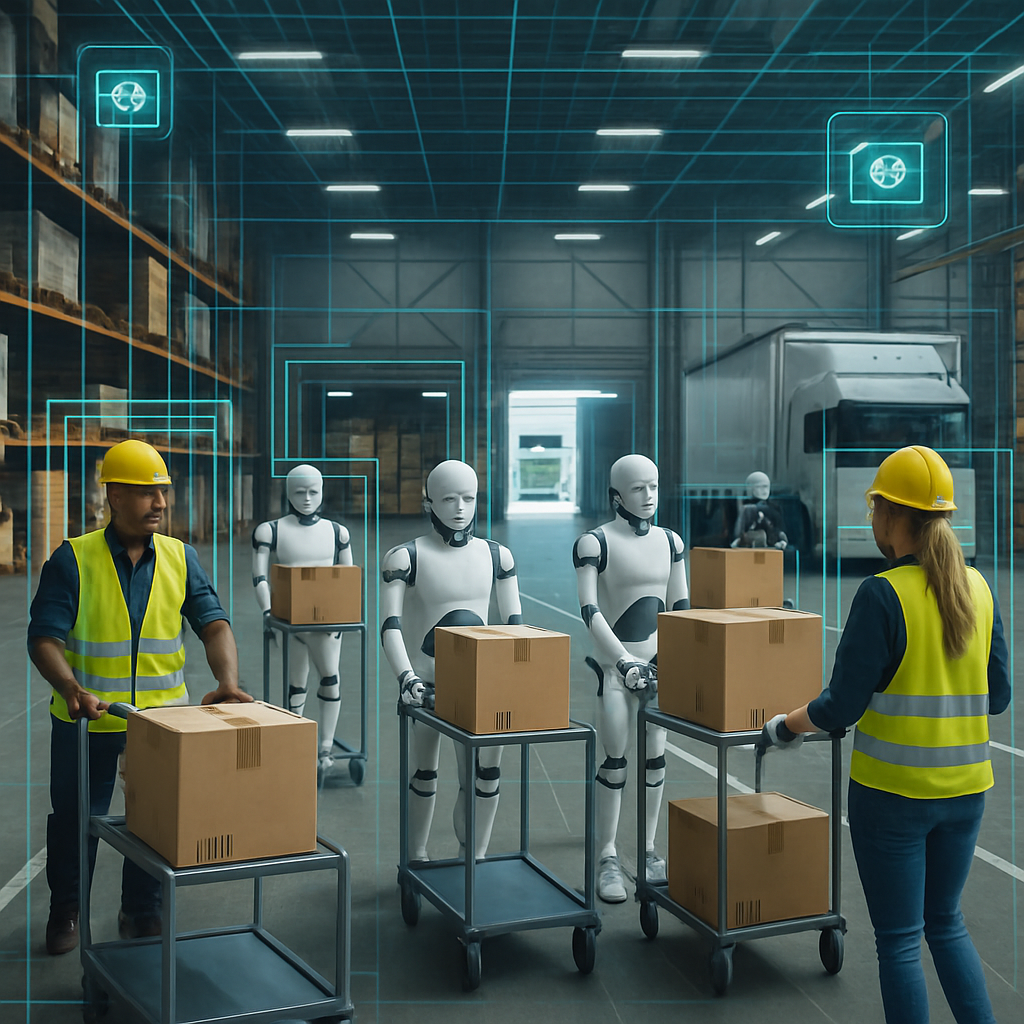
Destro AI is pulling off something different in the robotics world. Rather than designing new robot hardware or reinventing how robot hands work, the startup has built an AI intelligence layer—what it calls a robotics orchestration platform—that bridges human workers and robots in logistics environments. Backed by an $8 million seed round, Destro emerged from stealth as a non-robotics robotics company, focused instead on making existing robots actually solve real warehouse problems.
A new layer where AI teaches machines workflow
At its core, Destro offers two operating systems. One, Vision, uses vision-language-action models that allow robots to interpret camera inputs and instructions to navigate complex visual scenes. The other, dubbed Mothership, sits on top of Vision and handles orchestration—telling robots what to do, when, and how, integrating them with humans and other parts of the supply chain.
This setup was piloted at a Yusen Logistics cross-dock facility in the Pacific Northwest with three robots provided by Miva Robotics. In these cross-docking workflows, goods are unloaded from one truck, sorted, and reloaded into other trucks for final delivery. Destro directs both the human and robot actors—workers, carts, unloading, loading—all coordinated via Mothership, while the robots operate guided by Vision.
Why Destro is winning where robot makers aren’t
Many robotics startups chase flashy form factors or ultra-dexterous hardware. Destro argues those are solving the wrong problems first. Customers like Yusen have encountered solutions that handled specific tasks—cart movement, fleet software, or robot bodies—but no system that tied together robot autonomy with human workflow in a way that fully matches operational needs. Destro won in Yusen’s tests by tackling the full stack—from vision to action to orchestration.
Building product in close collaboration with firms like Yusen has also shaped what Destro delivers. Yusen’s director of automation helped push the startup to adapt its solution for cross-docking, a major pain point in logistics. Seeing the startup change gear to support that worked in their favor.
Destro is scaling fast. The initial pilot in Oregon or Washington is expanding into a full deployment of 26 robots. Simultaneously, another pilot of 17 robots is underway at Yusen’s Southern California facility. The plan is to replicate this cross-dock approach across many warehouses in the country.
Challenges remain. Tasks requiring dexterity—handling oddly-shaped items, gripping, manipulation—are still difficult with generic robot bodies and current open source models. Some companies building foundation models or humanoid robots are directly targeting those spaces. Whether Destro can lean on research advances or whether it will be pushed to build its own robot hardware remains an open question.
Destro’s founder, a veteran of robotics and supply chain, believes that the orchestration layer—the “harness” around model, hardware, and automation—is where most value will accrue. Research and investment are flowing into foundation models, sensors, and robot components, and Destro’s bet is that its system architecture will ride that wave rather than try to replace it.
Why this matters:Logistics — cross-docking, order fulfillment, sorting — are among the most labor-intensive operations in commerce right now. Machines that improve consistency and throughput without forcing companies to rebuild entire workflows are especially valuable. As robotics hardware improves, orchestration platforms like Destro may become the glue enabling real automation at scale. The real test will be translating pilots into reliable, low-cost deployments in multiple geographies, and proving the AI layers are robust to edge cases in messy warehouse environments.