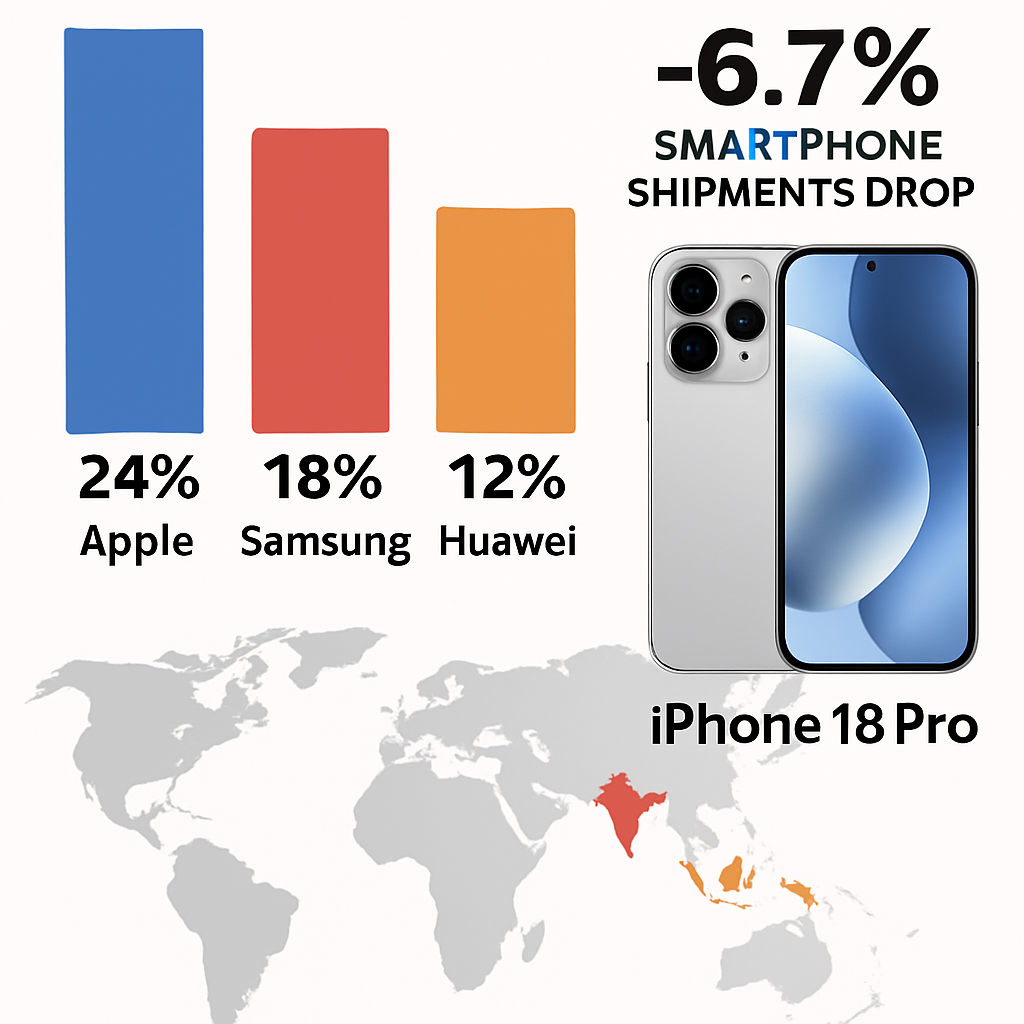
Worldwide smartphone shipments dropped sharply in the third quarter of 2026 — down about 20% compared to last year — but Apple managed to expand its presence during the downturn. Preliminary analysis shows Apple captured a record 22% share of global handset shipments in Q3, edging close to Samsung, which remains slightly ahead with 23%. The industry saw total shipment volumes fall to their lowest levels since around 2012.
Fewer Units, Bigger Slice
Even as its smartphone volumes slid, Apple bucked more significant declines suffered by many rivals by increasing its relative stake in the global market. Market‐watchers highlight that the decline in Apple’s shipments was less severe than for most others — helped by the strong early performance of its premium models. The launch schedule played a role too: the company held back a standard iPhone 18 model this September, focusing on the iPhone 18 Pro lineup, which reduced total device flow into retail channels.
The iPhone 18 Pro series got off to a better start compared to last year’s Pro models, especially in China and India — two of the world’s biggest and most competitive markets. Meanwhile, the iPhone 17 continued to pull its weight in terms of shipments. In China specifically, Apple’s shipment drop was only around 4.3%, far outperforming the country’s overall market contraction of over 15%. Still, Apple trailed Huawei in China with a 17.8% share versus Huawei’s 21%.
Why Premium Holds Up Better
One major trend in Q3 was the rising resilience of premium devices compared to lower‐end phones. Manufacturers have contended with higher component costs — notably memory chips — which pushed up production expenses. Retail prices of smartphones globally have gone up roughly 20% year‐to‐date, but buyers of high-end phones, particularly from brands like Apple, have shown more willingness to absorb the increase.
In markets hit hardest by economic pressures and price sensitivity, budget and mid-range phones saw steeper drops in demand. Apple, however, benefited by leaning into its best-selling Pro models and sustaining lift from last year’s iPhone 17, even without releasing a standard iPhone 18 model in September. This strategy helped limit its shipment decline while others saw much steeper drops.
In China, where the broader smartphone market has faced six consecutive quarters of yearly decline — totaling approximately 57.9 million units shipped in Q3 — Apple’s relatively modest drop and strong performance of its new models underlined its competitive standing. The smaller number of new variants released also meant less saturation pressure compared to some rivals.
All told, the data illustrates how Apple is managing to increase its footprint even as the smartphone industry shrinks. By leaning into premium lines, focusing on fewer but well-performing models, and maintaining strong demand in key regions like China and India, Apple gained ground without increasing its overall shipment volume.
This matters because the smartphone market appears to be undergoing a structural reset. Component shortages, rising input costs, and higher retail prices are forcing both manufacturers and consumers to rethink the trade-off between features, cost, and frequency of upgrade. Apple’s ability to grow market share in this environment suggests that demand for premium experiences may be more durable than many expect. What to watch for next: whether Apple can do the same when the standard model of its next lineup returns, and how rivals adapt pricing or product strategies to stem steep declines in the mid- and budget segments.