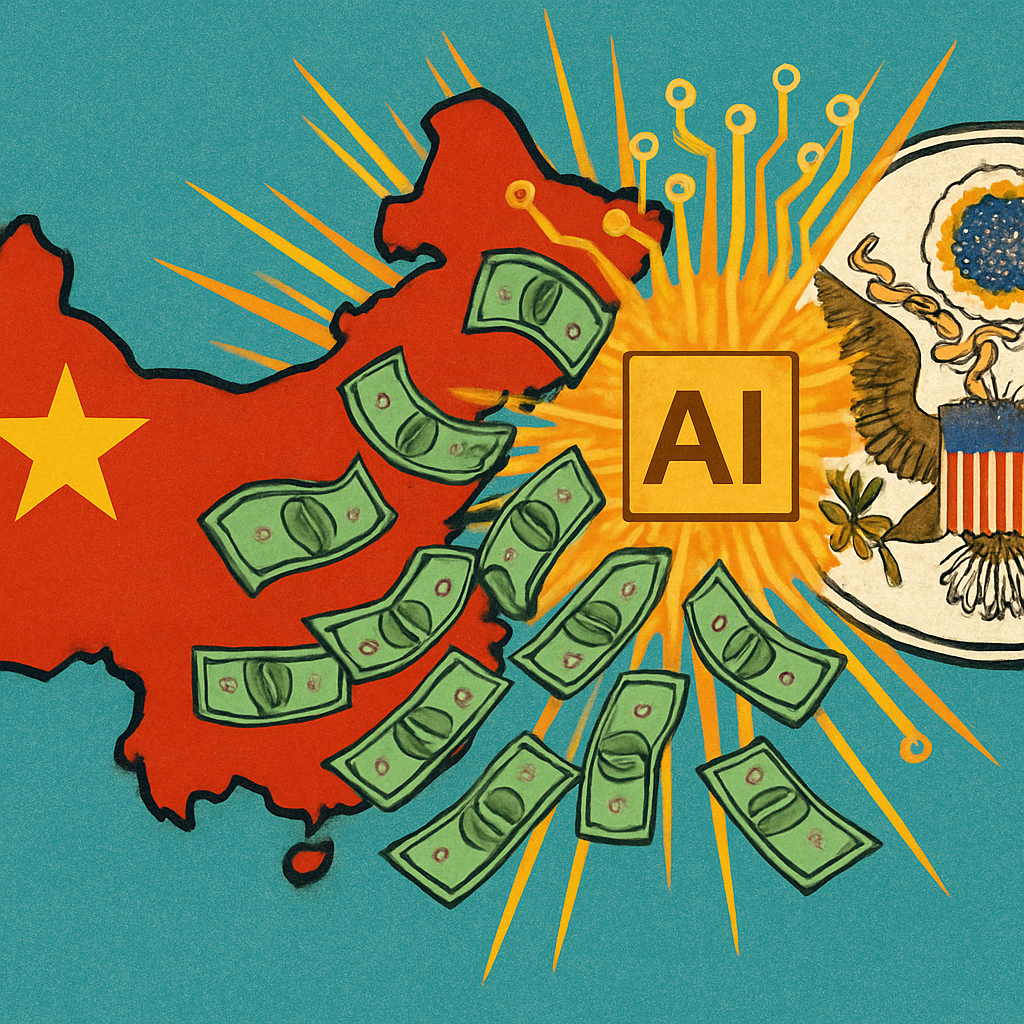
DeepSeek, a leading AI startup based in Hangzhou, has secured roughly $15 billion in funding mere days after the U.S. ordered all federal civilian agencies to strip its AI systems over security concerns. The massive round, reportedly backed by names including battery giant CATL and Tencent, marks one of the largest financing events in China’s tech sector.
The fresh capital follows a June investment in which DeepSeek raised over $7 billion at a $50 billion valuation. Shortly after, in July, the company was said to be seeking an additional $1.5 billion, targeting a valuation close to $71 billion, with an IPO in China potentially slated for next year.
Expansion despite restrictions
Though facing U.S. sanctions that bar federal civilian agencies from using its AI technology, DeepSeek is accelerating its investments in AI infrastructure and open-source model development—both domestically and internationally. This move is part of broader efforts to compete with China’s growing stable of AI rivals.
Already, others in China’s AI ecosystem are seeing heavy investor interest: Moonshot AI raised $2 billion in May at a $20 billion valuation, Manus AI just secured over $500 million earlier this month, and companies like Zhipu AI (also called Z.ai) and MiniMax, which both went public in Hong Kong in January, have market caps around $29 billion and $7.2 billion respectively.
Origins, ownership, and leadership
DeepSeek was founded in 2023 by Liang Wenfeng, who previously co-founded the quantitative hedge fund High-Flyer. His team gained global notice in early 2025 with an open-source, free-to-use model named RI, known for its reasoning capacities—positioning DeepSeek as a challenger to U.S. AI incumbents.
After the June funding round, Liang is estimated to retain approximately 81.6% ownership of the Chinese entity of DeepSeek, according to corporate ownership records.
DeepSeek did not provide immediate comment in response to requests for clarification.
What this means: DeepSeek’s massive raise just after U.S. restrictions reflects how AI investment—especially in China—is increasingly resilient to geopolitical pressure. It signals that regulatory blows abroad may no longer stall funding or ambition. For DeepSeek, the real tests ahead will be executing on its open-weight models at scale, navigating both international competition and potential regulatory backlash, and whether IPO plans next year can match soaring valuation expectations. Also worth watching: whether this cycle of funding boosts innovation or inflates risky valuations across AI firms globally.