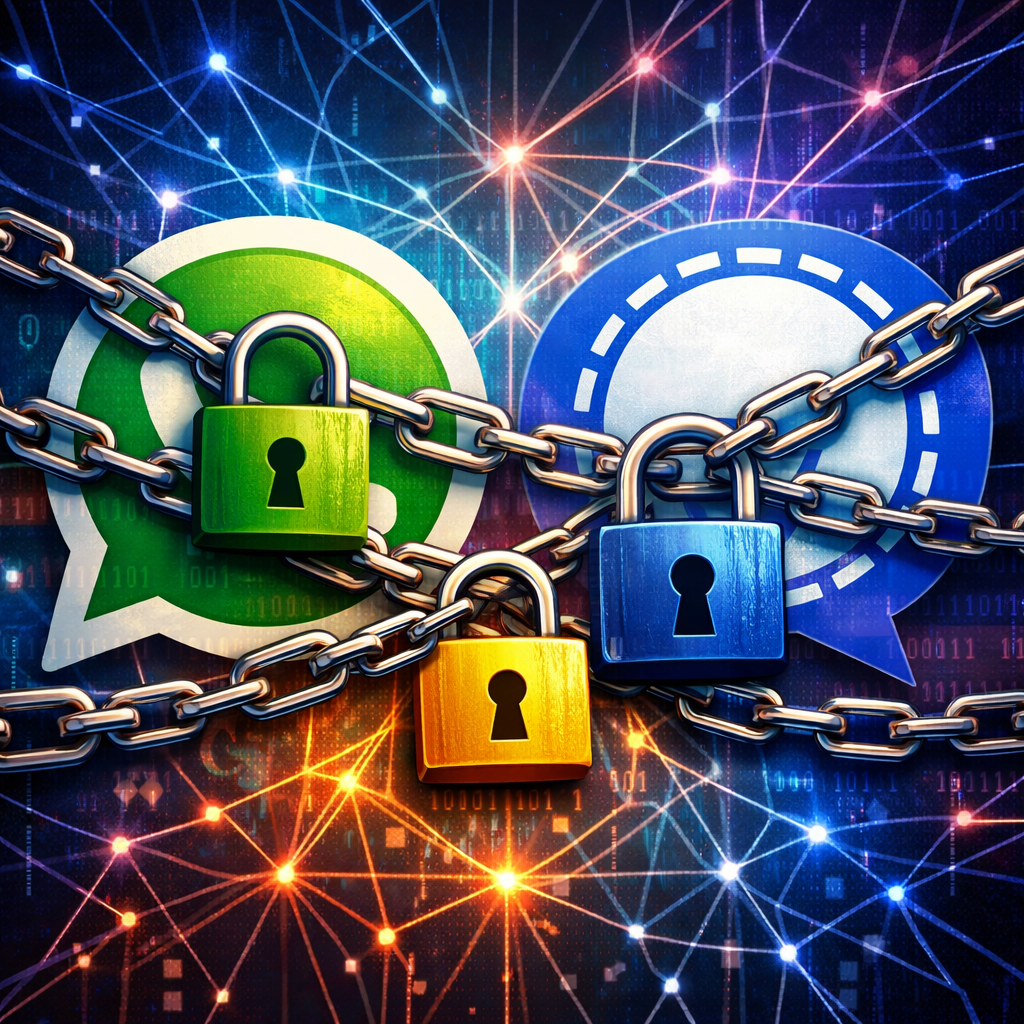
The cryptography underlying Signal and WhatsApp has just crossed a major milestone. DeepMind has completed a formal verification of the Signal protocol, offering the first mathematical confirmation that it holds up under all conditions. That’s a step beyond typical testing: instead of probing for weak spots, formal methods prove there are none.
What Was Analyzed—and What’s New
The Signal protocol is the backbone of end-to-end encryption for Signal, WhatsApp, and Google Messages. It’s long been considered the benchmark in secure messaging; even Edward Snowden praised it. DeepMind’s recent work is the first time that protocol has been “formally verified” using agentic AI—essentially teaching AI to prove cryptographic guarantees itself. The result: the protocol’s claims about confidentiality, integrity, and forward secrecy now carry mathematical weight.
Importantly, the verification applies to the protocol itself—not the actual apps built on it. Real-world clients like Signal have had vulnerabilities in older versions. DeepMind tested those past versions and successfully flagged known flaws, showing the verification can spot security holes when deployed improperly.
Scope, Limitations & Broader Implications
The effort drew on prior non-AI formal verification work and took four weeks, though it remains unclear how many computing hours or how large a team were needed. DeepMind cautions that scaling these methods across the vast landscape of software is nontrivial. The resources required, and adaptability to different protocols, are still open questions.
Unlike fuzzing or pentesting, formal verification proves that no counter-example exists—that under no possible allowed usage will the protocol fail to meet its security promises. It’s a gold standard for cryptographic assurance. DeepMind’s finding doesn’t mean Signal or WhatsApp apps are perfectly secure today—rather, this raises confidence in the core protocol those apps use.
Why It Matters
This verification marks a turning point in the cryptography-AI crossroad. It’s the first time someone has applied agentic AI to prove a widely used messaging protocol, opening the door for similar treatment of other foundational security tools. For users, it means that the risk from the protocol’s design is now greatly reduced; the biggest remaining risks lie in implementation, client design, and bugs in apps themselves.
Going forward, the challenge will be pushing formal verification into regular practice—for apps, services, and even operating systems. If DeepMind and others can find ways to do this broadly and efficiently, we may reach a point where software security isn’t just tested, but assured.
What to watch for: whether DeepMind publishes its methodology, whether other protocols—say for email, web encryption, or video calls—receive similar treatment, and whether developers integrate formal verification into their standard security workflows. This could reshape how we evaluate and trust secure communications under the hood.