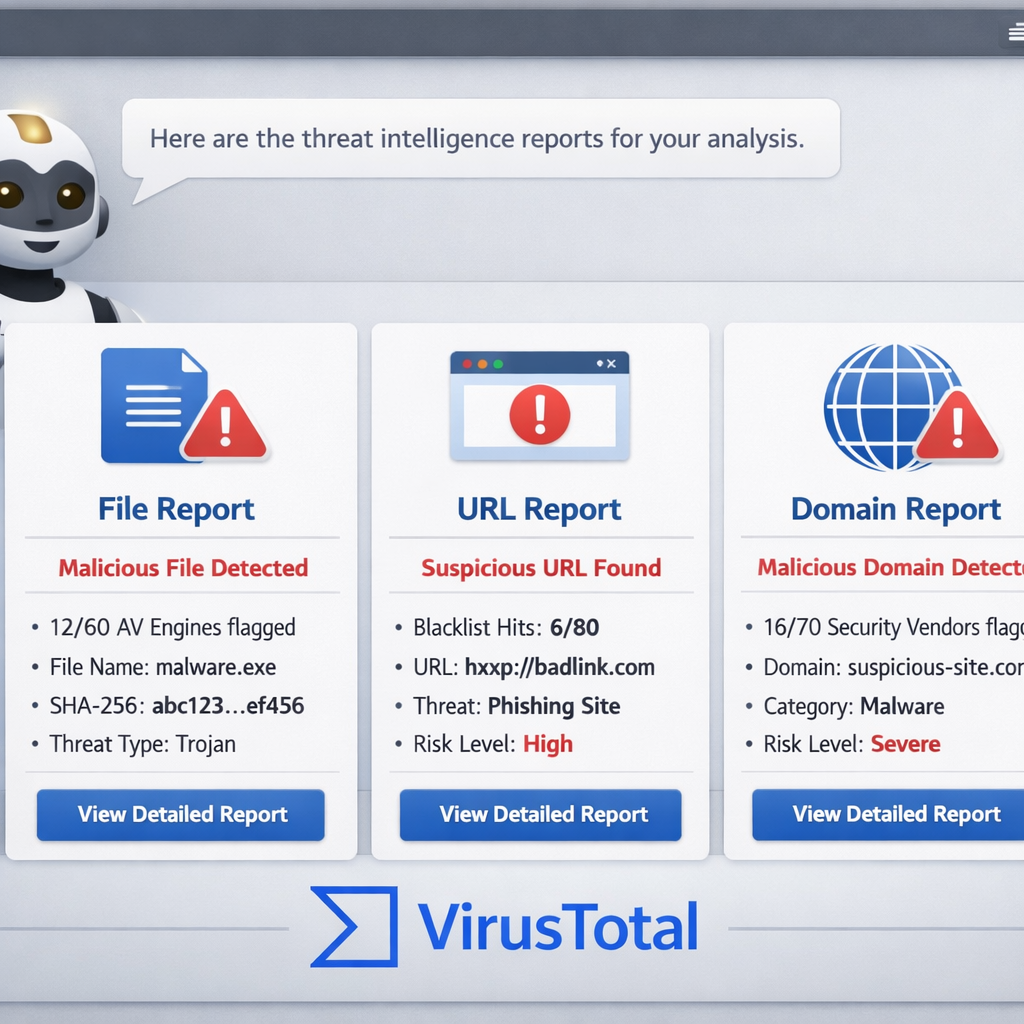
Claude, the AI assistant platform, now integrates with VirusTotal’s threat intelligence system to enhance malware and URL analysis. This partnership enables users to bring reports for files, URLs, domains, and IPs directly into Claude’s workflow—allowing detection details, analysis dates, coverage statistics, and source links to be reviewed without relying solely on AI’s verdicts.
How the Integration Works
The connection leverages the Model Context Protocol (MCP) to link Claude with VirusTotal AI (VTAI). Authentication is done via browser OAuth, so users don’t need to provide their personal VirusTotal API keys. In organizational settings, an owner may need to approve this connector before staff can use it.
When investigating threats, analysts can give Claude things like a file hash or suspicious URL and request explanations based on VirusTotal findings. This brings structured threat intelligence into conversations while keeping the original source reports available. Importantly, empty or missing detections are not taken automatically as clearance—analysts must check report currency, coverage, and relevance.
Privacy, Local Analysis, and Controls
Remote threat intelligence lookups remain separate from submissions. Submitting a file, URL, or domain involves explicit user consent. For file uploads, Claude first checks a verified hash and only transfers the original bytes after confirming they weren’t already identified—or if the service isn’t blocked by permission issues. URL reports expose full address details, including query parameters.
An optional plugin introduces what’s called a “local file hook,” which checks file paths, sizes, SHA-256 hashes, and blocks often-sensitive filenames so human review is triggered. Hosted Claude chat services do not run the local hook and cannot access local file paths. Meanwhile, authenticated modes such as Claude Code can use it.
Usage Limits & Data Disclosure
Free access under this integration allows up to 60 queries per minute and 1,000 per UTC day per connection. Each query includes report lookups or explicit analyses; new file uploads and contribution receipts aren’t counted against the query quota—but submissions still adhere to distinct contribution limits.
Standard submissions become part of VirusTotal’s public community and its security partner network. Sensitive data—including private documents, internal code, credentials, or personal data—must be disclosed only when expressly permitted. Users may revoke access at any time. However, revoking the connector does not erase previously collected submissions or derived intelligence receipts.
The move addresses long-standing gaps in enterprise workflows. While previous integrations like VirusTotal’s ChatGPT connector allowed similar threat lookups, this extension into Claude brings more context, control, and privacy-aware intelligence into SOCs (Security Operations Centers).
What this Means: This integration elevates AI-assisted threat hunting and incident response. By embedding VirusTotal’s evidence-based findings into Claude’s conversational format—without letting AI misinterpret lack of detection as security clearance—organizations gain stronger visibility and safer decision-making tools. Watch for how this shapes analyst behavior: will teams lean too heavily on AI summaries, or will this encourage rigorous verification? The balance struck here could set a new standard for trust in AI-enabled security workflows.