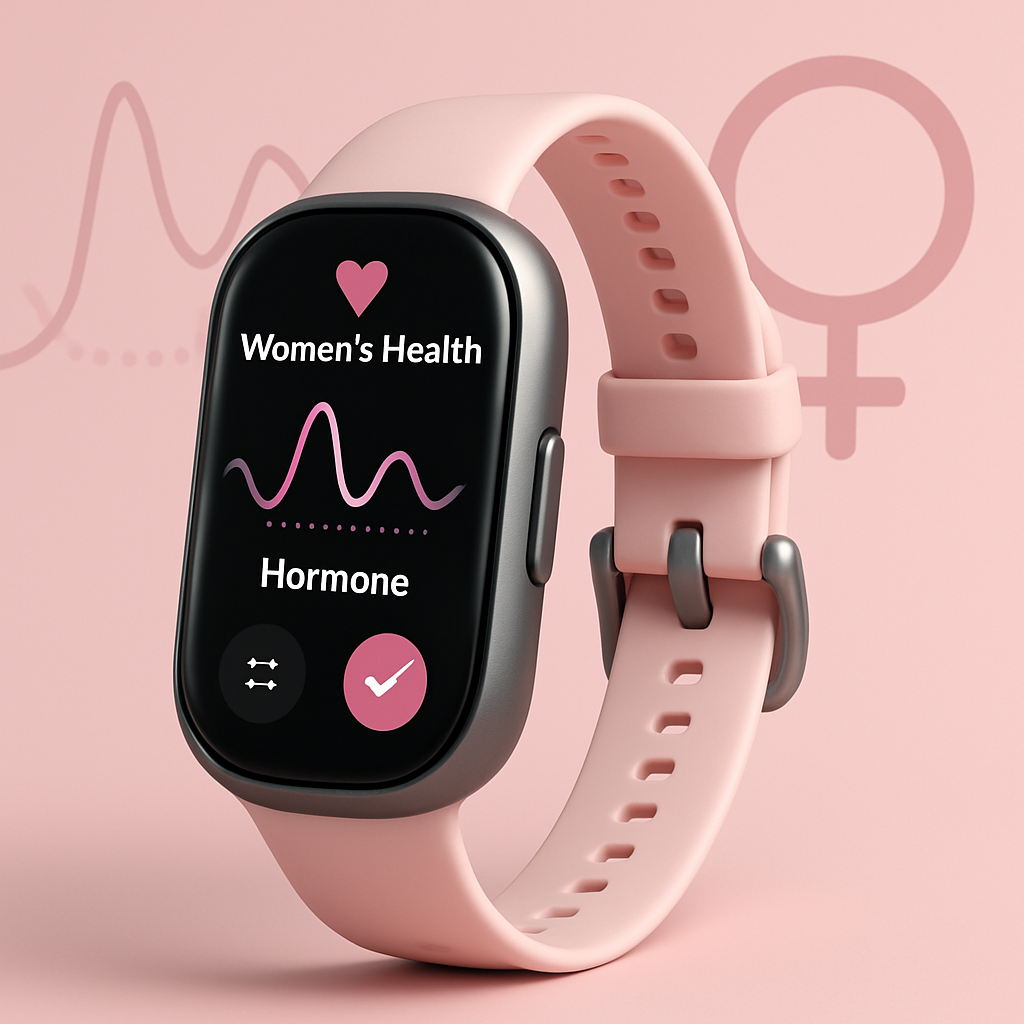
Clair Health, a startup founded by Stanford alumni Jenny Duan and Abhinav Agarwal, has successfully raised $11.6 million in funding to develop a noninvasive wearable device aimed at providing women with real-time insights into their hormonal health. The funding round was led by Khosla Ventures and included contributions from a16z speedrun, Brydge Club, Treehub, Cartan Capital, AGI House, Insiders VC, Anne Wojcicki, and Stephanie Coleman.
The company’s innovative wearable is designed to monitor various health markers such as inflammation, bloating, energy levels, and menstrual cycle phases. This comprehensive tracking aims to assist women in understanding cycle irregularities, perimenopause, and hormonal fluctuations, thereby facilitating better health management.
To enhance user engagement and data accuracy, Clair Health employs a voice-based onboarding process. This approach allows users to communicate their health concerns naturally, enabling the company’s AI system to analyze voice biomarkers and determine the user’s current cycle phase within minutes. This method addresses the limitations of traditional health apps that often fail to capture a wide range of symptoms.
The wearable device is equipped with ten biosensors, including a novel biomagnetic sensor specifically designed for hormonal insights. Unlike conventional health trackers that rely on gyroscopes, optical sensors, and temperature sensors, Clair Health’s device offers a more comprehensive analysis of hormonal health. It continuously monitors changes throughout the four phases of the menstrual cycle, providing insights into aging pace, inflammation, bloating, and perceived exertion rates.
Clair Health also aims to support women experiencing menopause and perimenopause by offering detailed data that can be shared with healthcare providers. This data-driven approach seeks to improve the quality of care by moving beyond subjective symptom reporting.
Co-founder Jenny Duan’s interest in women’s health began during her time at a nonprofit in Portland, Oregon, and was further developed through a Stanford class focused on women’s health and nonprofits, where she met Agarwal. Their combined experiences have culminated in the creation of Clair Health.
The startup is building its own model based on various biomarkers for women’s health, leveraging data partnerships that provide access to millions of electronic health records and longitudinal health data. Through these partnerships, Clair Health aims to generate insights into conditions such as endometriosis, Premenstrual Dysphoric Disorder (PMDD), and perimenopause.
In the broader context of health technology, Clair Health’s approach represents a significant advancement in noninvasive hormone monitoring. By integrating advanced biosensors with AI-driven voice analysis, the company is poised to fill a critical gap in women’s health tracking. This development reflects a growing trend towards personalized, data-driven healthcare solutions that empower individuals to take proactive control of their health.