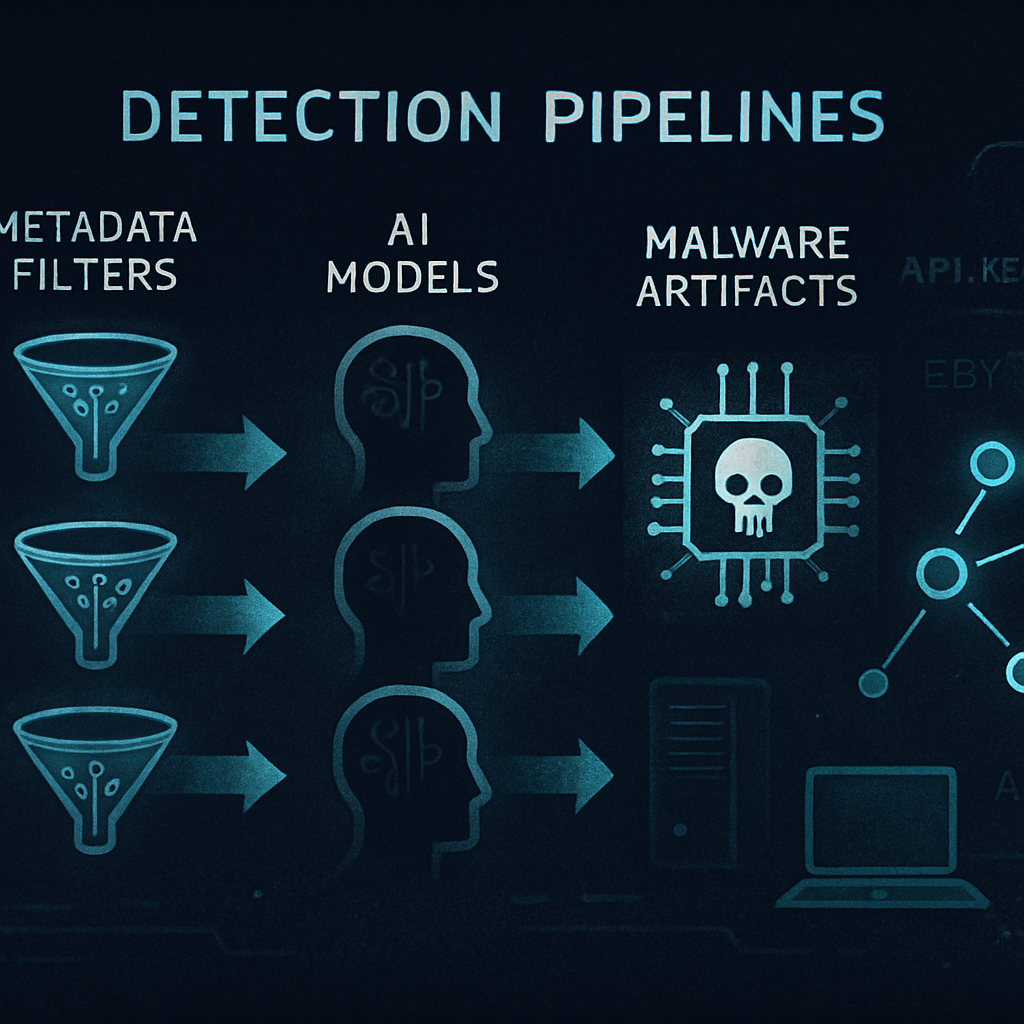
Cisco Talos has launched a new open-source framework called CAIRN (Cognitive Artifact Intelligence Research Network) aimed at identifying, classifying, and tracking malware that leverages artificial intelligence without needing ongoing human guidance. The rise of these autonomous threats has led to CAIRN’s development, designed to detect evidence — or “artifacts” — left in software that signal AI‐powered behavior. These include prompt templates, API keys, endpoints, model inference tools, and orchestration syntax. CAIRN processes metadata from strings, antivirus signatures, sandbox behaviors, and uses up to 24 different acquisition filters to seed its detection pipeline.
ClosedQuorum: A Glimpse of Model-Driven Malware
One specific case Talos examined is CLOSEDQUORUM, a potential Windows implant that delegates tactical decisions to AI models instead of a human operator or a traditional command & control (C2) server. Though not confirmed to be in active use, it demonstrates a full decision loop. Using prompts built from system context, CLOSEDQUORUM queries four commercial large language models — DeepSeek, Qwen, Mistral, and Google Gemini — then lets them vote on the next action. Actions could include data theft, persistence establishment, code injection, or exfiltration via Discord. Notably, these choices may lead to memory dumping of LSASS, credential theft, or process hollowing, among other dangerous behaviors.
How CAIRN Works & Layered Detection
CAIRN sorts samples into three tiers based on the level of evidence. Tier 1 captures basic indicators like AI provider domains or function-calling syntax. Tier 2 introduces behavioral context — signs of evasion, known C2 techniques. Tier 3 ties everything together by mapping samples to recognized malware families using reverse engineering. It also allows rule updates that can be applied retroactively to previous corpus entries.
The toolkit creates clusters and relationship graphs to uncover campaign infrastructure. It connects samples via shared domains, certificates, imports, and metadata. For less-obvious connections it deploys embedding algorithms coupled with clustering (HDBSCAN) and dimensionality reduction (UMAP) to pinpoint outliers or related samples. Still, Talos cautions that these clusters are investigatory tools rather than full attribution.
Challenges & Defensive Implications
Legitimate software already uses many of the same AI strings and libraries — from LangChain or LiteLLM to inference tools like llama.cpp or Ollama — so CAIRN’s Tier 1 or 2 detections can generate a lot of noise. That’s by design: CAIRN filters first, then leans on deeper analysis. Talos does not see CAIRN replacing reverse engineering, but augments it — narrowing down large collections for focused investigation.
The emergence of tools like CLOSEDQUORUM points toward a pivot in attack methods. Malware is shifting from manual instruction to model-driven decision making. Previous examples like LAMEHUG in 2025 already used AI to generate commands, but CLOSEDQUORUM assigns critical decision authority directly to models. Traditional defenses, such as blocking AI provider domains, are insufficient. Analysts are urged to look instead for anomalies like unexpected multi-model queries alongside signs like LSASS dumping, process injection, new persistence, or communication paths like Discord channels.
CAIRN stands as a practical guardrail against these rising threats. Even though CLOSEDQUORUM isn’t confirmed to be in the wild, CAIRN’s framework provides visibility into what Talos labels a new kind of “machine-directed” malware — one where much of the attack lifecycle could be automated.
Analytical Takeaway: The unveiling of CAIRN signals that adversaries may be gearing up to offload tactical decision-making to AI models, creating smarter, faster malware that acts without direct human instruction. Security teams should brace for this shift by investing in metadata analysis tools, embracing AI-aware detection rulesets, and integrating behavior-based monitoring — because waiting until binary execution or active compromise is likely too late. Real defense will come from seeing the AI traces early, not cleaning up messes after they happen.